How does an online medical cannabis evaluation work with a licensed physician? In most cases, it is a real telehealth appointment: you complete intake information, meet remotely with a clinician authorized in your state, discuss your health history and symptoms, and receive a clinical decision. If certification is appropriate, there may still be a separate state registration step before you can visit a dispensary.
The details matter. State regulations can affect whether an initial visit may occur online, whether video is required, where the physician must be located during the appointment, and how certification reaches the state medical cannabis registry.
Table Of Contents
• The Online Evaluation Process
• What A Licensed Physician Evaluates
• State Rules That Can Change The Process
The Online Evaluation Process
An online medical cannabis evaluation is a clinical consultation conducted through authorized telehealth technology. It is not meant to be an automatic approval system. A licensed physician reviews whether medical cannabis may be appropriate under applicable state rules and based on your individual health information.
The process is often brief, but it should still have the basic parts of a medical visit: identity confirmation, informed consent, a review of symptoms and medical history, a discussion of risks and potential benefits, clinical documentation, and a decision by the physician.
Start With A Legitimate Telehealth Provider
The first step is choosing a provider that operates in your state and connects patients with properly licensed physicians. A credible service should clearly explain its clinical process, fees, state availability, privacy practices, and the steps that happen after the appointment.
For example, PrestoDoctor is a HIPAA compliant telemedicine provider with more than 10 years of history and over 23,500 five star reviews. We connect eligible patients in participating states with licensed physicians for confidential online evaluations, renewals, treatment guidance, and state process support.
A few practical signs can help separate a credible service from a questionable one:
• The service identifies the state where it operates and confirms that the clinician is licensed or authorized there.
• The process includes a live patient consultation rather than only an automated form.
• The service explains that physician certification and state enrollment may be separate steps.
• The provider gives clear information about what happens if the physician does not recommend medical cannabis.
• Privacy, payment terms, cancellation policies, and follow up options are easy to find before you book.
A short appointment is not automatically a problem. Some established telehealth providers describe appointments lasting roughly 10 to 15 minutes after the patient completes intake. What matters is whether the physician can perform an adequate evaluation, ask follow up questions, and make an independent clinical decision.
Complete Intake And Verify Your Identity
Before the visit, you will usually create an account and complete a medical questionnaire. The form gives the physician a starting point. It is not the evaluation itself.
You may be asked to provide:
• A driver’s license, passport, or other government issued photo ID
• Proof of residency when your state program requires it
• Your current address and contact details
• Information about your diagnosis, symptoms, and prior care
• A list of prescription medications, supplements, and allergies
• Relevant medical records, test results, or notes from other clinicians, if available
At PrestoDoctor, patients upload a photo of their driver’s license or other photo ID, complete a quick medical questionnaire, and book an appointment available seven days a week. The information helps the physician understand the reason for the consultation before the secure video visit begins.
Records are not always required in the same form for every patient. Their usefulness often depends on the condition. Someone seeking an evaluation for chronic pain may bring imaging results, a specialist note, or documentation of prior therapies. A patient with a documented qualifying diagnosis may need fewer records but should still be ready to explain symptoms, past treatment, and current medications accurately.
Meet With The Physician By Secure Video
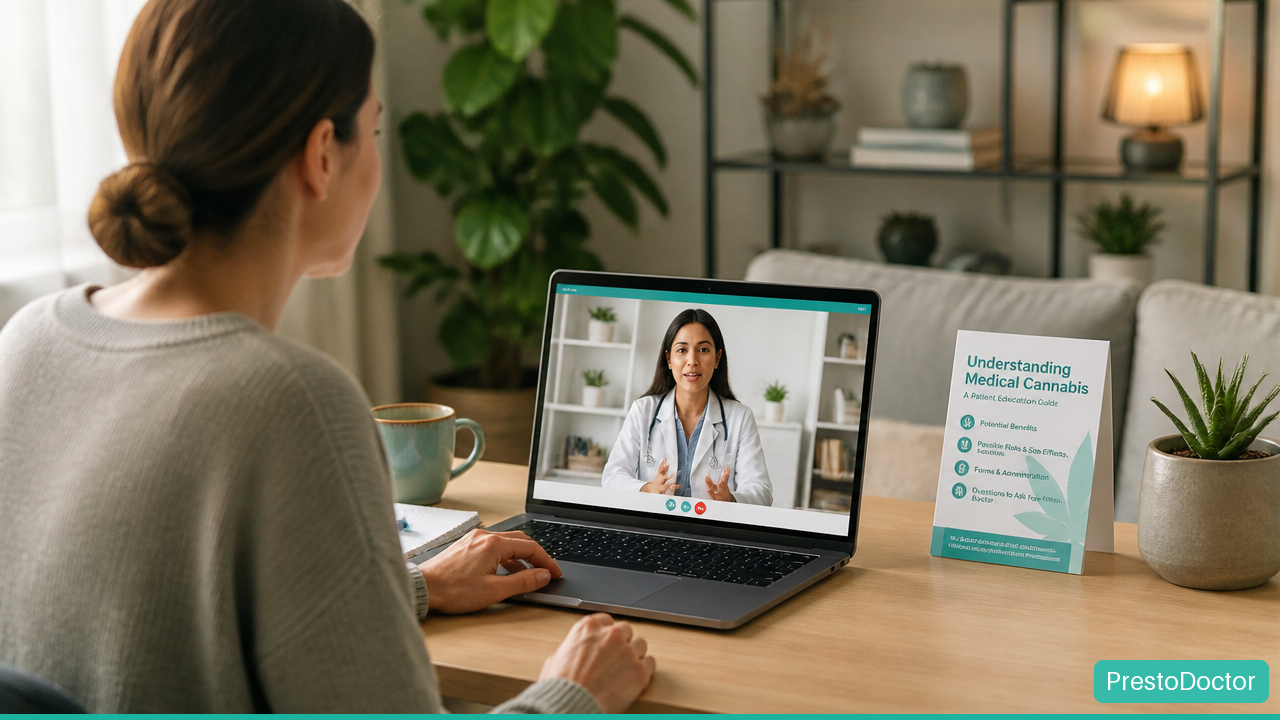
The appointment generally takes place through a secure telehealth platform. With PrestoDoctor, the video call works on a computer, tablet, or phone with a camera. Choose a private, well lit location with a stable internet connection and keep your ID nearby in case the physician needs to verify it.
The physician may begin by confirming your identity, location, and consent to telehealth. This is not just administrative work. Your physical location at the time of the visit can affect whether the appointment meets state requirements.
The conversation should feel more like a focused medical consultation than a sales call. You may be asked what symptoms affect your daily activities, what treatments you have already tried, whether you have used cannabis before, and what you hope to improve. Give direct answers. If cannabis has caused unpleasant effects in the past, mention that too.
A medical cannabis evaluation should result in a physician’s independent clinical judgment, not a guaranteed outcome promised before the visit.
Receive A Decision And Complete Next Steps
After reviewing the information, the physician may decide that you meet the state and clinical criteria for a medical cannabis recommendation or certification. If so, the next action depends on the state.
In some programs, the physician submits certification information to a state registry. In others, you receive a recommendation letter or documentation that you use to complete your own state application. State approval, registry enrollment, payment of government fees, and issuance of a patient card can all be separate actions.
If you use PrestoDoctor, we provide the required paperwork and forms available for your state, detailed application instructions, and real human support if you need help completing the next stage. That support can reduce confusion, but it does not replace the state’s review or change eligibility requirements.
What A Licensed Physician Evaluates
The physician’s role is broader than checking whether you can name a qualifying condition. A responsible evaluation considers your current health status, the condition being treated, previous treatment, medication use, possible contraindications, and whether medical cannabis is reasonably appropriate for you.
Your Condition, Symptoms, And Treatment History
State programs often list qualifying conditions, but a diagnosis alone may not answer every clinical question. The physician generally needs to understand how the condition affects you now.
Expect questions such as:
• What symptoms are you experiencing, and how often do they occur?
• How do those symptoms affect sleep, work, mobility, appetite, mood, or daily routines?
• What treatments, therapies, or medications have you tried?
• Did those treatments help, cause side effects, or stop working over time?
• Are you currently under the care of a primary care clinician or specialist?
Consider a patient with a qualifying pain condition who has tried physical therapy and prescription medication but still has trouble sleeping. The physician may ask about the severity and pattern of pain, medication side effects, and whether the patient has ever experienced dizziness, anxiety, or impairment with cannabis. Those details help shape the decision and any treatment guidance.
Medication Review And Contraindication Screening
A medication list is not paperwork for its own sake. It helps the physician assess possible interactions, additive sedation, impaired coordination, and other safety concerns. The review may also identify situations where medical cannabis requires extra caution or may not be appropriate.
Relevant concerns can include a history of severe mental health symptoms, substance use disorder, heart or lung issues, pregnancy or breastfeeding, medication interactions, or work and driving duties where impairment creates serious risk. The exact clinical questions vary by person and state program.
A 2020 Maryland Cannabis Administration telehealth bulletin required certifiers to review medical records, assess medical history and the patient’s current condition, and maintain records under medically accepted standards. The bulletin illustrates why a meaningful clinical review is more than a checkbox process: Maryland’s telehealth certification guidance required review of records, history, current condition, and clinical documentation.
Expected Benefits, Limits, And Safer Use
If the physician believes medical cannabis may be appropriate, the visit may include discussion of treatment expectations. This can cover product forms, timing, dosing principles, impairment risks, and when to seek follow up care.
No physician can promise a particular result. Responses to cannabis vary, and state medical cannabis programs do not turn cannabis into a risk free treatment. Patients should ask practical questions, including whether they should avoid driving, how to handle unwanted effects, and when a symptom change warrants contacting another healthcare professional.
A sound plan is usually cautious rather than aggressive. For a patient new to cannabis, that may mean beginning with lower intensity options and adjusting only with clinical guidance and within state rules. Patients should also keep their regular clinicians informed when appropriate, especially when managing complex conditions or multiple medications.
State Rules That Can Change The Process
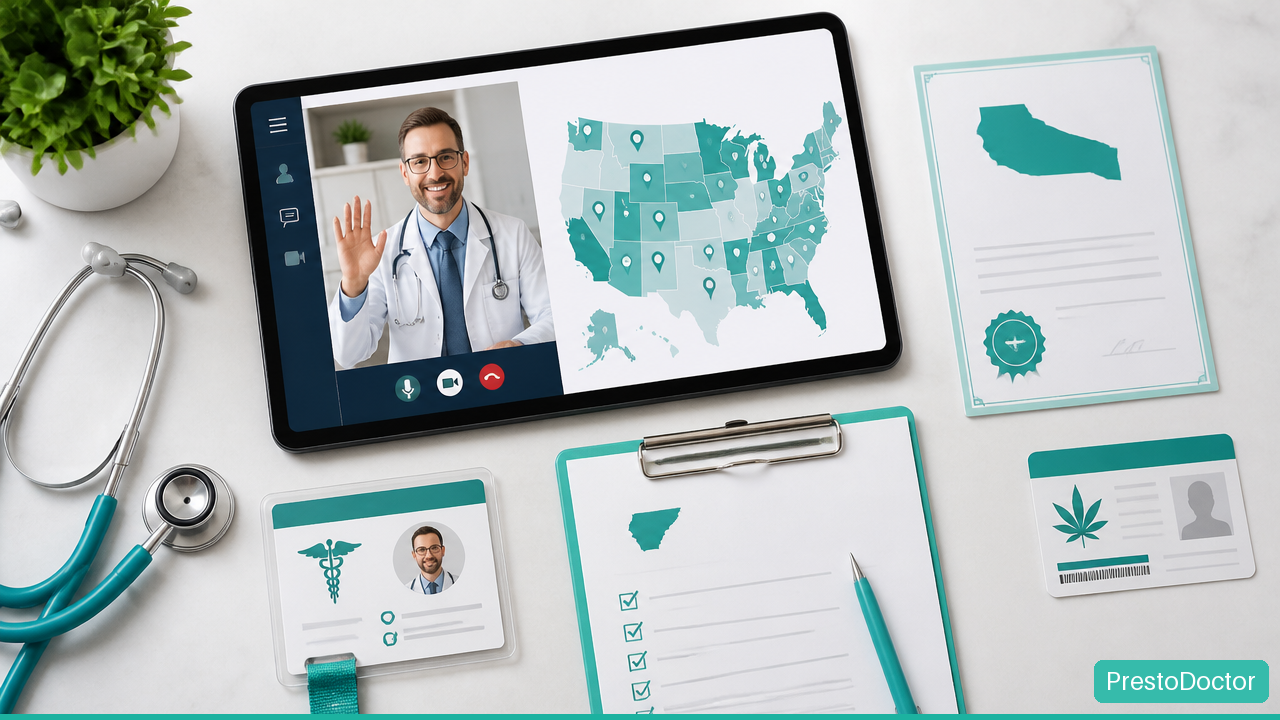
Telehealth availability is not one nationwide rule. The legal answer can change based on the patient’s state, the clinician’s authorization, whether the visit is an initial certification or renewal, the communication method used, and sometimes the clinician’s physical location during the appointment.
Initial Certifications And Renewals May Follow Different Rules
A state may allow telehealth for renewals but impose extra limits on a first certification. Another state may require video for a particular appointment type but permit audio only in narrower circumstances. This is why general advertising about “online medical cards” is not enough.
Before you pay for an appointment, confirm these details for your exact situation:
| Question To Confirm | Why It Matters |
|---|---|
| Is telehealth permitted for an initial certification? | First visits can have stricter requirements than renewals. |
| Is video required, or is audio only allowed? | Permitted visit formats differ by program and visit type. |
| Is the physician authorized for the state program? | A general medical license may not be enough for certification. |
| Must the patient be physically in the state? | Your location during the appointment may affect legality. |
| Does the physician submit to the registry? | This determines whether you must complete a separate application. |
If you are traveling outside your home state, do not assume that you can complete your evaluation from wherever you are staying. Contact the provider first. The correct answer may depend on both your location and the state program’s rules.
The Clinician’s Location Can Matter Too
Patients often focus on where they are located. In some states, the physician’s location is also part of the rule.
For example, the Hawaii Department of Health states that the provider must be physically located in Hawaii during a telehealth medical cannabis certification appointment. This is a specific state rule, not a universal national standard, but it shows why a provider’s marketing alone cannot confirm compliance. Review Hawaii’s requirement that the certifying provider be physically located in Hawaii if that program applies to you.
The practical lesson is simple: verify the state, the appointment type, the technology format, and the clinician’s authorization before scheduling. If the provider cannot answer those questions clearly, consider choosing another service.
Why A Questionnaire Alone Is Not Enough
A questionnaire can make a visit more efficient, but it cannot replace clinical judgment. A legitimate physician evaluation should involve a live interaction, an opportunity for follow up questions, assessment of symptoms and medical history, and documentation supporting the decision.
This matters when the intake answers raise a safety concern. For example, a patient may select a qualifying condition on a form but omit a medication that causes sedation or a past reaction to cannabis. A live physician can clarify that information, discuss risk, and decide whether certification is appropriate.
If a website guarantees approval before any clinician speaks with you, gives no opportunity for questions, or provides only an automated letter, treat that as a warning sign. A proper provider patient relationship is a clinical and legal foundation for certification in states that require it.
Key Takeaways
• An online evaluation should be a real telehealth appointment with a licensed physician, not an automated questionnaire approval.
• The physician reviews your symptoms, treatment history, medications, health risks, and whether medical cannabis is clinically appropriate.
• A qualifying condition may be part of eligibility, but it does not guarantee certification.
• Initial evaluations, renewals, phone visits, video visits, and in person requirements can differ by state.
• Physician certification and state registry enrollment are often separate steps. Dispensary access may begin only after the state process is complete.
• Choose a provider that explains the process clearly, protects privacy, confirms state eligibility, and offers support without promising approval.
Frequently Asked Questions
Is An Online Cannabis Evaluation A Real Doctor’s Appointment Or Just A Questionnaire?
It should be a real telehealth appointment. The questionnaire collects background information, while the physician consultation allows for identity confirmation, medical questions, risk screening, discussion, and an independent clinical decision. A form alone should not be treated as the full evaluation.
Does The Physician Need To Be Licensed In My State?
Generally, the physician must be licensed or otherwise authorized to practice and certify patients under the medical cannabis rules that apply to you. In some states, the clinician may also need program specific registration. Confirm this before booking.
Can I Complete My First Certification Online?
Possibly, but it depends on your state and the type of visit. Some programs allow telehealth for initial certifications, while others may limit remote care to renewals or require a particular visit format. Ask the provider about your state’s current rule before you schedule.
What Documents Should I Have Ready?
Have a government issued photo ID, any required proof of residency, a current medication list, and relevant medical documentation if you have it. Useful records may include diagnosis notes, treatment summaries, imaging results, or specialist records. Bring what helps explain your condition without delaying care while searching for every document you have ever received.
Can The Appointment Be Done By Phone?
Sometimes, but not always. State rules may distinguish between audio only calls and video telehealth. Video can also help with identity verification and a more complete clinical assessment. Confirm the allowed format for your specific state and whether you are seeking an initial certification or renewal.
What Happens If The Physician Approves Me?
The physician may submit your certification to a state registry, provide a recommendation letter, or give you documentation needed for your application. You may still need to register with the state, submit identification, pay a state fee where applicable, and wait for program approval before purchasing from an authorized dispensary.
What If The Physician Decides Medical Cannabis Is Not Appropriate?
You should receive an honest clinical decision rather than a forced approval. The physician may explain the concern, suggest discussing other options with your regular healthcare provider, or advise follow up if more information is needed. A denial can be frustrating, but it is also evidence that the evaluation was based on clinical judgment.
Sources And References
• health.hawaii.gov: https://health.hawaii.gov/medicalcannabisregistry/files/2025/09/Telehealth-Requirements.pdf
• cannabis.maryland.gov: https://cannabis.maryland.gov/Documents/bulletins/Bulletin\_2020-011-Telehealth-Maryland-State-of-Emergency-COVID-19\_April.7.2020.pdf