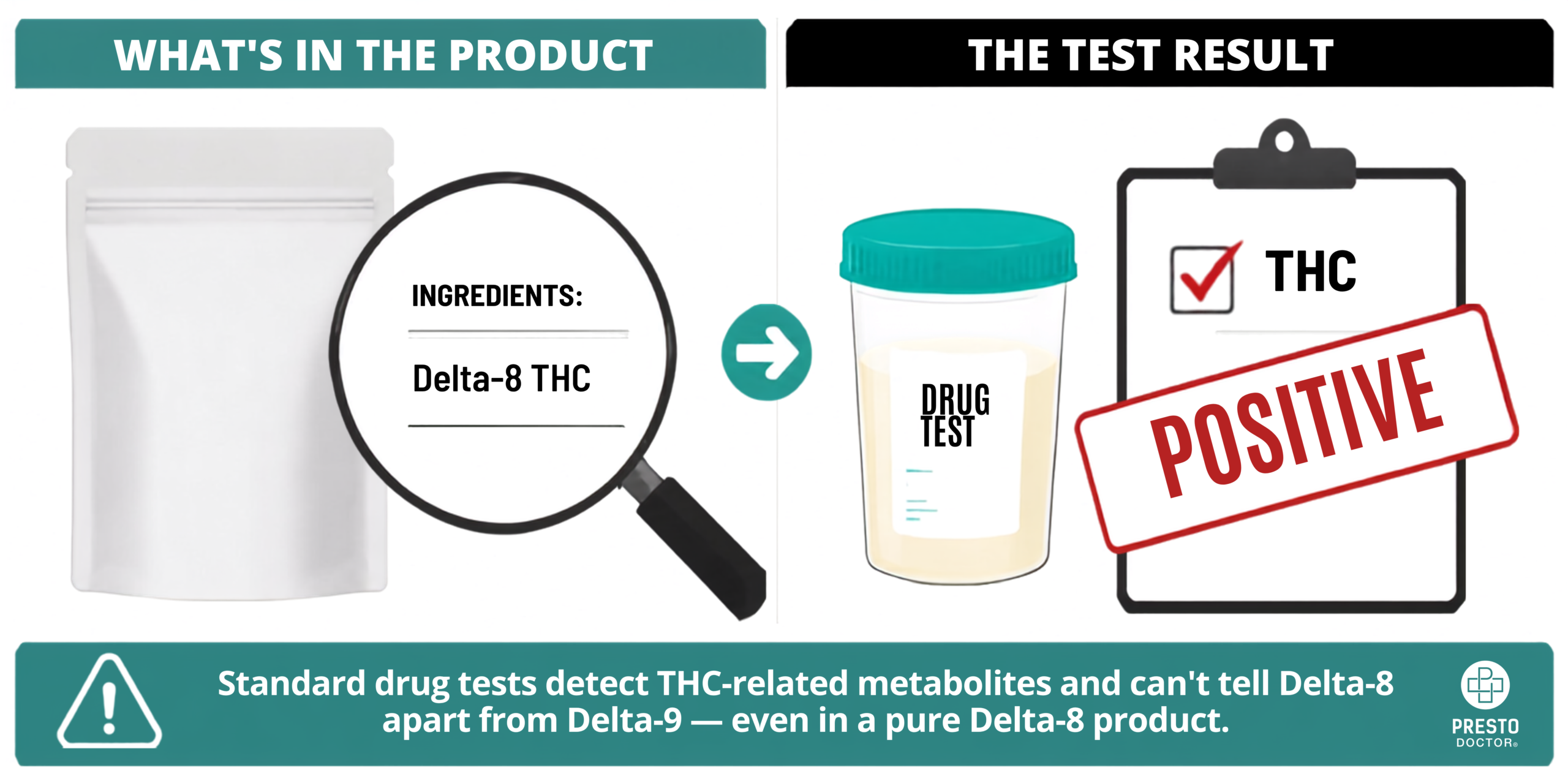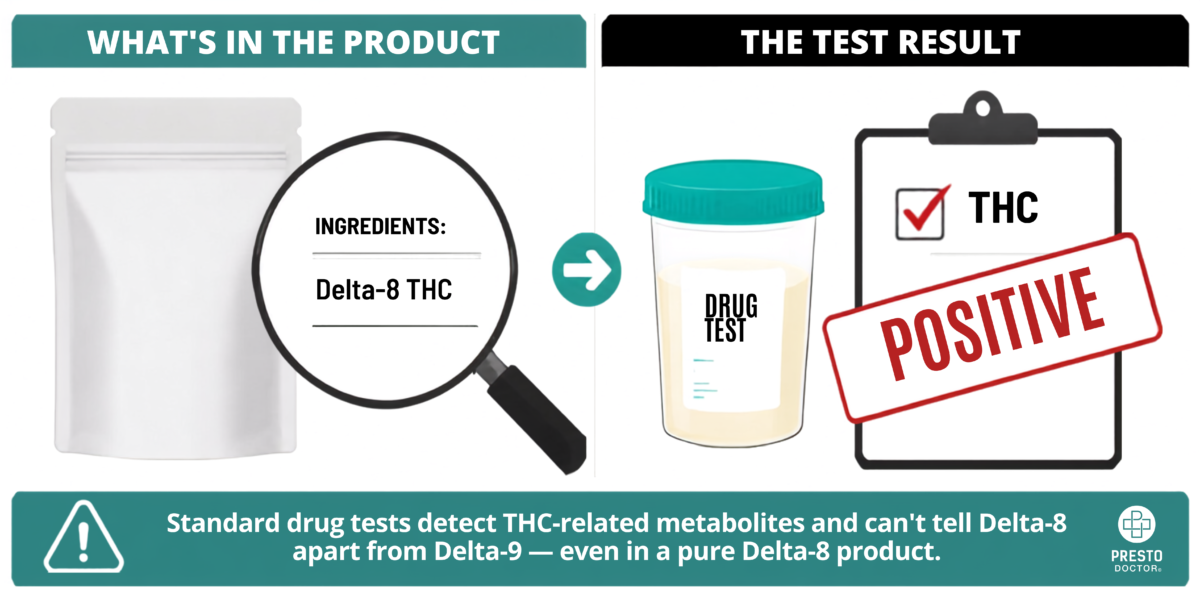
Yes, Delta-8 THC can show up on a drug test because its metabolites can cross-react with standard cannabinoid immunoassays, even when Delta-9 THC was not used. [1][2]
That means using a hemp-derived or legally purchased Delta-8 product does not guarantee a negative drug-test result.
Whether Delta-8 is detected depends on the type of test, the testing method, the cutoff used by the laboratory, the amount and frequency of Delta-8 use, and other individual factors.
Plain-English testing note: An initial “screening” test looks for a chemical signal associated with cannabinoids. A more specific confirmation test can identify individual compounds, but Delta-8 can also interfere with some confirmation procedures. “Unreportable” means the laboratory could not confidently report the result—it does not mean the lab falsely identified Delta-8 as Delta-9. [1]
At a Glance: Can Different Drug Tests Detect Delta-8?
| Drug test | Can Delta-8 be detected? | What to know |
|---|---|---|
| Urine | Yes | Delta-8-THC-COOH can cross-react with cannabinoid immunoassays. [1][4] |
| Oral fluid / saliva | Yes, potentially | SAMHSA states that Delta-8 THC can cross-react with oral-fluid initial immunoassays. [2] |
| Blood | Potentially | Detection depends heavily on the analyte and laboratory method; cannabinoid immunoassay cross-reactivity has been documented. [5] |
| Hair | Potentially | Detection depends on the laboratory’s analytical method and target compounds. |
| Confirmatory laboratory testing | Yes, with appropriate methods | Specific analytical methods can differentiate Delta-8-related compounds from Delta-9-related compounds, although Delta-8 can cause analytical interference in some workflows. [1][3] |
Why Does Delta-8 Show Up on a Drug Test?
Delta-8 THC is a closely related isomer of Delta-9 THC, the cannabinoid most commonly associated with marijuana.
After the body processes Delta-8, it produces metabolites including 11-nor-9-carboxy-delta-8-tetrahydrocannabinol (Δ8-THC-COOH). Some drug-testing methods recognize these compounds because they are chemically similar to the Delta-9 metabolites those tests are designed to detect.
A 2023 study by Lawrance D. Mullen and colleagues, published in the Journal of Analytical Toxicology, tested Δ8-THC-COOH against cannabinoid immunoassays from three manufacturers at 20, 50, and 100 ng/mL cutoffs. At the 50 ng/mL cutoff, cross-reactivity ranged from 87% to 112% across the three testing platforms. [1]
That finding provides a scientific explanation for why Delta-8 can produce a positive cannabinoid screening result.
The important distinction is that the initial screen may respond to Delta-8 metabolites without identifying them specifically as Delta-8.
Can Delta-8 Cause a Positive Urine Drug Test?
Yes. Delta-8 can cause a positive urine cannabinoid screening result.
Urine testing commonly begins with an immunoassay screen. These tests are designed to identify evidence of cannabinoid exposure, but their chemical recognition is not always limited to one specific cannabinoid.
The Mullen et al. study demonstrated substantial cross-reactivity between Δ8-THC-COOH and three commercially available cannabinoid immunoassays. [1]
A separate 2023 study by Carl E. Wolf and colleagues evaluated six commercially available urine cannabinoid immunoassays and found that the assays cross-reacted with Delta-8 THC and several Delta-8 metabolites, although the degree of cross-reactivity varied by assay and cutoff concentration. [4]
Can Delta-8 fail a 50 ng/mL urine test?
It can.
At a 50 ng/mL cutoff, Mullen et al. reported 87% to 112% cross-reactivity for Δ8-THC-COOH across the three immunoassay platforms they evaluated. [1]
That does not mean every person who uses Delta-8 will necessarily receive a positive result at that exact cutoff. The concentration of metabolite in the specimen, timing, product dose, metabolism, and particular assay all matter.
The evidence does mean that 50 ng/mL should not be treated as a cutoff that automatically excludes Delta-8.
Can Delta-8 Show Up on a Saliva or Oral-Fluid Drug Test?
Yes, Delta-8 can potentially affect oral-fluid testing.
SAMHSA’s 2025 Medical Review Officer Guidance Manual specifically states that Delta-8 THC can cross-react with oral-fluid initial test immunoassays. [2]
Oral-fluid testing is different from urine testing, however. The specimen, analytical process, and applicable testing procedures can differ.
That means you should not take a urine detection window and assume the same timeframe applies to an oral-fluid test.
Can Delta-8 Show Up on a Blood Test?
Delta-8-related compounds can be detected in blood with appropriate analytical methods.
A study examining cannabinoid isomers in whole blood found substantial cross-reactivity for delta-8-carboxy-THC in the direct cannabinoid ELISA method that was evaluated. [5]
However, blood testing can serve very different purposes from routine workplace urine screening.
Whether a particular blood test detects Delta-8 depends on what compounds the laboratory is looking for and what analytical technique it uses.
Can Delta-8 Show Up on a Hair Drug Test?
It can potentially be detected, depending on the laboratory’s testing method and the analytes included in the test.
Hair testing is not simply a longer version of urine testing. It uses a different biological specimen and different analytical procedures.
For that reason, a claimed urine detection window should not automatically be applied to hair.
Anyone trying to determine whether a particular Delta-8 product will be detected by a specific hair test should look at the laboratory’s testing panel and methodology rather than relying on a generic number of days.
How Long Does Delta-8 Stay in Your System?
There is no single detection window that applies to everyone who uses Delta-8.
Detection can be influenced by:
- Amount of Delta-8 used
- Frequency of use
- Time since last use
- Individual metabolism
- Type of product
- Type of specimen
- Laboratory method
- Screening or reporting cutoff
Someone who uses Delta-8 once may have a different detection profile from someone who uses it frequently.
It is also important to separate the duration of the noticeable effects from the period during which metabolites may be detectable. Feeling normal does not necessarily mean a drug test will be negative.
Does Delta-8 stay in your system longer than Delta-9?
There is not enough evidence to say that Delta-8 always remains detectable longer—or shorter—than Delta-9.
Both are THC isomers, but detection depends on the compound being measured, the testing method, the specimen, the timing, and individual factors.
Therefore, claims that Delta-8 universally “clears faster” or “stays longer” than Delta-9 are too broad without specifying the testing conditions.
Does Legal or Hemp-Derived Delta-8 Still Show Up on a Drug Test?
Yes, it can.
Drug testing and legal status are separate questions.
A laboratory generally analyzes a specimen for particular compounds or metabolites. It does not determine whether the product was purchased legally before deciding what chemical signal is present.
SAMHSA’s 2025 MRO Guidance Manual specifically discusses both hemp products and cannabinoid isomers in the context of workplace drug testing. It states that Delta-8 THC and its metabolite can cross-react with initial oral-fluid and urine immunoassays. [2]
So these statements should not be treated as equivalent:
“Delta-8 is sold legally.”
and
“Delta-8 cannot cause a positive drug test.”
The first may be true in a particular jurisdiction or under a particular set of rules. The second does not follow from it.
Can a Drug Test Tell the Difference Between Delta-8 and Delta-9?
An initial screening test may not distinguish them. More specific laboratory testing can distinguish the compounds, but Delta-8 can create analytical interference that laboratories must account for. [1][3]
This is an important distinction between screening and confirmation.
The Mullen et al. study found strong cross-reactivity between Δ8-THC-COOH and cannabinoid immunoassays intended to screen for Δ9-THC-COOH. [1]
Another 2023 study evaluated an immunoassay and gas chromatography-mass spectrometry (GC-MS) methods specifically for detecting and distinguishing Δ8-THC-COOH from Δ9-THC-COOH. The researchers found that the GC-MS method they evaluated could separate the two compounds sufficiently to identify them independently. [3]
This means a positive initial cannabinoid screen should not automatically be interpreted as proof that someone used Delta-9 THC.
Can Delta-8 Cause a False Positive for Delta-9 THC?
Delta-8 can cause an initial cannabinoid screen to react, but that is not the same thing as a confirmed false-positive Delta-9 result.
This distinction is directly addressed in the Mullen study.
When samples containing Δ8-THC-COOH were evaluated in conjunction with Δ9-THC-COOH confirmation procedures, researchers observed unreportable Δ9-THC-COOH results caused by chromatographic interference or mass-ratio failures. However, they reported no false-positive Δ9-THC-COOH results from the HHS-certified laboratories involved in the study. [1]
In practical terms:
The initial screen can react to Delta-8. A properly designed confirmatory method can distinguish the compounds, but Delta-8 can make some confirmation results unsuitable for reporting.
What Happens After a Positive Drug Screen?
A positive initial screen does not necessarily tell you which cannabinoid caused the result.
Drug-testing programs may use more specific laboratory testing to confirm a screening result. The exact process depends on the testing program.
For federal workplace testing, SAMHSA explains that specimens are split into Container A and Container B. Container A is tested by an HHS-certified laboratory, while Container B is retained for additional testing under applicable procedures. SAMHSA also describes the role of Medical Review Officers in the federal testing process. [2]
Non-federal employers and other organizations may use different policies and procedures.
If you receive a positive result, the relevant testing program’s policy and laboratory process matter more than assuming every “THC positive” means the same thing.
What About Delta-8 Gummies, Vapes, and Tinctures?
The form of a Delta-8 product does not automatically determine whether it can affect a drug test.
Delta-8 is sold in products such as gummies, vapes, tinctures, and other formulations. What matters for drug testing is exposure to Delta-8 and the metabolites that result from that exposure.
Changing from one type of Delta-8 product to another does not make the underlying testing issue disappear.
The amount used and frequency of use can still affect the concentration and timing of detectable compounds.
Can CBD or Other Hemp Cannabinoids Also Affect Drug Testing?
Some can, depending on the compound and the test.
A 2023 study by Wolf et al. evaluated Delta-8 THC, Delta-10 THC, CBD, several metabolites, and HHC-related compounds across six commercially available urine cannabinoid immunoassays. The researchers found that cross-reactivity varied substantially by cannabinoid, metabolite, assay, and cutoff. [4]
That is why it is risky to treat all “hemp” or “cannabinoid” products as if they have identical drug-testing characteristics.
Blended or synthetic cannabinoid products, such as those marketed as THC-X, often contain Delta-8-derived compounds and carry similar drug-testing risk.
Can You Have a Medical Marijuana Card and Still Fail a Drug Test?
Yes. Having a medical marijuana card does not automatically make a person immune from drug testing or guarantee a negative result.
A medical marijuana card concerns authorization under applicable state law. A drug test measures compounds or metabolites in a biological specimen.
Employment protections are a separate legal issue and can vary substantially by state, employer, occupation, and circumstances.
PrestoDoctor maintains state-specific medical marijuana information because medical cannabis rules are not uniform nationwide. You can review the states where PrestoDoctor provides medical marijuana evaluations and access state-specific information through the PrestoDoctor state directory.
For example, PrestoDoctor’s state information reflects differences among state programs, including eligibility, patient protections, and other rules. PrestoDoctor States
This article is not legal advice. Employment protections should be evaluated under the laws and policies applicable to your specific situation.
Can You Avoid a Positive Drug Test After Using Delta-8?
There is no guaranteed way to make a Delta-8 user test negative by a particular date.
Claims about detox drinks, excessive water intake, supplements, exercise, or other “flush” methods should not be treated as reliable ways to control a drug-test result.
If you know you may be subject to drug testing, the most dependable way to avoid adding Delta-8-related exposure is to not use Delta-8 THC.
Frequently Asked Questions
Does Delta-8 show up on a standard drug test?
Yes. Delta-8 THC metabolites can cross-react with cannabinoid screening tests, including commonly used urine immunoassays. [1][4]
Can Delta-8 make you fail a urine test?
Yes. Δ8-THC-COOH can cross-react with urine cannabinoid immunoassays and may produce a positive cannabinoid screening result. [1]
Can one use of Delta-8 cause a positive drug test?
It can, but there is no guaranteed outcome. The result depends on the dose, timing, individual’s metabolism, specimen tested, assay, and cutoff.
Does Delta-8 show up as THC?
It can produce a positive cannabinoid or THC screening result. An initial immunoassay may respond to Delta-8 metabolites without specifically identifying them as Delta-8. [1]
Does a 10-panel drug test detect Delta-8?
It depends on the particular 10-panel test and its cannabinoid testing method. If the panel includes a cannabinoid screen that cross-reacts with Delta-8 metabolites, Delta-8 may affect the result.
Does Delta-8 show up on a hair drug test?
It can potentially be detected, but the answer depends on the laboratory’s analytical method and which compounds the test is designed to identify.
Does Delta-8 show up on a saliva test?
Yes, it can potentially affect oral-fluid testing. SAMHSA specifically notes that Delta-8 THC can cross-react with oral-fluid initial immunoassays. [2]
Can labs tell whether you used Delta-8 or Delta-9?
Specific laboratory methods can distinguish Delta-8-related compounds from Delta-9-related compounds. However, Delta-8 can interfere with some confirmation workflows. [1][3]
Is Delta-8 safer for passing a drug test than marijuana?
No. You should not rely on Delta-8 to avoid a positive cannabinoid drug test.
Does hemp-derived Delta-8 show up on a drug test?
Yes, it can. Being hemp-derived does not guarantee a negative drug-test result.
The Bottom Line
Delta-8 THC can show up on a drug test because Delta-8 metabolites can cross-react with standard cannabinoid immunoassays.
A 2023 Journal of Analytical Toxicology study found 87% to 112% cross-reactivity for Δ8-THC-COOH at a 50 ng/mL cutoff across three cannabinoid immunoassay platforms. [1]
A second 2023 study found that six commercially available urine cannabinoid immunoassays cross-reacted with Delta-8 THC and multiple Delta-8 metabolites, with results varying by assay and cutoff. [4]
At the same time, a positive screening result should not automatically be interpreted as proof of Delta-9 THC use. More specific laboratory methods can distinguish Delta-8-related compounds from Delta-9-related compounds, although Delta-8 can create analytical interference during some confirmation procedures. [1][3]
If you have an upcoming drug test, the safest assumption is that Delta-8 THC can put you at risk of a positive cannabinoid result—even if the product is hemp-derived or legally sold.
Sources
[1] Mullen LD, Hart ED, Vikingsson S, Winecker RE, Hayes E, Flegel R. “∆8-THC-COOH cross-reactivity with cannabinoid immunoassay kits and interference in chromatographic testing methods.” Journal of Analytical Toxicology.2023;47(7):557–562. DOI: 10.1093/jat/bkad042. PMID: 37405696. PubMed
[2] Substance Abuse and Mental Health Services Administration (SAMHSA). Medical Review Officer Guidance Manual for Workplace Drug Testing Programs. 2025. SAMHSA specifically discusses Delta-8 THC and Delta-8-THCC cross-reactivity with oral-fluid and urine initial immunoassays. SAMHSA
[3] “Evaluation of a Delta-9-Tetrahydrocannabinol Carboxylic Acid (Δ9-THC-COOH) Immunoassay and a Gas Chromatography-Mass Spectrometry (GC-MS) Method for the Detection of Delta-8-Tetrahydrocannabinol Carboxylic Acid (Δ8-THC-COOH).” 2023. PubMed
[4] Wolf CE, Pokhai AA, Poklis JL, Williams GR. “The cross-reactivity of cannabinoid analogs (delta-8-THC, delta-10-THC and CBD), their metabolites and chiral carboxy HHC metabolites in urine of six commercially available homogeneous immunoassays.” Journal of Analytical Toxicology. 2023;47(8):732–736. DOI: 10.1093/jat/bkad059. PMID: 37602947. PubMed
[5] “Determination of Cross-Reactivity of Contemporary Cannabinoids with THC Direct Immunoassay (ELISA) in Whole Blood.” 2022. PMID: 35867546. PubMed
Medical disclaimer
This article is for educational purposes only and is not a substitute for medical, legal, employment, or toxicology advice. Drug-testing procedures, reporting standards, and employment protections can vary by testing program and jurisdiction.