Looking to Qualify for Medical Marijuana in Texas?
Texas recognizes 13 statutory medical condition categories under the Texas Compassionate Use Program (TCUP). PrestoDoctor connects patients with licensed Texas physicians via private video telemedicine consultations with a 100% money-back guarantee if you are not approved.
Texas Medical Marijuana Qualifying Conditions: The 13 Statutory Categories
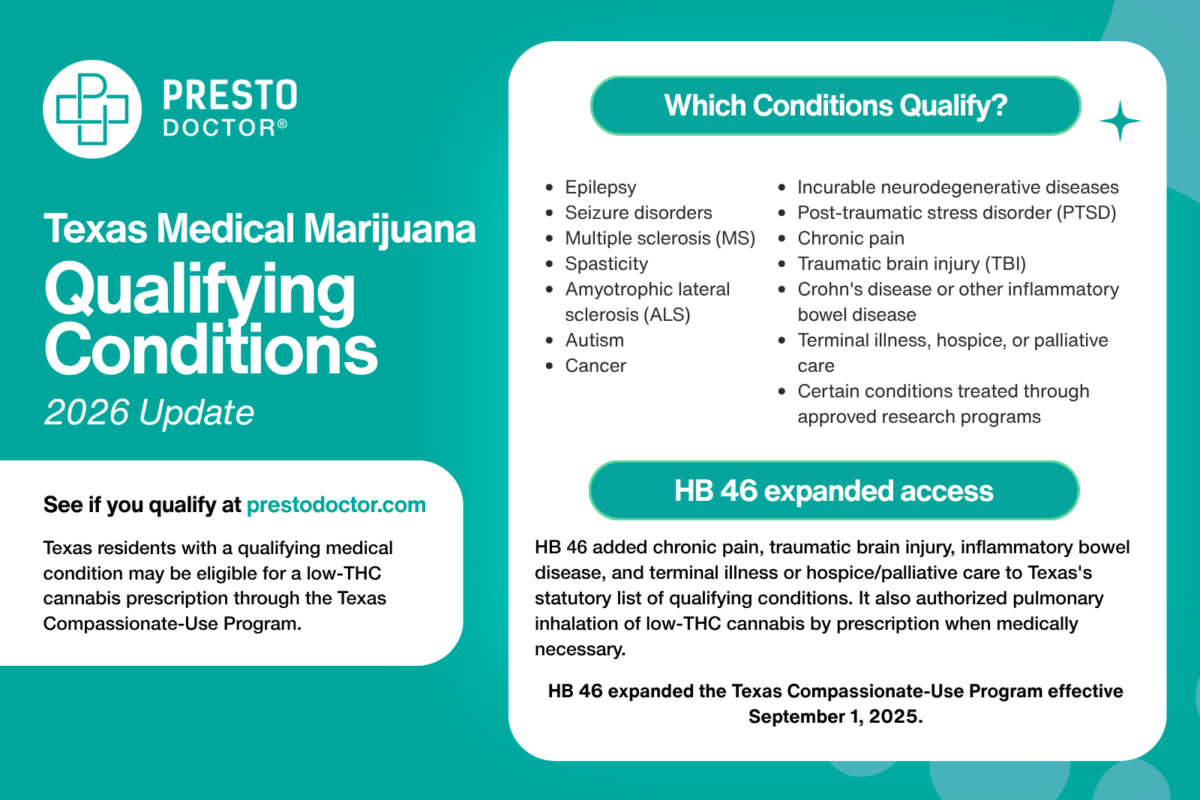
Texas law (Texas Health and Safety Code Chapter 169) currently recognizes 13 medical-condition categories for medical cannabis prescriptions under the Texas Compassionate Use Program, plus a designated research-program pathway:
- Chronic Pain: Defined by statute as severe pain lasting more than 90 days associated with a chronic pathological process, for which a qualified physician determines that low-THC cannabis is a viable treatment and for which the physician would otherwise consider prescribing an opioid. (Note: Texas law does not require that a patient has previously taken opioids, but the clinical condition must meet this statutory severity standard).
- Post-Traumatic Stress Disorder (PTSD): Formally diagnosed PTSD from trauma, military service, or psychological events.
- Cancer: All types and stages of cancer for symptom and palliative management.
- Epilepsy and Other Seizure Disorders: Intractable or recurring seizure disorders.
- Multiple Sclerosis (MS): Including severe spasticity and tremor symptoms.
- Autism Spectrum Disorders: Diagnosed autism with associated behavioral or sensory dysregulation.
- Traumatic Brain Injury (TBI)
- Crohn’s Disease or other Inflammatory Bowel Disease (IBD)
- Amyotrophic Lateral Sclerosis (ALS / Lou Gehrig’s Disease)
- Incurable Neurodegenerative Diseases: Approved condition list designated by the Department of State Health Services (DSHS), including Parkinson’s disease, Alzheimer’s disease, Huntington’s disease, and related neurodegenerative disorders.
- Spasticity: Severe muscle spasticity associated with neurological illness or injury.
- Terminal Illness or Hospice/Palliative Care: Any condition for which a patient is receiving hospice or palliative care, or with a prognosis of six months or less.
- Qualified Clinical Research Program: Patients enrolled in approved institutional clinical research studies evaluating low-THC cannabis.
Conditions such as neuropathy, degenerative disc disease, severe arthritis, and fibromyalgia are not listed as standalone statutory categories in Chapter 169. However, when these conditions cause severe pain lasting more than 90 days that meets the statutory definition of chronic pain, a qualified Texas physician may evaluate and determine eligibility under the chronic-pain category. Having a diagnosis does not guarantee approval; a physician must determine that potential benefits outweigh clinical risks.
How Texas CURT Prescription Entry Works
Texas does not issue a physical medical marijuana card. Instead, your prescription is entered electronically by your doctor into the Compassionate Use Registry of Texas (CURT) managed by the Department of Public Safety (DPS).
| Step | Description | Cost & Timeframe |
|---|---|---|
| 1. Telemedicine Evaluation | 15-minute video consult with a Texas CURT-certified physician | $149.99 (100% money-back guarantee) |
| 2. CURT Electronic Entry | Doctor enters prescription into DPS database | Same day ($0 Texas state fee) |
| 3. Dispensary Fulfillment | Dispensary verifies prescription in CURT via ID & DOB | Pickup or statewide delivery |
Ready to Consult with a Texas Physician?
If you suffer from chronic pain, PTSD, oncology symptoms, or any qualifying category, connect with an authorized Texas doctor today.