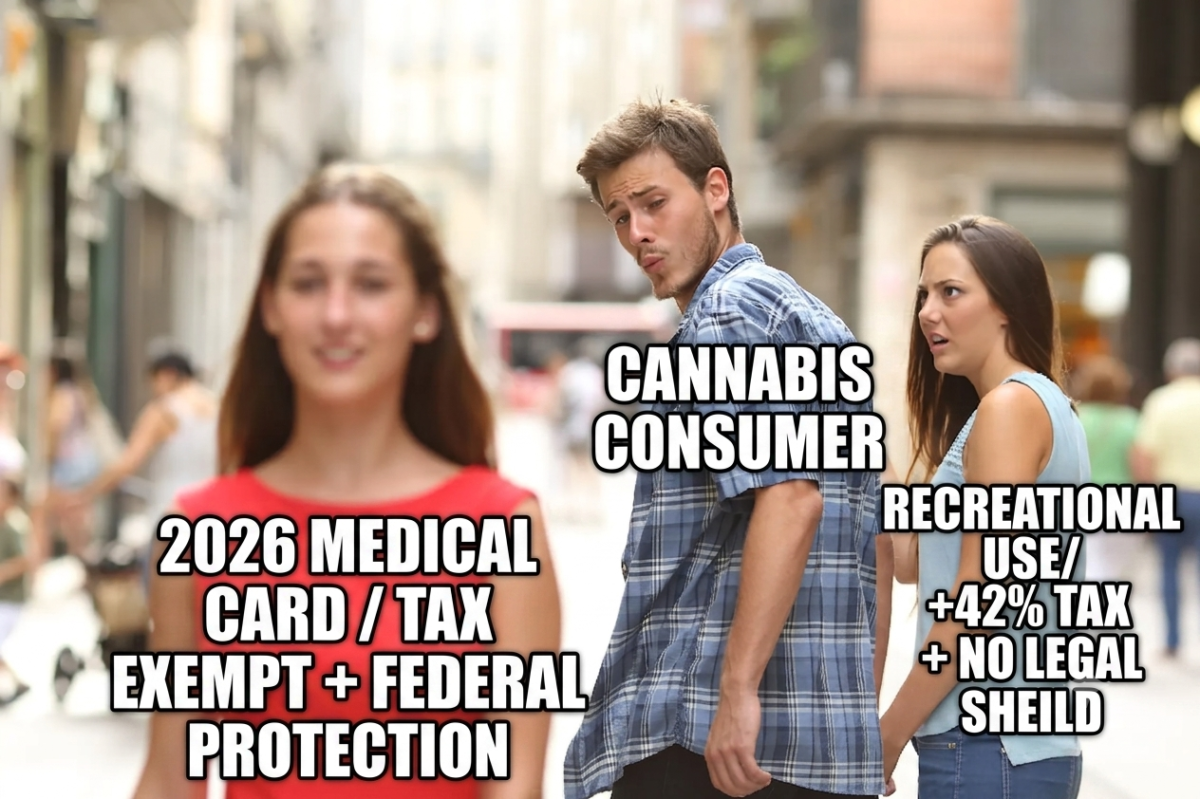
In April, the federal government did something it hadn’t done in over fifty years. It moved medical cannabis into a new legal category. Recreational cannabis stayed exactly where it was.
No press release hit your group chat. No banner ad. Just a quiet DOJ order that changed the math for anyone holding a medical card, or thinking about skipping one.
If you’re still renewing the old way, or you ditched your card years ago because “recreational is basically the same thing now,” you’re working off information that already expired.
The Recreational Tax Trap
Select your state to reveal the markup on adult-use cannabis.
The Renewal Nightmare We All Remember
Let’s be honest about how bad this used to be.
Getting a medical card five years ago meant driving to a strip-mall clinic, sitting under bad fluorescent lighting, and paying a doctor for a five-minute conversation. Then came the state paperwork.
Mail-in forms. Blurry photo uploads. A wait for a laminated card that showed up in your mailbox weeks later. And then, twelve months in, you did it all again.
It’s no surprise a lot of people just gave up and paid recreational prices instead. The process was built like an obstacle course, and plenty of people opted out.
What Actually Changed on April 23
Here’s the part that matters. On April 23, 2026, the Department of Justice and the DEA moved two specific categories of cannabis from Schedule I to Schedule III: FDA-approved cannabis drug products, and cannabis handled under a state medical license.
Recreational cannabis didn’t move. It’s still Schedule I, sitting next to substances the federal government considers to have no accepted medical use. A separate, expedited hearing running through summer 2026 will decide whether that changes too, but that outcome isn’t decided yet.
What this means in plain terms: medical and recreational cannabis aren’t just different retail experiences anymore. As of this year, they’re sitting in different federal drug schedules entirely. That’s a real, documented legal split, not a marketing angle.
The Card Itself Got a Glow-Up
States are catching up to the shift, and New York is the clearest example.
Under Senate Bill 2025-S3294A, signed in November 2025 and effective this past February, New York extended medical cannabis certifications from one year to up to two. The physical card is gone too, replaced by a digital certificate with a QR code that your provider files directly with the state. The same law also set up reciprocity, letting out-of-state medical patients purchase at New York dispensaries.
New Jersey and Oklahoma have moved in similar directions. But cannabis law is intensely state-specific — check your own state’s current rules before assuming any of this applies to you. A national trend doesn’t mean a universal one.
Why This Actually Moves the Needle on Cost
Most states with both medical and recreational markets exempt medical patients from the excise tax charged on recreational purchases. That tax runs anywhere from roughly 15% to over 40% depending on the state and city. Stretch your certification from one year to two, and one visit now covers double the savings window.
There’s a second, separate shift worth knowing about even if it doesn’t hit your receipt directly: because state-licensed medical operators are no longer classified under Schedule I or II, they’re no longer blocked by IRC Section 280E from deducting standard business expenses on federal taxes. That’s a huge deal for the industry’s bottom line, and it’s part of why more dispensaries are actively encouraging patients to get certified this year.
When state-licensed medical operators can suddenly deduct standard business expenses, their overhead drops overnight. Dispensaries are using these massive federal tax savings to slash base prices—but thanks to state laws, only certified medical patients are legally allowed to double-dip on those lower prices plus the tax exemption.
Your 2026 Medical Card Cheat Sheet
- The federal split: Since April 2026, state-licensed medical cannabis sits in Schedule III. Recreational cannabis remains Schedule I, pending a separate hearing running through summer 2026.
- Longer certifications: States including New York have extended medical certifications to up to two years. Confirm your state’s actual limit — it isn’t universal yet.
- No more plastic: Digital certificates with QR codes are replacing physical cards in states like New York. Check whether yours has made the switch.
- Tax treatment: Many states exempt medical patients from recreational excise taxes. The exact savings depend entirely on your state and municipality.
- Reciprocity: A small but growing number of states, New York included, now accept out-of-state medical patients at their dispensaries.
The Distinction Nobody’s Marketing
There’s a difference between being a retail customer and being a patient with a doctor-backed certification on file. Depending on where you live, that distinction can matter for things like workplace drug policies or housing agreements, though the specifics vary a lot by state and situation — this isn’t a blanket legal shield, and it’s worth confirming with a professional if it matters for your specific circumstances.
What’s changed is the cost of finding out whether it applies to you. A telehealth consultation now, in most states, takes a video call instead of a day off work. Getting certified isn’t the multi-week ordeal it used to be.
Let’s Settle This in the Comments
Now that medical and recreational cannabis are legally different categories under federal law for the first time, should more states be pushing people toward medical certification, paperwork and all? Or is expanding the recreational market the better long-term fix, so nobody has to see a doctor just to buy a plant? Tell me where you land.
This post is for general information only and isn’t legal or medical advice. Cannabis laws, tax treatment, and certification rules vary significantly by state and change often — verify current details with your state’s cannabis program before making a decision. You must meet your state’s minimum age and residency requirements to qualify for a medical cannabis program.