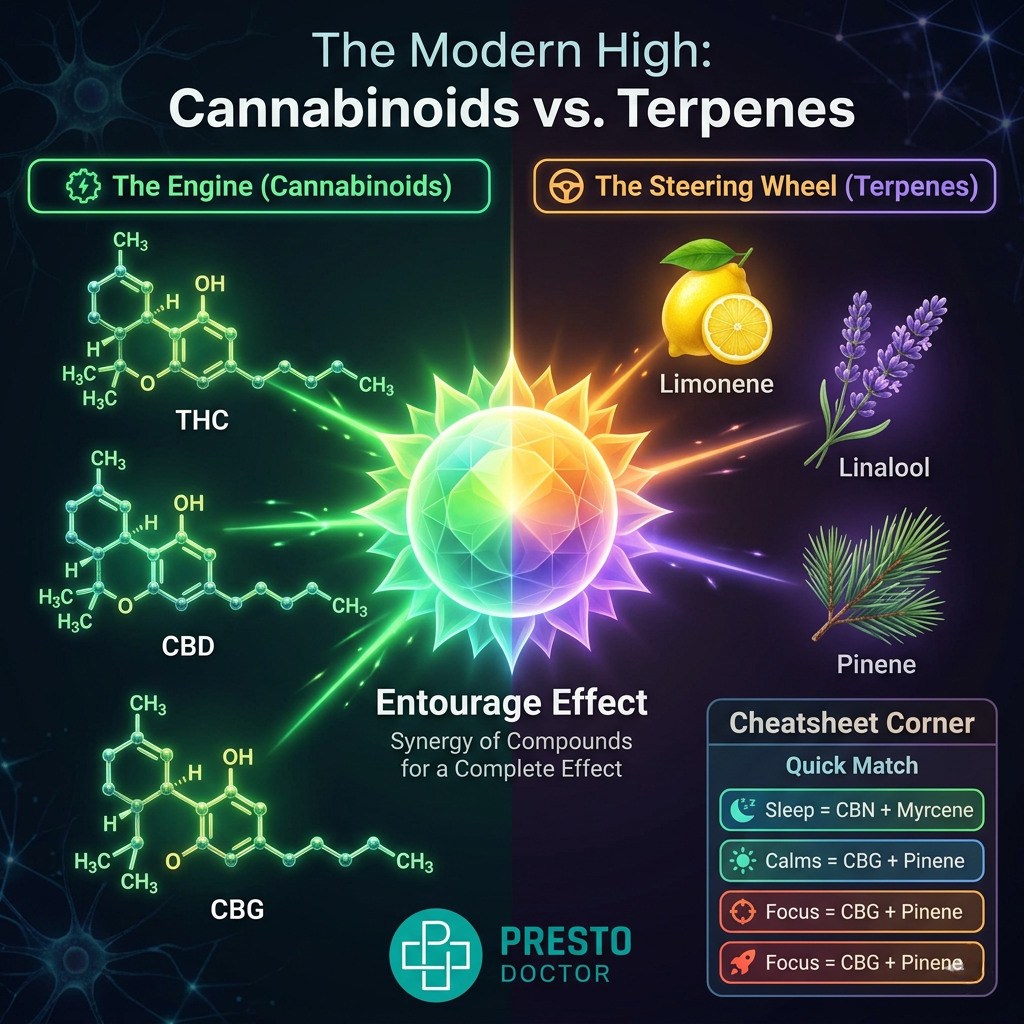
Cannabis contains more than THC. It also contains other cannabinoids — CBD, CBG, CBN — and aromatic compounds called terpenes, which give each strain its distinct smell and, according to a growing body of research, may shape how THC feels in the body. The theory that these compounds work better together than in isolation is known as the entourage effect.
It’s a popular idea in cannabis marketing. It’s also, as of 2026, still a hypothesis — one with some genuinely promising clinical evidence behind specific compound pairs, and a lot of unproven claims layered on top. This guide separates the two.
Key takeaways
- Cannabinoids (THC, CBD, CBG, CBN, THCV) interact directly with the body’s endocannabinoid system and drive most of cannabis’s therapeutic and intoxicating effects. Terpenes shape aroma and are being studied for their own biological activity.
- The entourage effect is a real, active area of research — but a 2024 systematic review found the evidence for broad synergy between cannabinoids and terpenes remains largely exploratory, not proven.
- The best current clinical evidence is narrow and specific: a 2024 double-blind, placebo-controlled study found that vaporized D-limonene reduced THC-induced anxiety and paranoia in a dose-dependent way — one real interaction, not proof that “every terpene enhances every cannabinoid.”
- Full-spectrum products aren’t automatically superior to isolates for every patient; the right choice depends on tolerance, condition, and whether any THC is appropriate at all.
What are cannabinoids?
Cannabinoids interact with the body’s endocannabinoid system (ECS), which helps regulate pain, mood, appetite, and sleep.
| Cannabinoid | What it’s known for | Evidence status |
|---|---|---|
| THC | The primary intoxicating cannabinoid; associated with pain relief and appetite stimulation | Well-studied, extensive clinical literature |
| CBD | Non-intoxicating; studied for anti-inflammatory and anti-anxiety effects | Extensively studied; FDA-approved for certain seizure disorders (Epidiolex) |
| CBG | A minor cannabinoid synthesized earlier in the plant’s growth; of growing research interest | Early-stage; mostly preclinical |
| CBN | Forms as THC degrades; commonly marketed for sleep | Marketing claims outpace current clinical evidence |
| THCV | Marketed as suppressing appetite and producing clearer-headed effects than THC | Limited human data so far |
Terpenes are the other half of the story — for a full compound-by-compound breakdown of myrcene, limonene, linalool, pinene, and the rest, see what cannabis terpenes are. Here’s how the two categories stack up directly:
THC vs. terpenes, at a glance
| THC | Terpenes | |
|---|---|---|
| Chemical class | Cannabinoid | Terpenoid |
| Primary role | Main intoxicating compound | Aroma, flavor, possible biological activity |
| Causes the “high”? | Yes | Not on their own |
| Research depth | Extensive | Growing, but still early for most terpenes |
| Found outside cannabis? | No — cannabis-specific | Yes — common throughout plants, fruits, and herbs |
What is the entourage effect, really?
The term was coined in 1998 by researchers Raphael Mechoulam and Shimon Ben-Shabat to describe the idea that “inactive” plant compounds could enhance the activity of primary cannabinoids. It has since become one of the most widely repeated claims in cannabis marketing — often stated as settled fact.
The current evidence doesn’t fully support that framing. A 2024 systematic review published in Pharmaceuticals, which screened the literature using the PRISMA methodology, found exploratory support for terpenes as modulators of cannabinoid activity, but the review’s authors stopped short of confirming true synergy — they concluded that terpenes’ ability to meaningfully boost cannabinoid efficacy hasn’t yet been demonstrated and called for further clinical trials (André et al., 2024, Pharmaceuticals).
A separate narrative scoping review reached a similar conclusion, describing the entourage effect as a term whose scientific foundation is still being actively debated, even as it’s become common in cannabis marketing (Simei et al., 2024, Cannabis and Cannabinoid Research).
That doesn’t mean nothing is happening — it means the evidence is compound-specific and still developing, not a blanket rule that applies to every cannabinoid-terpene pairing.
The strongest evidence so far: three studies worth knowing
1. D-limonene measurably reduces THC-induced anxiety. A double-blind, placebo-controlled crossover trial from Johns Hopkins University and the University of Colorado had 20 adults inhale vaporized THC, D-limonene, both together, or a placebo. Co-administering THC with D-limonene reduced self-reported anxiety and paranoia in a dose-dependent way, without blunting THC’s other effects — one of the first controlled human trials to isolate a specific cannabinoid-terpene interaction rather than infer one from anecdote (Spindle et al., 2024, Drug and Alcohol Dependence; Johns Hopkins Medicine summary).
2. Some terpenes act on cannabinoid pathways even without THC present. Research out of the University of Arizona Health Sciences found that certain cannabis terpenes are “cannabimimetic” — meaning, on their own, they produced cannabinoid-like effects (including reduced pain sensitivity) in animal models, and amplified cannabinoid pain relief when combined with them, without increasing negative side effects (Streicher lab, Scientific Reports, summarized by ScienceDaily, 2021). This is mechanistic and preclinical evidence — a meaningful signal, not yet a clinical guarantee in humans.
3. The overall research base is still exploratory. The 2024 Pharmaceuticals systematic review and the Simei et al. scoping review above remain the most comprehensive recent looks at the field, and both land in the same place: promising leads, unproven broad synergy, more clinical trials needed.
The pattern across all three: specific, testable interactions are starting to hold up under controlled conditions. Sweeping claims that “the whole plant always works better” still don’t — and treating a generic terpene chart as a prediction of your personal effects overstates what any of this shows.
Full-spectrum vs. isolate: what the evidence actually supports
- Full-spectrum products contain the plant’s broader cannabinoid, terpene, and flavonoid profile. This is the format most entourage-effect research is testing.
- Isolates contain a single, highly purified cannabinoid. They’re the right choice for patients who need to avoid THC entirely or who need precise, reproducible dosing.
Neither is universally “better.” A full-spectrum product may suit someone chasing a specific terpene-driven effect; an isolate may suit someone who’s THC-sensitive, drug-tested, or needs a controlled CBD-only dose. This is a conversation to have with a physician, not a default assumption in either direction.
How to actually use this information
Start low and go slow with any new cannabinoid-terpene combination, and treat terpene associations as a personal hypothesis to test, not a guarantee. For the mechanics of actually reading a product — total active cannabinoids, individual terpene percentages, and what a lab report is telling you — see how to read a terpene profile and COA and how to read a full dispensary label. And loop in a licensed physician before making a full-spectrum vs. isolate decision, especially if you’re managing a specific condition or taking other medications.
FAQ
Is the entourage effect proven? Not as a universal rule. A 2024 systematic review found exploratory, promising evidence for specific interactions but concluded that broad synergy between cannabinoids and terpenes remains unproven.
What’s the best-supported cannabinoid-terpene combination right now? THC plus D-limonene has the strongest controlled human evidence to date, specifically for reducing THC-related anxiety and paranoia — not for general symptom relief.
Should I choose full-spectrum or isolate? It depends on your goals, THC sensitivity, and any testing or medical constraints — this is worth discussing directly with a physician rather than deciding from a general rule.
The bottom line
Cannabinoids are the primary drivers of cannabis’s effects. Terpenes shape aroma and may modulate specific cannabinoid effects — the D-limonene research is the clearest current example. The entourage effect, as a whole-plant guarantee, is still a hypothesis under active study, not an established clinical fact. The most trustworthy way to talk about it is the way the actual researchers do: here’s what’s proven, here’s what’s promising, here’s what’s still unknown.
Sources
- André R, Gomes AP, Pereira-Leite C, et al. “The Entourage Effect in Cannabis Medicinal Products: A Comprehensive Review.” Pharmaceuticals. 2024;17(11):1543. PubMed
- Spindle TR, Zamarripa CA, Russo E, et al. “Vaporized D-limonene selectively mitigates the acute anxiogenic effects of Δ9-tetrahydrocannabinol in healthy adults who intermittently use cannabis.” Drug and Alcohol Dependence. 2024;257:111267. ScienceDirect · Johns Hopkins Medicine summary
- Streicher J, et al. “Cannabis sativa terpenes are cannabimimetic and selectively enhance cannabinoid activity.” Scientific Reports, 2021, University of Arizona Health Sciences. ScienceDaily summary
- Simei JLQ, Souza JDR, Lisboa JR, et al. “Does the ‘Entourage Effect’ in Cannabinoids Exist? A Narrative Scoping Review.” Cannabis and Cannabinoid Research. 2024;9(5):1202–1216. PubMed
This article is for educational purposes and does not constitute medical advice. Always consult a licensed physician before starting, stopping, or changing a medical cannabis regimen.