TL;DR: Don’t just shop for the highest THC percentage. To get the best cannabis, check the harvest date (aim for under 6 months old), look at the Total Active Cannabinoids (TAC) for a full-spectrum effect, check for therapeutic terpenes, and scan the QR code to verify the product passed safety lab tests.
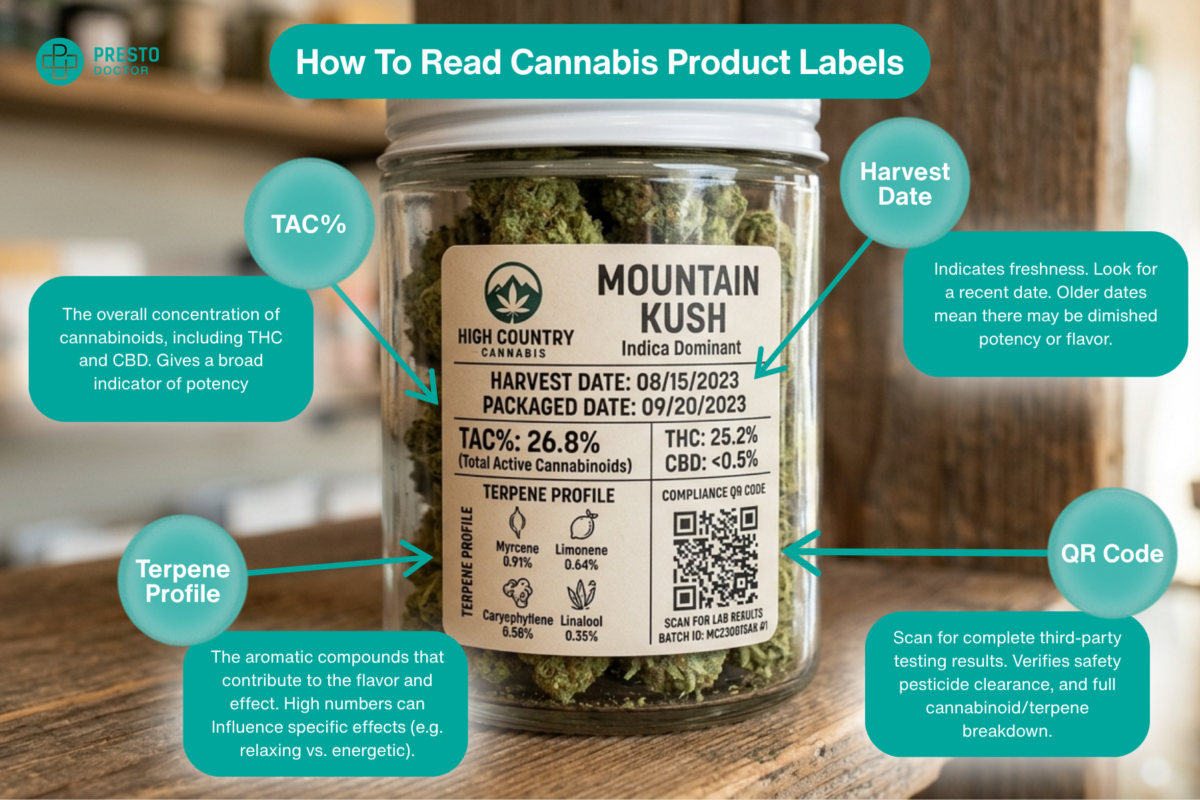
Walking into a modern medical dispensary can feel like walking into a pharmacy where everything is written in a different language. Between acronyms like TAC, obscure batch codes, and lists of unpronounceable terpenes, it is easy to get overwhelmed and simply ask the budtender for “whatever is popular.”
However, your cannabis experience is heavily dictated by what is printed on that tiny sticker. If you want to get the best value for your money and find genuine medical relief, you need to know how to decode it.
The Ultimate Dispensary Label Cheat Sheet
Before diving into the fine print, use this quick-reference table to understand exactly what each section of a cannabis packaging sticker means for your wellness journey.
| Label Component | What It Tells You | Why It Matters to Consumers |
|---|---|---|
| Harvest Date | The day the cannabis plant was cut down. | Dictates true freshness, flavor, and potency. |
| Package Date | The day the flower was placed in the final container. | Can be misleading; a product can be old but recently packed. |
| THC / Δ9-THC | The primary psychoactive compound percentage. | Indicates the immediate intoxicating strength of the strain. |
| TAC (Total Active Cannabinoids) | The sum of all active cannabinoids (THC, CBD, CBG, etc.). | Measures the full therapeutic footprint and “entourage effect.” |
| Terpene Profile | The essential oils responsible for aroma and specific effects. | Determines if a strain will make you sleepy, focused, or relaxed. |
| QR Code / Batch ID | Direct link to the third-party lab test results (COA). | Proves the product is clean and free of dangerous toxins. |
1. Cannabis Harvest Date vs. Package Date: The Freshness Factor
Cannabis is an agricultural crop. Like any vegetable or herb, it degrades over time. When understanding dispensary packaging, you will usually see two completely different dates listed: the Harvest Date and the Package Date.
- Harvest Date: The exact day the living plant was cut down and prepped for curing.
- Package Date: The day the cured flower was sealed inside its retail jar or bag.
The Golden Rule: Always prioritize the harvest date. A cultivator can harvest a crop, store it in bulk plastic bins for a year, and package it today. If you only look at the package date, you might think you are buying a fresh batch.
If the harvest date is older than six months, the delicate aromatic terpenes have likely evaporated, and the THC has begun degrading into Cannabinol (CBN). While CBN isn’t dangerous, it causes heavy sedation and fatigue, meaning your uplifting daytime strain could turn into an accidental sleep aid.
2. What Does TAC Mean on a Weed Label?
Most consumers zoom straight to the Δ9-THC percentage. However, experienced medical patients look for the TAC, which stands for Total Active Cannabinoids.
TAC vs. THC: Understanding the Full Profile
THC represents just one chemical compound. TAC represents the cumulative percentage of all measurable cannabinoids in the product, including CBD, CBG, CBC, and THCV.
For example, if a flower jar lists 20% THC but features a 26% TAC, that means it contains an additional 6% of non-psychoactive compounds. This diversity is often discussed in terms of the entourage effect — the theory that cannabinoids and terpenes may work together for a more well-rounded experience than isolated THC alone. It’s a promising, active area of research, but not yet a proven clinical guarantee — see our full evidence breakdown for what’s actually been tested.
To understand how TAC works alongside aromatic compounds to shape your experience, explore our deep dive on THC vs. terpenes and the entourage effect.
⚠️ Industry Note: Don’t confuse Total Active Cannabinoids with Total Aerobic Count. In a laboratory setting, “Total Aerobic Count” refers to a microbial safety test checking for bacteria and mold. On a consumer retail label, TAC almost always refers to your cannabinoid profile.
For a deeper breakdown of what a “good” terpene percentage actually looks like, see What Is a Good Terpene Percentage in Cannabis?
3. The Terpene Profile: Driving Your Cannabis Experience
If cannabinoids are the engine of your cannabis experience, terpenes are the steering wheel. Terpenes are the volatile aromatic compounds that give different strains their unique scents—like pine, citrus, or fuel—and dictate exactly how that strain will make you feel.
Many premium brands now print the dominant terpenes directly on the label. Total terpene percentages are commonly printed on labels, but there’s no universal number that guarantees quality — see our full breakdown of what a good terpene percentage actually means.
Once you locate the lab results, check our breakdown on what a good terpene percentage is and how to read a COA to evaluate the profile.
Terpenes for Sleep and Pain Relief
- Myrcene: Earthy, musky aroma; commonly associated with relaxation, though human evidence for this is still largely preclinical.
- Linalool: Floral, lavender-like; investigated for calming, anti-anxiety effects, though clinical evidence in cannabis consumers remains limited.
Terpenes for Focus and Mood Elevation
- Limonene: Bright citrus aroma; the terpene with the strongest current human evidence — a 2024 controlled study found it reduced THC-related anxiety and paranoia in a dose-dependent way.
- Pinene: Fresh, piney aroma; early research suggests it may help offset some short-term memory effects of THC, though this isn’t yet established in humans.
4. Batch Numbers and the Certificate of Analysis (COA)
Every legal cannabis product must feature a Batch ID, Lot Number, or a scannable QR code. This is your digital passport to the product’s official Certificate of Analysis (COA).
A COA is a certified, mandatory document issued by an independent, third-party testing laboratory. State regulatory agencies, such as the New York Office of Cannabis Management and the New Jersey Cannabis Regulatory Commission, enforce strict compliance laws requiring all products to pass these independent evaluations before landing on dispensary shelves.
When you scan the QR code and open the COA, ensure the lab holds an ISO/IEC 17025 accreditation, which verifies its technical competency. Check that the batch number matches your package and look for a definitive “PASS” status across these four critical safety panels:
- Pesticides & Growth Regulators: Ensures no toxic chemicals were used during cultivation.
- Heavy Metals: Verifies the plant hasn’t absorbed lead, arsenic, cadmium, or mercury from the soil.
- Microbials: Guarantees the flower is entirely free of harmful molds, yeast, salmonella, and E. coli.
- Residual Solvents: Crucial for vapes and concentrates; proves that chemical extractors like butane or ethanol were safely purged.
When buying cartridges, confirm whether your product uses authentic plant profiles by reading our guide to cannabis-derived terpenes (CDTs).
Key Takeaways for Smarter Shopping
- Check the Harvest Date: Avoid flower harvested more than 6 months ago to ensure potency and terpene retention.
- Prioritize TAC Over Solo THC: Look for a wider gap between THC and TAC percentages to enjoy a full-spectrum therapeutic experience.
- Target Specific Terpenes: Use the aromatic profile to customize your medical relief, whether you need daytime focus or nighttime pain control.
- Never Skip the QR Code: Always verify a third-party COA to guarantee you are consuming clean, safe, and lab-tested medicine.
Whether you are stepping into a store to buy a single pre-roll or looking into purchasing a bulk allotment, reading the fine print ensures you bring home safe, fresh, and highly effective medicine.
Guide on Cannabis Weights: From an Eighth to a QP
To access medical-grade selections, bypass heavy retail taxes, and secure legal consumer protections in your state, getting a medical marijuana card is your best path forward. You can safely consult with a licensed physician and get approved online through PrestoDoctor.
Frequently Asked Questions (FAQ)
What does TAC mean on a weed label?
TAC stands for Total Active Cannabinoids. It measures the total combined percentage of all active chemical compounds found in the cannabis product—such as THC, CBD, CBG, and CBN—rather than looking at isolated THC alone. A higher TAC points to a richer cannabinoid variety.
Does the packaging date matter more than the harvest date?
No, the harvest date is much more important. The harvest date tells you exactly when the plant material was cut down and dried. The packaging date only indicates when that flower was placed into its retail jar, which could be months after it was harvested.
What is a Certificate of Analysis (COA) in cannabis?
A Certificate of Analysis is an official document from an accredited, independent third-party laboratory. It details a cannabis product’s exact chemical makeup and provides verified proof that the batch passed state safety regulations for pesticides, heavy metals, mold, and residual solvents.
How do I find the terpene profile if it isn’t printed on the label?
If a brand does not print its dominant terpenes directly on the main sticker, you can easily find them by scanning the product’s compliance QR code. This pulls up the official lab COA, which features a dedicated section breaking down every individual terpene percentage.
Why does old cannabis make you feel sleepy?
As cannabis ages past its ideal shelf life, its primary psychoactive compound (Δ9-THC) naturally breaks down due to exposure to oxygen, light, and heat. It slowly converts into Cannabinol (CBN), a cannabinoid highly regarded for its profound, sedative sleep properties.
Does a higher terpene percentage on the label mean better quality?
Not automatically. There’s no universal terpene percentage that guarantees a product is higher quality or more effective \u2014 individual profile, product type, and freshness matter more than the total number alone.
What’s the difference between TAC and Total Aerobic Count?
They’re unrelated despite the similar abbreviation. Total Active Cannabinoids is a potency measurement; Total Aerobic Count is a microbial safety test for bacteria and mold. On a consumer label, TAC almost always refers to cannabinoids.