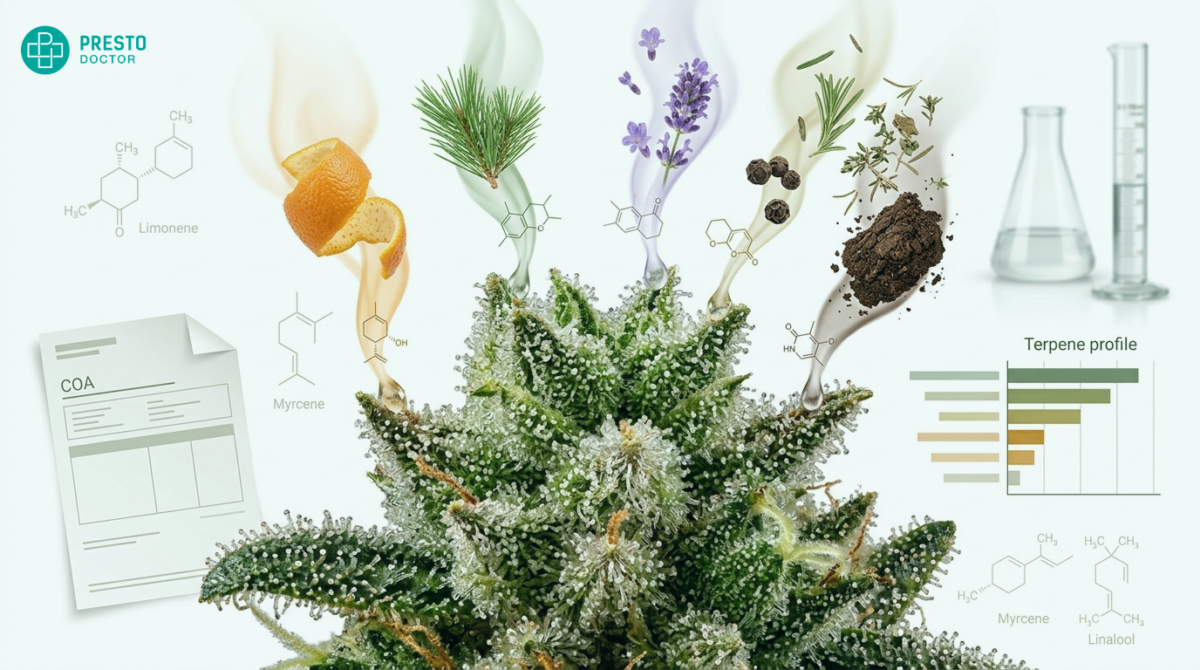
If you’ve ever opened a jar of cannabis and immediately noticed citrus, pine, pepper, lavender, fruit, earth or something unmistakably skunky, you’ve already experienced terpenes.
Terpenes are aromatic compounds produced by cannabis and countless other plants. In cannabis, they help create a product’s distinctive aroma and flavor, and researchers are investigating whether individual terpenes and combinations of terpenes may also influence biological and subjective effects.
What terpenes do not do is provide a simple formula for predicting exactly how a particular cannabis product will make you feel. Your experience can depend on much more than a terpene name or percentage, including cannabinoids, dose, route of administration, individual biology and the overall chemical profile of the product.
That distinction matters.
Terpenes have become one of the most talked-about parts of cannabis, but they’re also one of the most misunderstood. Here’s what we know, what researchers are still investigating, and how you can actually use terpene information when choosing cannabis.
What are terpenes?
Terpenes are naturally occurring compounds that contribute to the characteristic aromas and flavors of many plants.
They’re not unique to cannabis. Terpenes are found throughout nature—in citrus fruits, pine trees, lavender, herbs, spices and many other plants.
Cannabis produces a complex mixture of terpenes, and the combination can vary between cultivars and even between different harvests of the same cultivar.
That’s one reason two cannabis products with similar THC percentages can smell remarkably different.
Do terpenes get you high?
No. Terpenes are not considered the primary intoxicating compounds in cannabis.
THC is the cannabinoid most directly responsible for cannabis’s characteristic intoxication. Terpenes are better understood as part of the plant’s broader chemical and sensory profile.
Researchers are investigating whether terpenes can alter or interact with cannabinoid effects, but the science does not support treating a terpene chart as a simple map of exactly what your high will feel like.
What do terpenes do in cannabis?
At the most basic level, terpenes contribute to:
- Aroma
- Flavor
- The chemical profile of a cannabis cultivar
- The sensory differences between products
Terpenes also perform biological functions in plants, including roles in communication, defense and interactions with the surrounding environment.
For cannabis consumers, however, the most useful concept is the terpene profile.
What is a cannabis terpene profile?
A terpene profile is the combination and relative concentration of terpenes identified in a cannabis product.
Imagine two flower samples:
Product A
- Limonene: dominant
- β-caryophyllene: secondary
- Myrcene: smaller amount
Product B
- Myrcene: dominant
- Linalool: secondary
- β-caryophyllene: smaller amount
Even if their THC percentages were nearly identical, they could smell and taste completely different.
That’s because THC percentage tells you about one cannabinoid. A terpene profile tells you something about the aromatic chemistry of the product.
The profile can therefore be useful information—but it isn’t a guarantee of a specific effect.
The most common cannabis terpenes
There are many terpenes found in cannabis. Some appear frequently across cultivars, while others may occur in smaller amounts.
Here are some of the best-known.
Myrcene
Aroma: Earthy, musky, herbal and sometimes fruity.
Myrcene is one of the most frequently discussed cannabis terpenes and is found in many cannabis varieties as well as other plants.
You’ll often see myrcene described online as the “sleepy” or “sedating” terpene.
That’s an oversimplification.
Research into myrcene has produced interesting preclinical findings, but there isn’t enough human evidence to say that a particular percentage of myrcene guarantees sedation or determines whether a cannabis cultivar behaves like an “indica.”
In other words, the old rule that 0.5% myrcene automatically means indica while below 0.5% means sativa is not a scientifically reliable way to classify cannabis.
Limonene
Aroma: Lemon, orange and other citrus notes.
Limonene is especially recognizable because of its bright citrus aroma.
It is also one of the more interesting terpenes currently being investigated in human research. In a 2024 controlled study, vaporized D-limonene reduced some of the acute anxiety-provoking effects of THC in adults who intermittently used cannabis. The researchers did not find that limonene simply changed every effect of THC, which is a useful reminder that terpene effects can be specific and complicated.
That’s promising—but it is not the same thing as proving that limonene “treats anxiety.”
Linalool
Aroma: Floral, lavender-like and slightly sweet.
Linalool is found in cannabis as well as plants such as lavender.
It has attracted scientific interest for possible neurological, behavioral and other biological effects, but much of the evidence remains preclinical or exploratory.
So while you’ll frequently see linalool described online as “the calming terpene,” a more accurate statement is:
Linalool has been investigated for potentially calming or sedative-related biological effects, but clinical evidence in cannabis consumers is still limited.
β-Caryophyllene
Aroma: Peppery, spicy, woody and warm.
β-Caryophyllene is especially interesting because it interacts with CB2 receptors, making it unusual among commonly discussed terpenes.
That has led to substantial research interest.
But receptor activity is not the same thing as proving a therapeutic effect in humans. A promising mechanism is a reason for more research—not a guarantee that consuming a caryophyllene-rich product will produce a particular medical outcome.
Pinene
Aroma: Pine, evergreen and fresh.
Pinene occurs naturally in many coniferous plants and is also found in cannabis.
Researchers are studying pinene for a variety of biological effects, including possible interactions with the nervous system and inflammation.
Again, it’s important to distinguish biological plausibility from proven clinical outcomes.
Terpinolene
Aroma: Herbal, floral, citrusy and sometimes slightly piney.
Terpinolene appears in a range of cannabis cultivars and is also naturally occurring in many plants.
Despite the amount of attention it receives in strain descriptions, human evidence about its specific effects in cannabis remains limited.
Humulene
Aroma: Earthy, woody and hops-like.
Humulene is also found in hops and several other plants.
It’s frequently discussed alongside caryophyllene and has attracted research interest for potential anti-inflammatory and other biological properties, although much of the evidence remains preliminary.
Ocimene
Aroma: Sweet, herbal, floral and sometimes citrus-like.
Ocimene is another naturally occurring terpene that contributes to the aroma of some cannabis cultivars.
It’s less commonly used as a primary terpene descriptor than myrcene or limonene, but it can still be an important part of a product’s overall profile.
Cannabis terpene chart
| Terpene | Common aroma | Frequently associated with | Evidence status |
|---|---|---|---|
| Myrcene | Earthy, musky, herbal | Relaxing/earthy profile | Mostly preclinical/exploratory |
| Limonene | Citrus | Bright citrus profile | Some emerging human evidence |
| Linalool | Floral, lavender | Calming association | Mostly preclinical |
| β-Caryophyllene | Pepper, spice | Spicy profile; CB2 activity | Strong mechanistic interest, limited clinical evidence |
| Pinene | Pine, evergreen | Fresh/resinous profile | Emerging research |
| Terpinolene | Herbal, floral | Complex aromatic profile | Limited evidence |
| Humulene | Earthy, woody | Hops-like aroma | Primarily preclinical |
| Ocimene | Sweet, herbal | Fresh/aromatic profile | Limited evidence |
Important: A terpene’s common association should not be confused with a clinically established effect.
Does a higher terpene percentage mean better cannabis?
Not necessarily.
This is one of the most useful things to understand when shopping for cannabis.
There is no universal terpene percentage that automatically means a flower or extract is “premium,” “more effective,” or “better.”
A product’s overall quality can depend on:
- Which terpenes are present
- Their relative proportions
- Cannabinoid composition
- Cultivar genetics
- Harvest timing
- Drying and curing
- Storage conditions
- Product type
- Laboratory testing
A product with a lower total terpene percentage can still be appealing if its profile has aromas you enjoy.
Likewise, more terpenes aren’t automatically better for everyone.
How do terpenes change from harvest to harvest?
A cannabis plant does not produce a perfectly standardized chemical profile every time.
Genetics matter, but so do growing and post-harvest conditions.
Environmental conditions, maturity, drying, curing, storage and processing can all affect the compounds that remain in the final product.
That means a strain name alone doesn’t tell you its exact chemistry.
A “Blue Dream” flower from one producer isn’t necessarily chemically identical to “Blue Dream” from another.
The laboratory-tested profile is more useful than the strain name by itself.
What is the entourage effect?
The entourage effect is the idea that compounds in cannabis—including cannabinoids and terpenes—may interact in ways that produce effects different from those of individual compounds on their own.
It’s an influential concept in cannabis science.
It is also a concept that should be discussed carefully.
A 2024 systematic review examining the evidence concluded that exploratory research suggests terpenes may influence cannabis’s therapeutic effects, but the evidence for consistent synergistic or additive “entourage” effects remains unproven and further clinical trials are needed.
A separate scoping review likewise found that the evidence base remains too limited to treat the entourage effect as a settled clinical fact.
So the most accurate way to describe the entourage effect is:
It is a scientific hypothesis supported by some preclinical and emerging human findings, but its clinical significance is still being established.
That’s far more useful than simply telling patients that “the whole plant always works better.”
For the full evidence breakdown — including the specific studies behind these findings — see our complete guide to understanding the entourage effect.
Do terpenes determine how a cannabis strain will make you feel?
No single terpene determines your experience.
This is an important correction to a lot of cannabis marketing.
Your experience may be influenced by:
- THC concentration
- Other cannabinoids
- Terpene composition
- Dose
- Route of administration
- Tolerance
- Individual physiology
- Setting
- Expectations
- Other medications or substances
That’s why terpene profiles are better viewed as one piece of information, not a guaranteed effect predictor.
How should you use terpenes when choosing cannabis?
Think of terpene information as a way to become a more informed consumer—not as a crystal ball.
Start with the aroma and profile you actually enjoy.
Then look at the laboratory information.
Instead of asking:
“Which terpene will make me sleepy?”
try asking:
“What terpene profile does this product have, and how does that compare with products I’ve personally liked?”
That’s a more useful long-term approach.
Keeping track of products you enjoyed, their cannabinoid profiles and their terpene profiles can help you identify patterns specific to you.
How to read a cannabis terpene profile
A laboratory report may list:
Total terpenes: 2.1%
Then break that number down:
- Limonene: 0.72%
- β-Caryophyllene: 0.51%
- Myrcene: 0.38%
- Linalool: 0.19%
- Other terpenes: remaining percentage
The total tells you the approximate quantity of detected terpenes.
The individual breakdown tells you what makes up that total.
Those two pieces of information answer different questions.
For a deeper explanation, see our guide to how to read terpene percentages and cannabis COAs.
To verify these profiles before buying, learn how to inspect product packaging using our ultimate guide to reading dispensary labels.
Why cannabis smells skunky if terpenes aren’t the whole story
Here’s a fascinating wrinkle in cannabis aroma.
For years, cannabis’s signature smell was often discussed almost entirely in terms of terpenes.
Researchers have since identified volatile sulfur compounds—particularly 3-methyl-2-butene-1-thiol—as major contributors to the characteristic skunky aroma of cannabis.
That means:
Terpenes matter enormously to aroma, but they aren’t the entire story.
This is one reason a simplistic “terpene = smell = effect” model doesn’t adequately describe cannabis chemistry.
Where do the terpenes in a vape or concentrate actually come from?
Cannabis-derived and botanical terpenes raise a different question than the profile itself — it’s about sourcing, not effect. For the full breakdown of cannabis-derived vs. botanical terpenes, see our guide to CDT vs. BDT.
Terpene myths worth leaving behind
Myth: Myrcene determines whether cannabis is indica or sativa.
Reality: There is no reliable myrcene-percentage cutoff that determines those labels.
Myth: More terpenes always means better cannabis.
Reality: Total terpene content doesn’t tell you everything about quality or personal preference.
Myth: Limonene guarantees an uplifting experience.
Reality: Limonene has interesting emerging research, but individual responses vary.
Myth: Terpenes create the cannabis high.
Reality: THC is the principal intoxicating cannabinoid; terpenes are being studied for possible modulatory effects.
Myth: The entourage effect is proven.
Reality: It is a compelling hypothesis with growing research behind it, but the clinical evidence remains incomplete.
Frequently asked questions
What are terpenes in weed?
Terpenes are naturally occurring aromatic compounds found in cannabis and many other plants. In cannabis, they contribute to aroma and flavor and are being studied for possible biological and interactive effects.
What do terpenes do?
They contribute to the aroma and flavor of cannabis and may have biological activity. Researchers are also studying how terpenes might interact with cannabinoids.
Do terpenes get you high?
Not by themselves in the same way THC does. Terpenes are not the primary intoxicating compounds in cannabis.
What is the most common terpene in cannabis?
There isn’t one terpene that is universally dominant across all cannabis. Myrcene, limonene, β-caryophyllene and other terpenes can be prominent depending on the cultivar and product.
Are terpenes safe?
Safety depends on the specific terpene, concentration, route of exposure and product. Naturally occurring does not automatically mean harmless at every concentration or when inhaled in concentrated form.
What is a terpene profile?
A terpene profile is the combination and relative amounts of terpenes detected in a cannabis product.
Can terpenes help with anxiety?
Some terpenes are being investigated for effects relevant to anxiety. For example, a controlled 2024 study found that vaporized D-limonene reduced some acute anxiety effects produced by THC in intermittent cannabis users. That does not establish limonene as a treatment for an anxiety disorder.
The bottom line
Terpenes are one of the most interesting pieces of cannabis chemistry—and one of the easiest to oversimplify.
They help create the aroma and flavor that distinguish one cannabis product from another. They may also contribute biologically to the way cannabis works, but researchers are still determining exactly how important those interactions are and how consistently they translate to human outcomes.
The smartest way to use terpene information is not to look for a single “magic” terpene.
Look at the entire profile, pay attention to the product’s cannabinoid content, use laboratory data when available, and pay attention to your own experience.
That’s where terpene science becomes genuinely useful.