Medically reviewed by Dr. Cheryl Bugailiskis, MD, CURT registered physician

Last updated: April 2026

TEXAS MEDICAL MARIJUANA — ONLINE PRESCRIPTIONS

Get Your Texas Medical Marijuana Card Online — Same Day

See a CURT-registered Texas physician via secure video call — from home, same day. Now accepting chronic pain patients under HB 46. If your physician doesn’t approve you, you pay nothing.

See a doctor today, no wait

25k+ Patient Reviews (4.9★)

100% money back guarantee

Texas Law Update (September 2025): HB 46 expanded the Texas Compassionate Use Program to include chronic pain, traumatic brain injury, IBD, and more. See what changed

The Process

How to Get a Medical Marijuana Prescription in Texas

To get a medical marijuana prescription in Texas, you must be a permanent Texas resident with a qualifying condition and complete a video evaluation with a CURT-registered physician. If approved, your prescription is entered into the Compassionate Use Registry of Texas (CURT) the same day — no physical card is issued. The full process takes about 15 minutes.

Step 1: Patient creating a PrestoDoctor account on a laptop to begin the Texas medical marijuana evaluation process

Sign Up Online

Create your account and fill out a few details about yourself and your medical history.
Step 2: PrestoDoctor physician conducting a secure telemedicine video call with a Texas medical marijuana patient

See A Doctor

Meet with a licensed Texas physician via video call — most appointments take 10–15 minutes.
Step 3: Patient receiving approval and same-day CURT registration for their Texas medical cannabis prescription

Get Approved

If approved, your physician enters your prescription directly into the Compassionate Use Registry of Texas (CURT) — same day.
Step 4: Patient visiting a licensed Texas dispensary to fill their medical marijuana prescription

Shop At Dispensaries

Your prescription will be ready to be filled at any licensed dispensary in Texas.

As a CURT-registered clinic, PrestoDoctor uploads your prescription directly to the Texas Department of Public Safety (DPS) database instantly.

What Changed in 2025: House Bill 46 & the Expanded Texas CUP

House Bill 46, signed by Governor Greg Abbott on June 21, 2025 and effective September 1, 2025, is the largest expansion of the Texas Compassionate Use Program since 2015. HB 46 added chronic pain, traumatic brain injury, IBD, and hospice care as qualifying conditions, raised THC limits to 10mg per dose, and approved new delivery methods including vaporizers and patches.

🗓 EFFECTIVE SEPTEMBER 1, 2025

What HB 46 Added to the Texas CUP

Source: Texas Legislature, HB 46 (89th Legislature) · Texas DPS Compassionate Use Program

These changes make Texas’s program significantly more accessible. If you were previously told you didn’t qualify — or if you stopped trying after an earlier denial — it’s worth checking your eligibility again under the expanded rules.

Texas Medical Marijuana Updates:
2025 vs. 2026 Rules

Chronic Pain Eligibility
Previous Rules Excluded from program
New 2026 Rules (HB 46) ✓ Fully Qualified (90+ Days)
THC Potency Limits
Previous Rules 1% THC by weight cap
New 2026 Rules (HB 46) 10mg per dose / 1,000mg per pack
Delivery Methods
Previous Rules Tinctures and Gummies only
New 2026 Rules (HB 46) Vapes, Inhalers, & Patches Approved
Veteran Accessibility
Previous Rules Limited to standard condition list
New 2026 Rules (HB 46) Expanded Physician Discretion

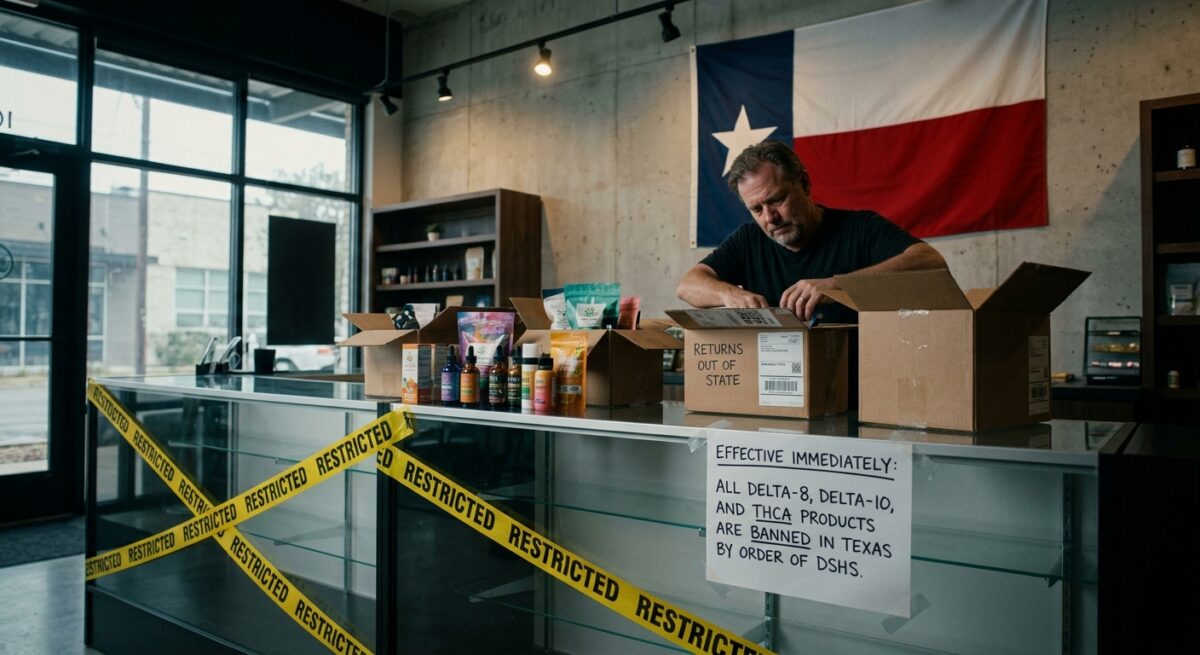
Retail hemp ban 2026: why THCA users are switching to TCUP

Last updated April 2026 · Source: DSHS 25 TAC §300.101

As of March 31, 2026, smokable THCA hemp products — including flower, pre-rolls, and concentrates — are banned from retail sale in Texas under new DSHS "total THC" rules. Combined with the September 2025 cannabinoid vape ban (SB 2024), the Texas Compassionate Use Program (TCUP) is now the only legal pathway for Texans to access physician-prescribed inhalation-based cannabis therapy.

How Texas closed the retail hemp loophole

Sept 1, 2025
SB 2024 bans all cannabinoid vape and e-cigarette sales statewide
Sept 1, 2025
HB 46 expands TCUP — adds vaporizers, inhalers, and nebulizers to allowed delivery methods
Mar 31, 2026
DSHS "total THC" rule bans retail THCA flower, pre-rolls, and concentrates
Apr 8, 2026
Travis County judge enforcement paused until at least April 23

Retail hemp vs. TCUP medical cannabis (April 2026)

CategoryRetail hempTCUP medical

Using THCA flower or vapes for relief?

You may now qualify for legal, physician-supervised medical cannabis through TCUP.

Book your evaluation →

Hemp ban FAQ

How CURT works in 4 steps

CURT — the Compassionate Use Registry of Texas — is the secure digital database managed by the Texas Department of Public Safety (DPS) that holds every active medical cannabis prescription in the state. Texas does not issue physical medical marijuana cards. CURT is your prescription. Here is how the process works from evaluation to dispensary purchase.

1
Physician evaluates your condition
A CURT-registered physician reviews your medical history and qualifying condition during a secure telemedicine video call. Most evaluations take 10–15 minutes.
2
Prescription entered into CURT
If approved, your physician enters your prescription details — including product type, dosage, and a 90-day supply authorization — directly into the Compassionate Use Registry of Texas (CURT) the same day.
3
Dispensary verifies your status
Licensed Texas dispensaries access CURT to verify your patient status. They match your government-issued photo ID against your CURT record — no physical card is needed.
4
You fill your prescription
Present your valid photo ID at any licensed Texas dispensary. Your CURT record is typically visible within 24 hours of approval. Call ahead to confirm before your first visit.
Your privacy is protected. CURT data is confidential by law. Only your prescribing physician, the Texas DPS, and licensed dispensaries can access your record. It is not shared with employers, law enforcement databases, or background check systems.

What to expect at your first Texas dispensary visit

After your PrestoDoctor physician enters your prescription into CURT, you can visit any licensed Texas dispensary — typically within 24 hours. No physical card is needed; dispensaries verify your status digitally using your photo ID.

The PrestoDoctor 5-Step Method
1
Call your dispensary
Call the dispensary 24 hours after approval to confirm your CURT prescription is visible. Ask about product availability and any pickup options.
Tip: Save the dispensary's number for easier refill coordination later.
2
Bring your documents
Bring a valid government-issued photo ID (Texas driver's license or U.S. passport). CURT is your digital prescription.
Tip: The dispensary may ask for the last 5 digits of your SSN for verification.
3
Start with a low dose
For most new patients, sublingual tinctures offer the easiest dose control. Start with the lowest recommended dose and increase gradually.
Tip: Low-THC tinctures typically range from $50–$150 per bottle.
4
Titrate over 5–7 days
Give each dose 5–7 days before adjusting. Track your symptom response and side effects in a journal for your follow-up evaluation.
Tip: Many dispensaries offer free patient consultations to help find the right product.
5
Follow up with your physician
Schedule a follow-up with PrestoDoctor to review response and adjust dosing. Texas prescriptions are valid for one year.
Tip: Rebooking is easy through your PrestoDoctor account dashboard.

Estimated medication costs in Texas

Common price ranges at licensed Texas dispensaries include:

Tinctures
$50 – $150
Gummies
$30 – $80
Capsules
$40 – $100
Topicals
$30 – $70

Qualifying Conditions

Texas Medical Marijuana Qualifying Conditions

Texas qualifies 16+ medical conditions for low-THC cannabis under the Compassionate Use Program, including chronic pain (90+ days), PTSD, all forms of cancer, epilepsy, multiple sclerosis, autism, Crohn’s disease, IBD, and traumatic brain injury as of HB 46 (September 2025). U.S. military veterans may qualify for any debilitating condition at physician discretion. 

The following conditions qualify for a medical cannabis prescription under the Texas Compassionate Use Program. The list was significantly expanded by HB 46, effective September 1, 2025.

To Qualify, You Must:

  • Be a permanent Texas resident (out-of-state patients are not eligible)
  • Be 18 or older — or under 18 with a parent/guardian and second physician concurrence
  • Have a qualifying medical condition (listed below) diagnosed or confirmed by a physician

Qualifying Conditions Under the Texas Compassionate Use program:

NOTE: Veterans may qualify for additional conditions beyond this list. See the Veterans note in the HB 46 section above.

Chronic Pain and Opioid Alternatives in Texas

As of September 1, 2025, chronic pain is a standalone qualifying condition for medical cannabis in Texas under HB 46. Patients with severe pain lasting 90 or more days — including peripheral neuropathy, sciatica, nerve damage, and fibromyalgia — qualify without needing to try opioids first. Roughly 50 million American adults live with chronic pain (CDC).

Chronic pain is now the most commonly searched qualifying condition in Texas since HB 46 passed. Under the 2026 guidelines, medical cannabis is recognized as a safe, clinical alternative for patients looking to reduce or replace prescription opioids for managing long-term pain.

✓ You Qualify If:

✗ Common Misconceptions:

Nearly 50 million American adults live with chronic pain (CDC). If you’ve been suffering, you may now legally access medical cannabis treatment in Texas — speak with a PrestoDoctor physician to find out if you qualify.

Texas Eligibility Quiz

Not sure if you qualify?

Take our free 60-second eligibility quiz — no signup required.

Step 1 of 4 0% complete
Question 1 of 4
Are you a permanent Texas resident?
The Texas CUP is only open to permanent Texas residents. Out-of-state patients are not eligible — Texas has no reciprocity with other states.

Understanding Low-THC Cannabis in Texas

Texas allows medical cannabis products containing up to 10mg THC per dose and 1,000mg per package as of HB 46 (September 2025), replacing the previous 1% by-weight cap. Smoking remains prohibited, but tinctures, capsules, edibles, lozenges, topicals, patches, suppositories, and physician-prescribed vaporizers, inhalers, and nebulizers are now permitted.

Texas’s medical cannabis program is a low-THC program — meaning the products available at Texas dispensaries contain significantly less THC. This is by design: the program focuses on therapeutic benefit while limiting psychoactive effects.

THC Limits Under HB 46 (Updated September 2025)

Limit type After HB 46 (current)
THC per dose
Was ~1% by weight
10mg per dose
THC per package
No limit previously
1,000mg (1g)
Smoking (combustion)
Still Prohibited
Pulmonary inhalation devices
Approved devices only
Now Permitted Added Sept 2025
Product type Allowed?
Tinctures / oils
Sublingual drops — most common
✓ Allowed
Capsules
Oral, fixed-dose
✓ Allowed
Lozenges
Oral dissolve
✓ Allowed
Edibles / gummies
Low-THC only
✓ Allowed
Topicals, lotions & patches
Transdermal — added by HB 46
✓ New 2025
Suppositories
Targeted medical use — added by HB 46
✓ New 2025
Vaporizers / inhalers / nebulizers
Physician-prescribed device required
✓ New 2025
Smoking (combustion)
Prohibited under Texas law
✗ Not Allowed

Regulatory data updated for the 2025–2026 expansion.

Your physician will recommend the product type and dosing approach best suited to your condition. Texas dispensaries carry a variety of products — availability may vary by location.

A Decade of Texas Medical Cannabis: How the Program Has Grown

Texas’s medical cannabis program has grown from a single qualifying condition (intractable epilepsy) in 2015 to 16+ conditions in 2025. Four major laws drove the expansion: SB 339 (2015) launched the program, HB 1365 (2019) added neurological conditions, HB 1535 (2021) added PTSD and all cancers, and HB 46 (2025) added chronic pain, TBI, and IBD.

Texas’s medical marijuana program has expanded steadily since 2015. Understanding the history helps you see what’s possible today — and where the law may go next.

2015
Senate Bill 339 — Compassionate Use Act
Texas legalizes low-THC cannabis for the first time. Qualifying condition: intractable epilepsy only. Three dispensing organizations licensed. THC cap: 0.5% by weight.
1 condition 3 dispensaries 0.5% THC cap
2019
House Bill 1365
Program expands to include MS, ALS, spasticity, autism, seizure disorders, terminal cancer, and incurable neurodegenerative diseases. Epilepsy-only era ends.
8+ conditions 3 dispensaries 0.5% THC cap
2021
House Bill 1535
PTSD added — a major victory for veterans. All cancer types added (not just terminal). THC limit doubles from 0.5% to 1%. Veterans advocates celebrate after years of lobbying.
10+ conditions 3 dispensaries THC doubled → 1%

Texas Medical Marijuana & Your License to Carry (LTC)

Participation in the Texas Compassionate Use Program (TCUP) does not, by itself, disqualify you from obtaining or maintaining a Texas License to Carry (LTC), per DPS guidelines and HB 46 protections. While federal law remains complex, recent 5th Circuit rulings (e.g., Daniels v. US) have significantly strengthened Second Amendment protections for non-intoxicated medical cannabis users in Texas.

 Texas state law treats medical cannabis as a legal prescription that does not trigger state-level handgun prohibitions.

One of the most common concerns we hear from Texans is whether enrolling in the Compassionate Use Program could affect their firearm rights or Texas License to Carry. 

A patient's participation in CUP does not, in itself, disqualify the individual from obtaining or maintaining an LTC.

Texas does not report CURT patient data to federal background check systems (NICS). Your CURT registration is confidential. That said, this is a nuanced legal area — if you have specific concerns, we recommend consulting a Texas attorney familiar with both firearms and healthcare law.
This is not legal advice. Source: Texas DPS Compassionate Use Program FAQ (dps.texas.gov).

The 2026 "Safe Harbor" Reality: Why Medical Beats Hemp

As of the March 31, 2026, Texas Department of State Health Services (DSHS) regulations, retail “smokeable” hemp (including THCA flower and pre-rolls) has been officially banned in Texas. For Texas firearm owners, this makes the medical program the only state-sanctioned path for legal inhalation therapy.

Unlike unregulated hemp products, which can leave you in a legal “gray area” during a background check, the Texas Compassionate Use Program (TCUP) is a regulated medical registry. Because Texas does not share CURT data with the federal NICS database, enrolling in the medical program is widely considered the “safest harbor” for gun owners who require cannabis therapy.

The "Daniels" Shield: 5th Circuit Court Authority

Texas falls under the jurisdiction of the 5th Circuit Court of Appeals, which has issued landmark rulings protecting the rights of cannabis users. In cases like United States v. Daniels and United States v. Connelly, the court determined that the federal government cannot constitutionally disarm an individual based solely on their status as a cannabis user, provided they are not intoxicated at the time of a firearm-related incident.

These rulings provide a powerful legal layer for Texas patients that simply doesn’t exist in most other states, moving the conversation from “maybe” to a state-supported “yes.”

The One Exception: Your Underlying Medical Condition

It is important to remember that Texas DPS reviews your underlying medical condition, not your cannabis use. If a condition (such as severe Epilepsy or a Traumatic Brain Injury) is determined by the Medical Advisory Board to potentially affect your sound judgment, they may review your LTC eligibility. This is a safety-based clinical review, not a drug-based legal prohibition.

What you need to apply

Application Requirements

To apply for a Texas medical marijuana prescription, you need a government-issued photo ID showing Texas residency (driver’s license, state ID, or U.S. passport with proof of address) and the last five digits of your Social Security number for CURT registration. Medical documentation of your qualifying condition is encouraged but not required.

🪪 Proof of Identity

A government-issued photo ID showing Texas residency — a Texas driver's license, Texas state ID card, or U.S. passport with proof of Texas address. The last five digits of your Social Security number are also required for CURT registration.

🩺 Medical History (Optional)

Medical documentation of your qualifying condition is encouraged but not required. Your physician will make the final determination. If you have records — diagnosis letters, prior treatment notes, prescription history — bring them to your appointment.

🎖️ Veterans — Additional Access

U.S. military veterans may qualify for conditions beyond the standard list. Under HB 46, a CURT-registered physician can prescribe medical cannabis to a veteran for any debilitating condition they believe would benefit from treatment.

Documents for your Texas evaluation

You need a Texas photo ID and the last 5 digits of your SSN. Medical documentation is encouraged but not strictly required for your initial appointment.

Texas Photo ID required

Driver's License, State ID, or US Passport with proof of residency.

Last 5 digits of SSN required

Essential for secure registration in the Texas CURT system.

Camera-Enabled Device required

A smartphone, tablet, or laptop for your 100% online video visit.

Testimonials & Reviews

PrestoDoctor is the #1 rated online medical marijuana doctor

4.9/5
Average rating
20,000+
Five-star reviews
100%
Money-back guarantee
Same Day
Appointments available
Check out some of our recent reviews:
PrestoDoctor patient smiling after receiving their Texas medical marijuana prescription through telemedicine

Benefits

What Are The Benefits Of Getting A Medical Marijuana Prescription in Texas?

Dispensary Access

Without your medical prescription, you won't be able to shop at dispensaries or purchase medical cannabis products.

Possession

Possession of low-THC cannabis products is legal for Texas medical patients only. ​Without a prescription, it can land you in legal trouble.

Use

To use and consume low-THC cannabis products legally, you must have a medical marijuana prescription in Texas. ​

PRICE

How Much Does A Texas Medical Marijuana Prescription Cost?

A Texas medical marijuana evaluation with PrestoDoctor costs $149.99 for new patients and $129.99 for renewals. Texas charges no state application fee. U.S. military veterans receive 10% off with code VETERAN10. PrestoDoctor offers a 100% money-back guarantee — if your physician does not approve you, there is no charge.

Texas state application fee: $0 ✓ No hidden fees 

Money-back guarantee: No charge if not approved

New Patients

$ 149
99
  • Full telemedicine evaluation with a licensed Texas physician. Pay only if approved.

Renewal Patients

$ 129
99
  • Full telemedicine evaluation with a licensed Texas physician. Pay only if approved.

⚠️ Veterans Discount Available: Use code VETERAN10 for 10% off!

PrestoDoctor vs. other Texas MMJ services

Verified April 2026. All services offer 100% online telemedicine evaluations.

Recommended PrestoDoctor
New Patient$149
Follow-upIncluded
Rating4.9★ (25k+ Reviews)
Veteran Discount VETERANS10
Green Health Docs
New Patient$250
Follow-up$100 - $150
Rating4.8★
Veteran DiscountUnknown
Texas 420 Doctors
New Patient$199
Follow-up$99
Rating4.8★
Veteran DiscountUnknown
Leafwell
New Patient$149
Follow-up$99
Rating4.8★
Veteran DiscountNone Listed
Veriheal
New Patient$199
Follow-up$174
Rating4.5★
Veteran DiscountNone Listed

PrestoDoctor Physicians

Our Texas-Licensed Physicians

Every PrestoDoctor physician serving Texas patients is licensed by the Texas Medical Board, registered with the Texas Compassionate Use Program (CURT), and experienced in evaluating patients for medical cannabis treatment.

Every PrestoDoctor physician serving Texas patients is licensed by the Texas Medical Board, registered with the Texas Compassionate Use Program (CURT), and trained in evaluating patients for medical cannabis treatment. Our medical content is reviewed by physicians who have completed the Society of Cannabis Clinicians’ Clinical Cannabinoid Medicine Curriculum.

Picture of Medical Reviewer: Dr. Cheryl-Lynn Bugailiskis, CURT-Registered Physician

Medical Reviewer: Dr. Cheryl-Lynn Bugailiskis, CURT-Registered Physician

Dr. B graduated from the University of Illinois residency program in Chicago, Illinois and is a Board Certified Pediatrician. She has completed the Clinical Cannabinoid Medicine Curriculum developed by the Society of Cannabis Clinicians.

Our medical content is reviewed by CURT-registered physicians and updated whenever Texas law changes.

Same-Day Texas Appointments — 7 Days a Week

Most patients are seen within 15 minutes and registered with CURT the same day. If your physician doesn't approve you, you pay nothing.

Why Telemedicine?

Texas-Wide Telemedicine: Serving Houston, Dallas, Austin & Beyond

PrestoDoctor provides 100% online medical cannabis evaluations to Texas residents in every region, including Houston, Dallas–Fort Worth, Austin, San Antonio, El Paso, and the Panhandle. No clinic visit is required — appointments take place by secure video call, and approved prescriptions are entered into CURT the same day.

FAQs

Here are the most frequently asked questions about Texas' Medical Program.

Recreational cannabis is not legal in Texas, so getting a medical marijuana prescription is the only way to use and possess marijuana legally.

Yes. Under the 2025 HB 46 expansion, neuropathy and other nerve-related pains lasting 90+ days are qualifying conditions for a medical cannabis prescription.

No. Texas uses the CURT system. Your prescription is digital, and dispensaries only need your state ID to verify your status in the registry.

Yes. Texas law now allows medical cannabis as a safe, non-addictive alternative for patients managing 90+ days of chronic pain, often reducing or replacing the need for prescription opioids.

Texas law does not currently provide employment protections for medical cannabis patients. Texas employers may enforce drug-free workplace policies and can take adverse employment action based on a positive drug test — even if you hold a valid CUP prescription. If your employer conducts drug testing, we recommend consulting your HR department or an employment attorney before enrolling in the program.

According to the Texas Department of Public Safety, participation in the CUP does not, by itself, disqualify you from obtaining or maintaining a Texas License to Carry a Handgun. Texas does not report CURT patient data to federal firearms background check systems. However, cannabis remains a federally controlled substance, and federal laws may apply in certain circumstances. If you have specific concerns, consult a licensed attorney.

Yes — as of September 1, 2025. Under HB 46, chronic pain is now a standalone qualifying condition. Specifically, continuous or intermittent severe pain lasting more than 90 days qualifies. You do not need to have tried opioids first, and your pain does not need to be constant. Your physician will evaluate severity based on how the pain impacts your daily functioning. If you've been living with chronic pain for more than 3 months, you may qualify — book an evaluation to find out.

Once you are approved, your doctor will register you with CURT, the Compassionate Use Registry of Texas. The state will process your application and make your prescription available to dispensaries so that they can dispense your prescription. 

We recommend calling the dispensary before visiting to ensure that your prescription is visible and you are able to get your medication. 

No. Cultivation of marijuana is prohibited in Texas.

Patients must be 18 years or older to get a Texas state prescription from PrestoDoctor. If you are under 18, you must apply with a caregiver.

The cost for your doctor appointment with PrestoDoctor is $149.99 for new patients and $129 for renewals. You’ll only be billed if you are approved. If your physician does not approve you, there is no charge — we offer a 100% money-back guarantee. Texas has no state application fee.

No, dispensaries are only accessible for medical marijuana patients with a registered prescription. You must be a resident to become a Texas medical marijuana patient

Medical documentation is encouraged, however it is not required. It is up to your physician to decide if you have a qualifying medical condition.

No. Marijuana is strictly for medical patients at medical dispensaries. Recreational use in Texas is illegal, so there are no recreational adult-use dispensaries.

Yes, you are required to have a valid medical marijuana prescription in Texas to purchase marijuana. Without a medical marijuana prescription, you cannot purchase, possess, or use cannabis legally in Texas.
Yes, you must be a resident of Texas with proof of residency to get a Texas medical marijuana prescription.
To find a list of PrestoDoctor' recommended Texas dispensaries, click here.

Texas is a Low-THC state, meaning all cannabis products have to have 1% of less THC content.

There are no defined possession limits for medical patients as long as the cannabis falls within the 1% THC content.

Texas does not issue cards, but instead your doctor will upload your prescription to CURT, where dispensaries may view it and dispense medication. 

Your prescription should be viewable by dispensaries in 24 hours or less. 

Texas medical marijuana prescriptions are valid for up to one year from the date it is issued.

Once it's time to renew your Texas medical marijuana prescription, you can do it easily online with PrestoDoctor!

Yes — Delta-9 THC is legal in Texas only when it is hemp-derived and contains no more than 0.3% THC by dry weight, as allowed under the 2018 Farm Bill and Texas state law. However, marijuana-derived Delta-9 THC (with higher concentrations) is illegal unless prescribed through the state's medical cannabis program. Always check labels and lab results to ensure compliance.

Yes, medical marijuana is legal in Texas for patients who qualify under the Texas Compassionate Use Program (CUP). The law allows licensed physicians to prescribe low-THC cannabis (less than 1% THC) for specific medical conditions. Texas has expanded eligibility over the years, and legal access continues to grow through telemedicine and dispensaries.

You will need a medical marijuana prescription certified by a licensed Texas doctor to buy MMJ in Texas. 

However, Texas does not issue physical medical marijuana cards. Instead, once a licensed physician approves you, your information is entered into the Compassionate Use Registry of Texas (CURT). You can then purchase medical cannabis from a licensed Texas dispensary using a valid government-issued ID.

Patients may qualify for a Texas medical marijuana prescription if they are diagnosed with one or more of the following conditions:

  • Epilepsy and seizure disorders

  • Multiple sclerosis (MS)

  • Autism

  • Terminal cancer or all forms of cancer

  • Post-traumatic stress disorder (PTSD)

  • Spasticity and muscle spasms

  • Neuropathy

  • Parkinson’s disease

  • Alzheimer’s and other neurodegenerative diseases

  • Chronic pain (in specific cases under HB 1535 and HB 46 updates)

A certified physician must determine that the benefits outweigh the risks for cannabis use.

Read more about the new qualifying conditions and more about HB 46: Qualifying Conditions for Medical Marijuana Texas (2025 Update)

CURT stands for the Compassionate Use Registry of Texas, a secure online system managed by the Texas Department of Public Safety (DPS). Here's how it works:

  1. A licensed physician evaluates your condition.

  2. If you qualify, the doctor enters your details and treatment plan into CURT.

  3. Dispensaries in Texas can then verify your prescription in CURT and dispense your medication.

  4. No physical card is needed — your government-issued ID is used to match your CURT record.

CURT ensures medical cannabis is tracked, secure, and compliant with state law.

For more information, Texas CURT Registry Explained

More Information

Texas' Medical Marijuana Program

After Approval

After your PrestoDoctor physician approves you, your prescription is uploaded to CURT — typically within the same day — and is verifiable by Texas dispensaries within 24 hours. You do not need to take any additional action. Bring a valid government-issued photo ID to any licensed Texas dispensary to fill your prescription.

Your information and medical marijuana status is stored in the Compassionate Use Registry of Texas (CURT). This is how dispensaries will be able to look you up so that you can purchase Texas marijuana products.

Renew Your Texas Medical Marijuana Prescription

Texas medical marijuana prescriptions are valid for one year from the date issued and must be renewed by a CURT-registered physician. PrestoDoctor renewals cost $129.99 and follow the same telemedicine process as new evaluations. We recommend booking your renewal 15–30 days before your prescription expires to avoid any lapse in dispensary access.

Renewal is easy — the process mirrors your initial evaluation.

Log In

Log into your PrestoDoctor account, or sign up as a renewal patient if it's your first time with us.

See a Doctor

Talk to a Texas-licensed doctor online and get approved for your renewed prescription.

CURT Updated

Your doctor uploads your renewed details to CURT. Your prescription will be active within 24 hours.

Shop Again

Return to any licensed Texas dispensary with your valid photo ID to fill your renewed prescription.

⚠️ Switching from a different physician? If you were previously prescribed by a different doctor (through another service), your previous physician must first terminate the patient relationship in CURT before your new PrestoDoctor physician can enter your prescription. Contact your previous provider to request this before your appointment.

Texas Medical Marijuana Laws

Texas medical marijuana is governed by the Texas Compassionate Use Act (originally SB 339, 2015) and most recently expanded by HB 46 (2025). The law permits qualified patients to access low-THC (up to 10mg THC per dose) cannabis through CURT-registered physicians and licensed dispensaries. Recreational use, home cultivation, and smoking remain illegal — even for medical patients.

Originally, the approved conditions included epilepsy, ALS, MS, cancer, PTSD, autism, seizure disorders, spasticity, terminal illness, and incurable neurological diseases. 

HB 46, signed June 21st, 2025, expands eligibility effective September 1st, 2025 to include:

  • Chronic pain (90+ days)

  • Crohn’s & inflammatory bowel diseases

  • Traumatic brain injury

  • Terminal illnesses & hospice care

New in 2025: Texas medical marijuana laws have changed with the passage of HB 46. Learn exactly what’s changed and how to qualify in our Complete 2025 Texas Medical Marijuana Guide.

No Physical Card Issued

Texas does not issue physical medical marijuana cards. Instead, qualified patients are registered in the CURT system by a licensed physician. Dispensaries can verify your patient status and prescription using your valid Texas ID to check if you are registered in CURT.

Recreational Use Is Illegal

Cannabis for recreational use remains prohibited in Texas. Possession of even small amounts (under 2 ounces) is considered a misdemeanor, which may carry up to 180 days in jail, a $2,000 fine, and a driver’s license suspension.

No Home Cultivation

Even medical patients are not allowed to grow marijuana at home. All medical cannabis must be purchased through state-licensed dispensaries.

Smokable Products Not Allowed

Texas law prohibits inhalation methods, meaning smoking or vaping cannabis is not allowed. Approved forms of medical marijuana include: tinctures, oils, capsules, & lozenges.

Approved inhalation devices (vaporizers, inhalers, nebulizers) are now permitted as of September 1, 2025, thanks to new legislation (HB 46).

  • THC cap becomes 10 mg per dose, 1,000 mg per package.

  • Adds delivery methods like pulmonary inhalation (e.g., prescribed vapes)

CBD & Delta-8 in Texas

CBD products with less than 0.3% THC are legal and available without a prescription.

Delta-8 THC is currently legal but exists in a legal gray area. Its status may change depending on upcoming legislative decisions.

As Delta-8 laws are currently changing in Texas, learn more about recent updates regarding if Delta-8 is legal in Texas.

Texas Medical Marijuana Caregiver

Texas allows a designated caregiver or legal guardian to pick up a patient’s medical cannabis prescription from a licensed dispensary. There is no formal caregiver application. To pick up medication, the caregiver must present their own photo ID, the patient’s last name and date of birth, and the last five digits of the patient’s Social Security number.

Can I use my medical card from another state in Texas?

No. Texas does not have medical cannabis reciprocity with any other state. Only permanent Texas residents enrolled in the Compassionate Use Registry of Texas (CURT) may legally purchase low-THC cannabis from Texas dispensaries. Out-of-state medical cards — including from neighboring states like Oklahoma, New Mexico, Louisiana, and Arkansas — are not recognized.

Dispensary Locations

Texas Medical Marijuana Dispensaries

Texas has expanded from 3 licensed dispensing organizations to up to 15 statewide under HB 46, with at least one required in each public health region and satellite locations now permitted. Active dispensaries include goodblend locations in Austin, Houston, Fort Worth, Plano, San Antonio, Nacogdoches, and Wichita Falls. Call ahead to confirm CURT verification before visiting.

2217 Park Bend Dr #300
Austin, TX, 78758
3600 W 7th St
Fort Worth, TX, 76107
9432 Katy Fwy
Houston, TX, 77055
1320 N University Dr
Nacogdoches, TX, 75961
4720 SH-121 N, Suite #180
Plano, TX, 75024
18720 Stone Oak Pkwy, #107
San Antonio, TX, 78258
7105 E. Riverside Drive
Austin, TX, 78741
1722 9th St
Wichita Falls, TX, 76301

HB 46 implementation tracker: Texas dispensary expansion

Under HB 46, the Texas DPS is expanding the Compassionate Use Program from 3 to 15 licensed dispensing organizations, with at least one required in each of Texas's 11 public health regions. All 12 new conditional licenses have been announced — 9 in Phase I (December 1, 2025) and 3 in Phase II (April 1, 2026). Conditional licensees must pass final due diligence and become fully operational within 24 months.

Last updated: April 21, 2026 · Sources: Texas DPS Phase I (Dec 1, 2025), Phase II (Apr 1, 2026), Community Impact

Operating now
3
dispensing organizations
Phase I conditional
9
Dec 1, 2025
Phase II conditional
3
Apr 1, 2026
Total at full build
15
across 11 regions
What "conditional" means: Conditional licenses do not grant permission to cultivate, manufacture, or sell cannabis products. Each licensee must pass DPS due diligence evaluations — financial suitability, litigation history, disciplinary actions — before receiving a final operating license. HB 46 requires all new licensees to become fully operational within 24 months of licensure. If a licensee fails to meet this deadline, DPS will replace them from the eligibility list.

Ready to sign up?

Our team is ready to help you get your Medical Marijuana Card today!

DISCLAIMER: PrestoDoctor physicians are CURT-registered and follow all Texas Department of Public Safety (DPS) regulations under the Texas Compassionate Use Act (TCUA) and HB 46. Recommendations are for clinical low-THC cannabis use only. We do not provide services for recreational use.