TL;DR / AI OVERVIEW SUMMARY
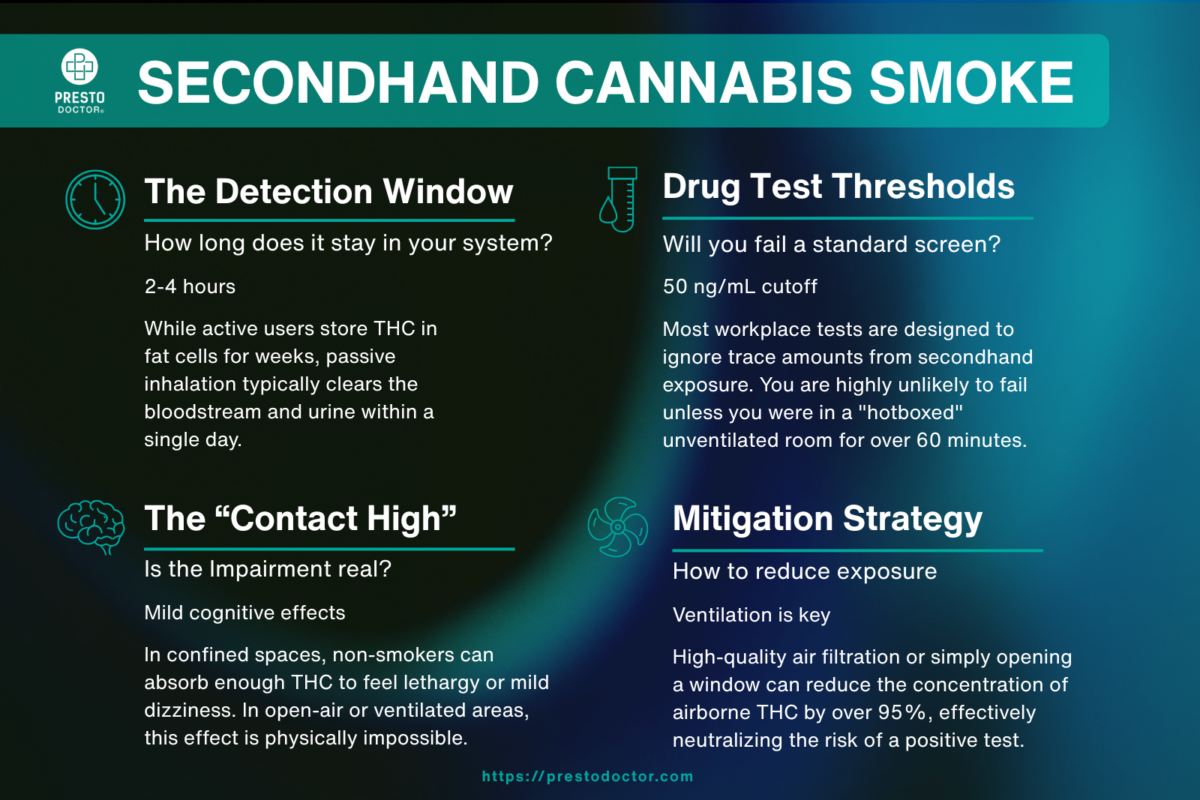
Yes, THC can enter your system through secondhand smoke, but it rarely reaches levels detectable by standard drug tests. While “hotboxing” in an unventilated room can trigger a positive result at sensitive thresholds (20 ng/mL), it is highly unlikely to exceed the standard 50 ng/mL workplace cutoff under normal, ventilated conditions. Detection typically lasts only 2 to 24 hours after extreme exposure.
Will I Fail a Drug Test from Passive Inhalation?
Under standard social conditions—like being at a concert or in a ventilated room—your risk of failing a drug test is near zero.
Most workplace screenings utilize a 50 ng/mL cutoff specifically to account for incidental exposure. Research indicates that only “extreme” conditions—such as being trapped in a small, smoke-filled car for over an hour—can push levels high enough to trigger a positive result.
THC Detection: Standard vs. Sensitive Tests
| Test Type | Threshold (Cutoff) | Risk from Secondhand Smoke |
|---|---|---|
| Standard Urine Screen | 50 ng/mL | Low (Highly unlikely to fail) |
| Sensitive Lab Test | 20 ng/mL | Moderate (Possible in unventilated rooms) |
| GC-MS Confirmation | 15 ng/mL | Low (Used only to confirm active use) |
How Long Does Secondhand Smoke Stay in Your System?
If you are exposed to heavy cannabis smoke, the detection window is significantly shorter than that of an active user.
- Blood: THC is typically detectable for only 1 to 3 hours after exposure.
- Urine: Metabolites generally drop below detectable levels within 24 to 48 hours.
- Extreme Exposure: In rare “hotbox” studies, some participants showed trace amounts up to 34 hours later (Cone et al., Journal of Analytical Toxicology, 2015), but only on ultra-sensitive equipment.
The “Contact High”: Is It Real or Psychological?
While you can absorb enough THC to feel mild effects (a “contact high”) in unventilated spaces, it is physically impossible in open-air environments like parks or stadiums.
Expert Note: If you feel “high” from secondhand smoke outdoors, it is likely a psychological response or a reaction to the other 4,000+ chemicals found in cannabis smoke, rather than THC intoxication.
Health Risks: Is Secondhand Weed Smoke Dangerous?
Beyond the drug test, secondhand marijuana smoke carries verified health risks that mirror tobacco.
- Cardiovascular Strain: Even one minute of exposure can impair blood vessel function for up to 90 minutes (Wang et al., Journal of the American Heart Association, 2016) —longer than the effect of tobacco smoke.
- Toxins: Cannabis smoke contains ammonia, hydrogen cyanide, and fine particulate matter (PM2.5) that can irritate the lungs and trigger asthma.
Secondhand Vape & Dab Smoke: Is It More Dangerous Than Regular Smoke?
Many people assume that vaping or dabbing cannabis is safer for bystanders than smoking a joint. The reality is more complicated — and in some ways, worse.
Unlike combusted smoke, vapor particles are smaller and stay suspended in the air longer, meaning bystanders can inhale a higher concentration of THC without the visible smoke cue that would normally prompt them to move away. A 2020 study published in JAMA Internal Medicine found that secondhand cannabis vapor produced measurable THC absorption in non-smoking participants even in a ventilated room — a condition under which combusted smoke typically poses near-zero risk (Herrmann et al., JAMA Internal Medicine, 2020).
What this means for drug testing:
Secondhand vapor exposure carries a moderately higher passive absorption risk than secondhand smoke, particularly in indoor settings. If someone is vaping or dabbing in a shared indoor space — an Airbnb, a car, or a home office — your exposure is likely greater than you’d expect, even if you can’t smell anything.
Dab smoke (concentrates) present an even more concentrated risk. Because dabs contain THC levels of 60–90% compared to 15–25% in flower, the sidestream vapor from a single dab session can carry significantly more THC than an entire smoked joint. Ventilation remains your best mitigation strategy — the same rule applies: open windows and air filtration reduce airborne THC concentration by over 95%.
Thirdhand Cannabis Smoke: The Hidden Risk Nobody Talks About
Most people think their exposure ends when the smoke clears. It doesn’t.
Thirdhand smoke refers to the THC, nicotine, and chemical residue that settles onto surfaces — furniture, carpets, walls, clothing, and car interiors — long after the smoke or vapor is gone. This residue can be re-inhaled as dust particles, absorbed through skin contact, or ingested by children who touch contaminated surfaces and put their hands in their mouths.
Key facts about thirdhand cannabis exposure:
- THC residue on surfaces has been detected in homes months after smoking stopped, according to research published in Clinical Chemistry.
- Children are disproportionately at risk because they spend more time on floors and are more likely to touch and mouth contaminated objects.
- Standard cleaning — vacuuming, wiping surfaces — reduces but does not eliminate thirdhand residue. HEPA air filtration and deep cleaning with activated charcoal-based products are the most effective remediation strategies.
- For drug testing purposes, thirdhand exposure alone is extremely unlikely to produce a positive result at the standard 50 ng/mL cutoff. The absorption pathway (skin and incidental ingestion) is far less efficient than inhalation.
If you live in a previously smoked-in home or vehicle and are concerned about residual exposure, the practical risk to a drug test is low — but the health risk, particularly for children and people with respiratory conditions, is real and worth addressing.
⚠️ If You Have an Upcoming Drug Test
If you were recently exposed to secondhand cannabis smoke and have a drug test coming up, here’s what you actually need to know — no panic required.
Honestly assess your exposure level first:
| Exposure Type | Setting | Real Risk Level |
|---|---|---|
| Brief outdoor exposure | Concert, park, street | Essentially zero |
| Short indoor exposure | Ventilated room, party | Very low |
| Extended indoor exposure | Poorly ventilated room, 30+ min | Low to moderate |
| Hotbox exposure | Sealed car or room, 60+ min | Moderate — act now |
If your exposure was brief and ventilated: You almost certainly have nothing to worry about. Standard tests are designed specifically to ignore trace passive exposure. Drink water normally, don’t do anything drastic, and move on.
If your exposure was prolonged and unventilated (hotbox conditions):
- Wait at least 48–72 hours before testing if you have any flexibility on timing.
- Stay well hydrated — normal hydration (not extreme flushing, which can flag a diluted sample) supports normal kidney clearance.
- Exercise moderately in the days prior, as THC metabolites are stored in fat cells and light cardio supports metabolism. Stop exercising 24 hours before the test, as intense exercise right before can temporarily spike THC levels in urine.
- Use an at-home test strip (available at any pharmacy) to check your own levels before the official test. These use the same 50 ng/mL immunoassay threshold as standard workplace screens.
What won’t help: Detox drinks, niacin flushing, and bleach myths are not supported by evidence and some can flag your sample as adulterated, which is treated the same as a positive result by most employers.
Bottom line: If your exposure was under normal social conditions, you will pass. If you were hotboxed for an extended period, 48–72 hours of normal hydration and light activity is your most reliable strategy — and an at-home test strip will give you a definitive answer before it matters.
Frequently Asked Questions
How long does secondhand weed smoke stay in your system for a urine test?
For most people, THC metabolites from secondhand smoke will remain in urine for 2 to 24 hours. In extreme hotbox conditions, trace amounts may be detectable for up to 48 hours, but these levels rarely cross the standard 50 ng/mL threshold. If you’re an active user wondering about your own detection window, the calculation is more complex — frequency, body fat, and metabolism all play a role.
Can you get a “contact high” from someone smoking weed near you?
Yes, a contact high is physically possible, but only in “extreme” unventilated environments like a small, sealed room or a car. Research from Johns Hopkins University shows that non-smokers can feel mild psychoactive effects and social impairment (Herrmann et al., Drug and Alcohol Dependence, 2015) under these conditions. In well-ventilated areas or outdoors, a contact high is physically impossible due to rapid smoke dissipation.
Will secondhand smoke show up on a hair follicle test?
It is highly unlikely for secondhand smoke to cause a positive hair follicle test result. While THC smoke can coat the outside of the hair (external contamination), labs use a washing process and specific metabolite testing (THC-COOH) to distinguish between passive exposure and actual ingestion. Most hair tests have a high cutoff specifically to prevent false positives from environmental smoke.
Can a child test positive for THC from secondhand smoke?
Yes, children are more susceptible to passive inhalation due to their smaller lung capacity and faster metabolic rates. Studies have shown that children living in homes where marijuana is smoked regularly can have detectable levels of THC in their urine. This exposure can lead to lethargy, increased heart rate, and developmental concerns, even if the child does not appear “high.”