If you’ve ever walked into a room and completely forgotten why you’re there after a few hits, you’ve experienced “weed brain.” It’s a classic trope, but for the modern consumer, it’s a genuine concern. Does this plant help us relax at the cost of our cognitive history?
The short answer? Yes, cannabis affects your memory—specifically the encoding of new information. However, the 2026 research reveals a “Recovery Framework” that proves most of this impact is reversible, manageable, and in some cases, even preventable.
⚡ TL;DR: The Executive Summary
- The Impact: THC disrupts the Hippocampus, preventing “Short-Term Encoding.”
- The Risk: Heavy use before age 25 can alter brain structure; use after 50 may actually reduce neuroinflammation.
- The “False Memory” Trap: Intoxication increases suggestibility, leading to “remembering” things that never happened.
- The Fix: Use a 1:1 CBD ratio, prioritize Alpha-Pinene terpenes, and utilize the 72-hour THC Reset.
The Biology of Forgetting: THC vs. The Hippocampus
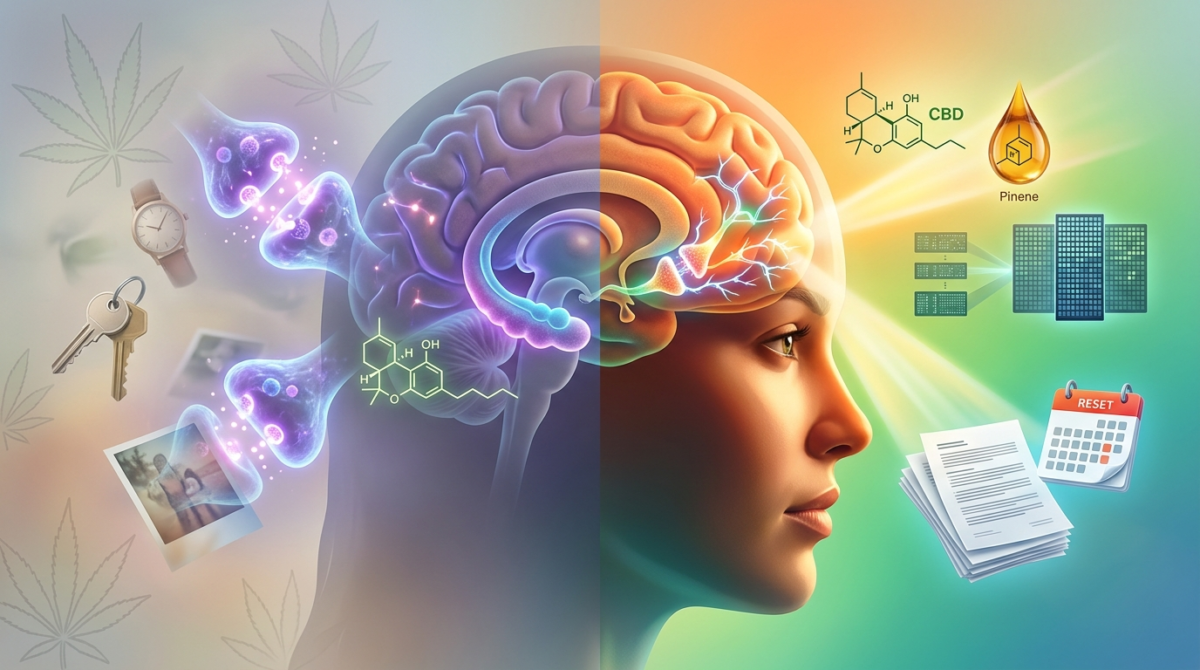
To understand what cannabis does to your memory, we have to look at the Hippocampus—the brain’s librarian. Its job is to take the “loose papers” of your daily experiences and file them into the “filing cabinets” of long-term memory.
The CB1 “Clog”
The hippocampus is saturated with CB1 receptors. When THC enters the system, it binds to these receptors with high affinity. This doesn’t “kill” brain cells; instead, it creates a “signal noise” that prevents Long-Term Potentiation (LTP).
LTP is the process of strengthening synapses based on recent patterns of activity. Think of it as the brain’s way of saying, “This is important; save it.” THC disrupts this “Save” command.
Encoding vs. Retrieval
This is the most misunderstood part of “weed brain.”
- Encoding (The Problem): You struggle to form new memories while high.
- Retrieval (The Safe Zone): Your ability to recall existing memories (your wedding day, your phone number) remains largely intact.
The “False Memory” Phenomenon (New 2026 Data)
As noted in recent reports by National Geographic and researcher Steve Midway, cannabis doesn’t just make you forget; it can make you misremember.
In a double-blind study, participants under the influence of high-THC cannabis were shown a series of images. Later, they were asked if they saw “lure” images (items that were similar but not actually present). The cannabis group was 1.5x more likely to claim they had seen the lure images with “high confidence.”
Why this happens: THC increases what psychologists call “Source Confusion.” Your brain remembers a thought you had about an object, but mistakenly tags that thought as a real-world observation. Cannabis disrupts the ‘Metadata’ of your memories.
The Age Paradox: Why 25 is the Magic Number
The most critical factor in cannabis-related memory loss isn’t how much you smoke, but when you started.
Adolescence (The Construction Zone)
Until age 25, the brain is undergoing “synaptic pruning.” It is essentially “wiring” itself for adulthood. Introducing heavy amounts of THC during this window can lead to a thinner hippocampal cortex.
The Senior Paradox (The Maintenance Phase)
In a shocking 2026 UK Biobank study, researchers found that in adults over 50, low-dose cannabis use was associated with better memory performance than non-users.
- The Theory: As we age, neuroinflammation increases. Low doses of cannabinoids may act as “brain cleaners,” reducing the inflammation that typically clouds senior memory.
The “Sleep Link”: How Cannabis Hijacks the Save Button
Most people use cannabis as a sleep aid, but this is a double-edged sword for memory.
Memory consolidation (moving short-term info to long-term storage) happens during REM (Rapid Eye Movement) sleep. THC is known to suppress REM sleep.
- The Result: Even if you learn something perfectly while sober, if you use high-THC products right before bed, your brain may fail to “upload” those memories to long-term storage overnight.
Memory-Safe Strain Guide
| Strain Name | Ratio | Primary Terpene | Best For |
|---|---|---|---|
| Harlequin | 5:2 (CBD:THC) | Myrcene/Pinene | Functional daytime focus |
| Jack Herer | High THC | Alpha-Pinene | Creative energy without the “fog” |
| Cannatonic | 1:1 | Myrcene | Medical relief with mental clarity |
| Durban Poison | High THC | Terpinolene | High-energy “clear” high |
The “Protection & Recovery” Framework
You don’t have to choose between cannabis and your memory. By using the PrestoDoctor Protection Framework, you can mitigate 90% of the cognitive “fog.”
Protocol A: The CBD Buffer
A 2025 study in Frontiers in Pharmacology found that CBD acts as a “non-competitive antagonist” to THC in the hippocampus.
- The Fix: Use products with at least a 1:1 CBD:THC ratio. CBD physically blocks THC from over-saturating the receptors responsible for memory encoding.
Protocol B: The Alpha-Pinene Strategy
Terpenes aren’t just for smell. Alpha-Pinene (the “forest scent”) is a natural acetylcholinesterase inhibitor. * The Science: It prevents the breakdown of acetylcholine, a neurotransmitter essential for memory and focus.
- The Fix: Seek out strains like Jack Herer, Dutch Treat, or Blue Dream which are naturally high in Pinene.
Protocol C: The 72-Hour Reset
Memory impairment from cannabis is not permanent for the vast majority of adults.
- The Science: CB1 receptors “downregulate” (hide) when flooded with THC. When you stop for 72 hours, they “upregulate” (return to the surface).
- The Fix: Take a 3-day “T-Break” once a month. This “resets the librarian,” allowing your brain to regain its natural encoding speed.
During your 72-hour reset, continue your CBD regimen to maintain neuroprotection while allowing THC receptors to upregulate.
Lessons Learned: A Real-World Experience
Case Study: “Michael,” Software Engineer & PrestoDoctor Patient
Michael struggled with “Function Drift”—forgetting the logic of his code halfway through writing it. He was using 90% THC distillates.
Our Recommendation:
- Shift to Flower: Vapes provide a “spike” of THC that overwhelms the hippocampus.
- The Pinene Pivot: He switched to Jack Herer (High Pinene).
- The “No-Smoke Window”: He stopped consumption 2 hours before bed to allow for REM sleep.
The Result: Within 14 days, Michael reported a “sharpening” of his mental landscape. He didn’t have to quit; he just had to optimize.
FAQs: What People Also Ask
Can cannabis cause permanent memory loss?
For adults over 25, the effects are generally not permanent and resolve within 72 hours to 21 days of abstinence. Heavy use in early adolescence (under 18) carries a higher risk of long-term structural changes.
Does CBD help with memory?
Yes. CBD acts as a neuroprotective “shield.” Studies show that users who include CBD in their regimen have better-preserved hippocampal volume compared to “THC-only” users.
Why do I have “false memories” when high?
THC increases the brain’s “yes bias” and suggestibility. This makes it harder for the brain to distinguish between an internally generated thought and an actual external event.
How long does “weed brain” last after stopping?
Residual “fog” typically clears within 72 hours for occasional users, or up to 21 days for heavy, chronic users as the THC leaves the fat cells.
What are the best “memory-safe” strains?
Look for strains with the terpene Alpha-Pinene (smells like pine/forest) and at least a 1:1 CBD ratio. Strains like Jack Herer or Durban Poison are often cited as more “clear-headed.”
What is the “Memory Terpene”?
Alpha-Pinene. It is found in pine needles and certain cannabis strains. It helps the brain retain acetylcholine, the “memory molecule.”
- If you’re looking to switch to a more balanced regimen, consult with a medical marijuana doctor to find a strain ratio that supports your cognitive health.
- Learn more about how to manage side effects in our guide to cannabis and brain aging.
- View the full National Geographic report on how cannabis affects false recall.
- Read the full study on Cannabis and False Memory Susceptibility here.
Key Terms to Know: A Cannabis & Memory Glossary
To understand how cannabis interacts with your brain, it helps to know the “language of the hippocampus.” Here are the high-level terms mentioned in this guide:
- What is Long-Term Potentiation (LTP)? LTP is the process by which synaptic connections between neurons become stronger with frequent activation. In the world of neuroscience, this is known as the biological basis of learning and memory—essentially the brain’s way of “hard-wiring” new information.
- What is Acetylcholinesterase? This is an enzyme that breaks down acetylcholine, a key neurotransmitter involved in focus and memory. Certain terpenes, like Alpha-Pinene, act as inhibitors to this enzyme, allowing more acetylcholine to remain available in the brain to support cognitive function.
- Hippocampus: A small, curved formation in the brain that plays a critical role in the formation of new memories and spatial navigation. It is the area most densely packed with CB1 receptors.
- CB1 Receptors: Part of the endocannabinoid system, these receptors are located primarily in the central nervous system. THC binds to these receptors to produce the “high,” but in the hippocampus, this binding can temporarily disrupt the memory-filing process.
- Source Confusion: A memory distortion that occurs when someone misattributes where a memory came from (e.g., remembering a fact but forgetting if it happened in real life, in a movie, or in a dream).