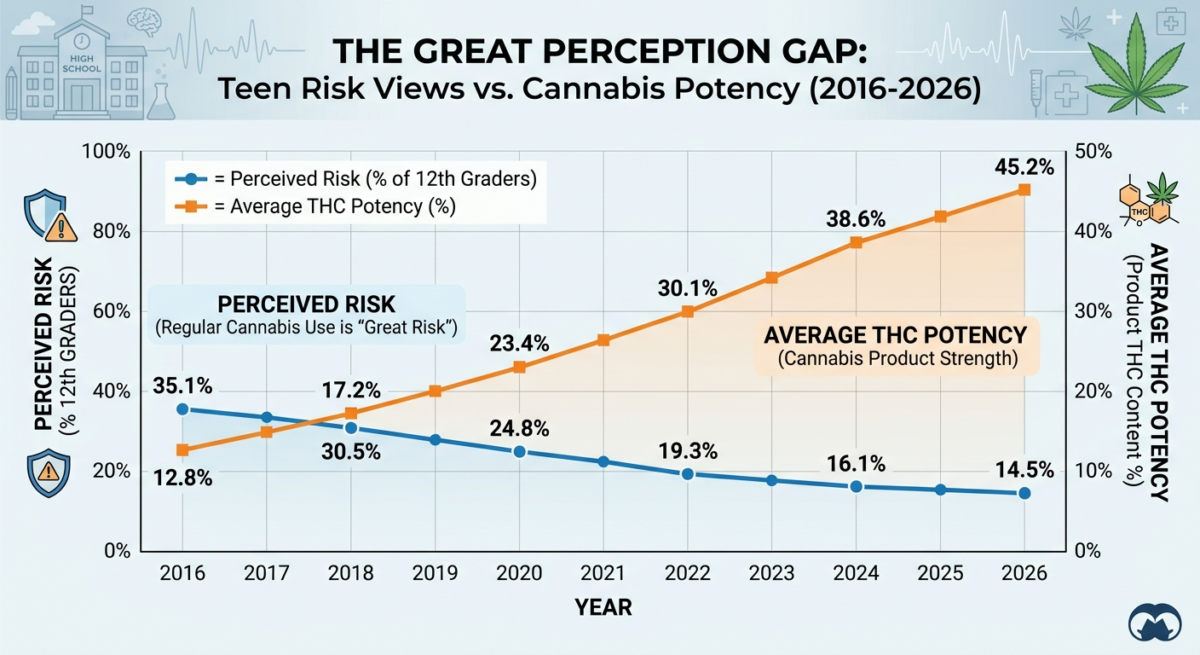
TL;DR: The Perception Gap is the widening divide between adolescents’ belief that cannabis is “low-risk” and new clinical data showing its impact on development. Major research released in April and May 2026 by UC San Diego and Kaiser Permanente confirms that frequent teen use is linked to Cognitive Lag and a 2x higher risk of psychosis. This data marks a shift from 1980s “scare tactics” toward a science-based, pro-brain-health dialogue.
What did the 2026 UCSD study find about teen brain development?
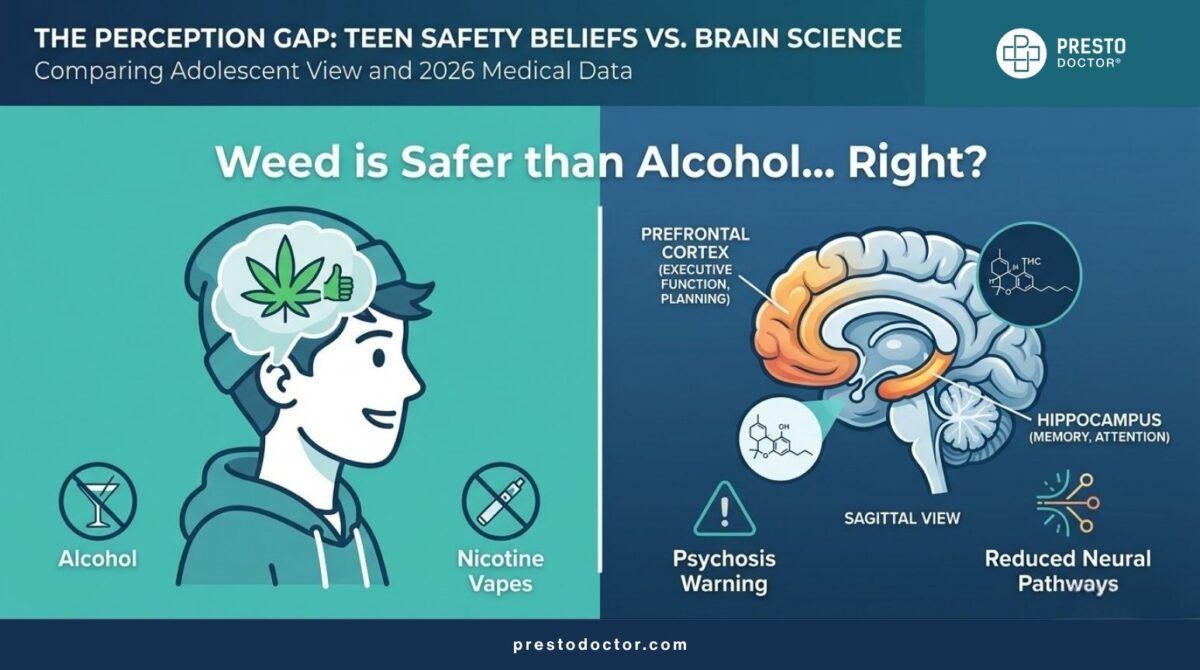
The 2026 UCSD study, published in Neuropsychopharmacology, found that regular cannabis use before age 18 is associated with Cognitive Lag. This phenomenon is a measurable slowing in the development of memory, attention, and thinking speed. Researchers observed that users performed 5% to 10% worse on memory recall tests than non-using peers.
The Science of Cognitive Lag and Neuroplasticity
Lead author Natasha Wade, PhD, analyzed data from the Adolescent Brain Cognitive Development (ABCD) Study, which tracks over 11,000 children. The research highlights that because the adolescent brain is in a state of high Neuroplasticity, THC interference can disrupt the “pruning” process in the prefrontal cortex.
- Restricted Growth: Teens who use cannabis don’t “lose” existing knowledge, but they fail to improve their cognitive skills at the same rate as their peers.
- Memory Deficits: Specific impacts were found in verbal and visual-spatial memory.
- Prefrontal Cortex Impact: THC binds to receptors in brain regions responsible for impulse control and long-term planning.
“Adolescence is a critical time for brain development, and what we’re seeing is that teens who start using cannabis aren’t improving at the same rate as their peers.” — Natasha Wade, PhD, UC San Diego School of Medicine.
Is cannabis use linked to teen psychosis and anxiety?
According to Kaiser Permanente’s May 2026 study of 500,000 California adolescents, those who used cannabis were twice as likely to be diagnosed with a psychotic or bipolar disorder later. The study also noted a 34% increased risk for depression and a 24% increased risk for anxiety disorders among past-year users.
The Mental Health “Trigger” and Timeline
The research, led by Kelly Young-Wolff, PhD, showed that self-reported cannabis use typically occurred 1.7 to 2.3 years before a formal psychiatric diagnosis. This suggests that cannabis may act as a catalyst for underlying mental health vulnerabilities or epigenetic changes.
- Psychosis Risk: Chronic exposure to high-potency THC can overstimulate dopamine pathways, potentially triggering a break with reality in susceptible individuals.
- The Anxiety Paradox: While many teens use cannabis to self-medicate, the data shows that long-term use often worsens mood symptoms and leads to rebound anxiety.
- Bipolar Correlation: Early-onset use is associated with an earlier “first manic episode” in teens with a family history of the disorder.
Why do teens think cannabis is safer than alcohol?
Teens increasingly view cannabis as the “least harmful” substance because of Social Normalization and a lack of immediate “hangover” effects compared to alcohol. A 2026 survey of 175,000 California students by Shu-Hong Zhu, PhD, found that perceived harm of cannabis consistently declines as students get older.
The “Natural” Fallacy and Social Acceptance
In California’s legal landscape, the visibility of dispensaries has “de-medicalized” the drug in the eyes of Gen Z. Many adolescents mistakenly equate “legal for adults” with “safe for developing brains.”
- The Hangover Trap: Teens see the physical sickness caused by alcohol as “harm” but view the lack of a cannabis hangover as “safety.”
- Peer Influence: The study found that having friends who use cannabis is the strongest predictor of a low-risk perception.
- The Vaping Comparison: Curiously, teens now rate nicotine vaping as more harmful than smoking cannabis, likely due to intensive anti-vaping education campaigns.
Comparative Analysis: Teen Perception vs. Medical Reality (2026)
| Feature | Teen Perception (Survey Data) | Medical Reality (2026 Research) |
|---|---|---|
| Brain Impact | Temporary; you “sober up” quickly. | Linked to Cognitive Lag and restricted memory growth. |
| Mental Health | It helps with stress and social anxiety. | Linked to a 2x higher risk of psychosis and bipolar. |
| Safety Ranking | Safer than alcohol, vapes, and cigarettes. | High-potency THC is a potent neuro-disruptor for minors. |
| Addiction | You can’t get addicted to “natural” weed. | 17% (1 in 6) teen users develop Cannabis Use Disorder. |
FAQ: People Also Ask
What is the perception gap in teen cannabis use?
The perception gap is the disconnect between the low level of risk teenagers attribute to cannabis and the significant developmental risks identified by scientists. While California teens increasingly see cannabis as safe, 2026 data shows it may delay cognitive maturity and increase psychiatric risks.
Does teen cannabis use cause permanent brain damage?
New research from UC San Diego suggests the impact is better described as Cognitive Lag. Instead of “destroying” cells, cannabis may slow down the brain’s ability to develop complex memory and attention skills, potentially leading to lower academic achievement and reduced verbal processing speeds.
How does California legalization affect teen drug views in 2026?
Legalization has led to a “normalization” effect. As cannabis becomes more available and socially accepted among adults, teens are less likely to view it as a dangerous substance, even though their developing brains are more vulnerable than adult brains.
Is high-potency THC more dangerous for teens?
Yes. 2026 studies from Kaiser Permanente indicate that the modern market’s high-potency extracts (dabs and vapes) are more strongly associated with first-episode psychosis and emergency room visits than the lower-THC “flower” used in previous decades.
Can cannabis use trigger bipolar disorder in adolescents?
The Kaiser Permanente JAMA Health Forum study found that teens using cannabis are twice as likely to receive a bipolar diagnosis. While it may not “cause” the disorder in everyone, it appears to act as a powerful trigger for those with a genetic predisposition.