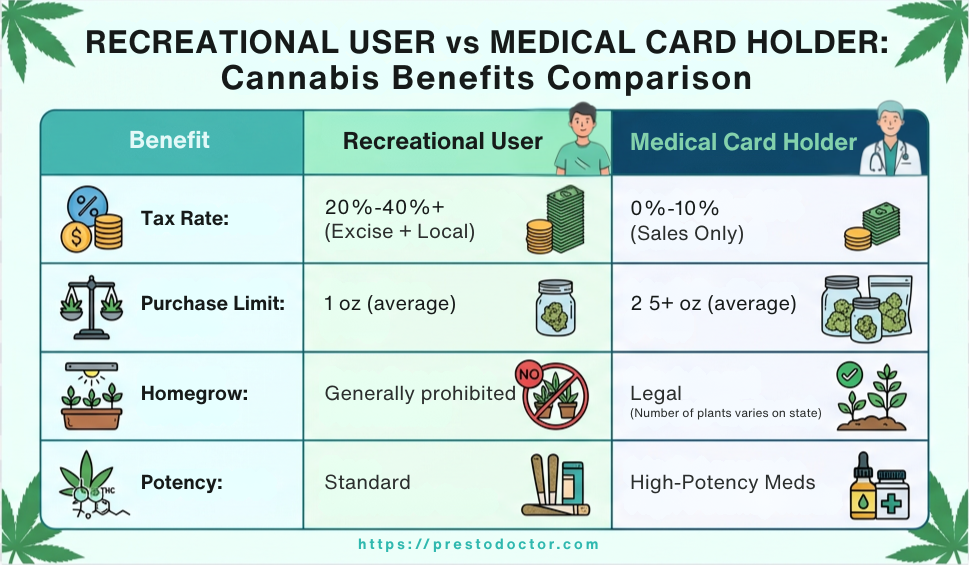
While recreational cannabis is widely available, it carries a hidden “convenience tax” that costs the average user over $1,200 annually. By securing a PrestoDoctor medical card, patients in states like New York, Pennsylvania, and Illinois bypass excise taxes (often up to 25% or more), access 3x higher potency limits, and unlock legal home cultivation rights that are strictly forbidden for recreational users.
For the average consumer spending $200–$400 a month, a medical card isn’t an expense—it’s a high-yield investment. With tax savings reaching up to 35% in some markets, most patients hit their ‘break-even’ point (where the card pays for itself) in just 3 to 4 months.
Break-Even Formula
The Break-Even Formula is calculated as (Cost of Card ÷ Monthly Tax Savings). For most regular users, the card pays for itself in 3–5 months.
The “Hidden” 2026 Tax Burden
In 2026, “legal weed” is often taxed like a luxury good. Recreational excise taxes have climbed as states look to fill budget gaps, while medical marijuana remains protected as an essential medicine.
| State | Recreational Tax Rate | Medical Tax Rate | Estimated Annual Savings |
|---|---|---|---|
| Illinois | 10% – 25% (tiered by THC) | 1% | $1,100+ |
| Michigan | ~16% (Excise + Sales) | 6% | $600 – $1,200+ |
| New York | ~13% + THC Potency Tax | 7% | $450+ |
| Pennsylvania | N/A (Medical Only) | 0% Sales Tax | Priceless (Legal Access) |
Recreational cannabis carries significant excise taxes and local surcharges that do not apply to medical patients. In states like Illinois, medical cardholders save up to 24% per transaction compared to adult-use buyers. These savings typically offset the cost of a PrestoDoctor consultation within the first three dispensary visits.
Potency & Access: Why “Medical Grade” Wins
It’s not just about the price; it’s about the value per milligram.
- Restricted Potency: States like New York have stricter controls on recreational product types. Medical patients frequently have access to a wider variety of high-potency concentrates and specialized delivery methods.
- Edible Limits: While recreational markets often cap edibles at 100mg per package, medical menus in many states include 500mg or 1,000mg options, drastically lowering the “cost per dose” for chronic pain management.
Beyond taxes, look at the ‘Price per Milligram.’ Medical menus often feature higher potency limits and allow for bulk purchasing. When you buy in larger quantities without the strict recreational ‘daily limits,’ your cost-per-dose drops significantly.
The “Home Grow” Loophole
For those truly looking to save, home cultivation is the ultimate wealth hack.
- In states like Illinois, only medical cardholders are legally allowed to grow their own plants (up to 5).
- Growing just two plants at home can produce a year’s supply of medicine, effectively erasing a $3,000+ annual dispensary bill.
One of the most overlooked wealth hacks is the right to cultivate. In states like Illinois, Arizona, and Michigan, medical patients can legally grow their own medicine. By growing just a few plants, you can produce thousands of dollars worth of premium flower for the price of basic gardening supplies.
Legal Insurance
As cannabis moves to Schedule III in 2026, the medical card is your strongest form of legal insurance. It provides a clear, documented medical necessity that offers superior protections for employment and professional licensing compared to recreational use.
Traveling? Take Your Savings With You
One of the most shared tips on forums is reciprocity. If you have a valid medical card from your home state, you can often maintain your tax-exempt status in other “Reciprocity States” like Maine, Michigan, and Nevada.
Medical card reciprocity allows patients to maintain their tax-exempt status and legal protections while traveling to participating states. This ensures patients aren’t forced to pay high “tourist” recreational taxes in markets like Michigan or Nevada. Always verify the current reciprocity laws of your destination before traveling.
FAQ: Is the Card Worth the Fee?
How much does it cost?
A PrestoDoctor consultation typically costs $50–$150, depending on the state.
When is the “Break-Even” point?
If you spend $150/month in a high-tax state like Illinois, you save ~$30 per trip. The card pays for itself in less than 4 months, after which all tax savings are pure profit.
Does Schedule III change this?
While federal reclassification is a win for research, state-level excise taxes on “recreational” use are expected to remain high to fund state programs, making medical cards a permanent financial advantage.
Disclaimer: Tax rates and laws are subject to change. Always verify with your local dispensary or PrestoDoctor’s state-specific guides.