Will the Supreme Court allow marijuana users to own guns?
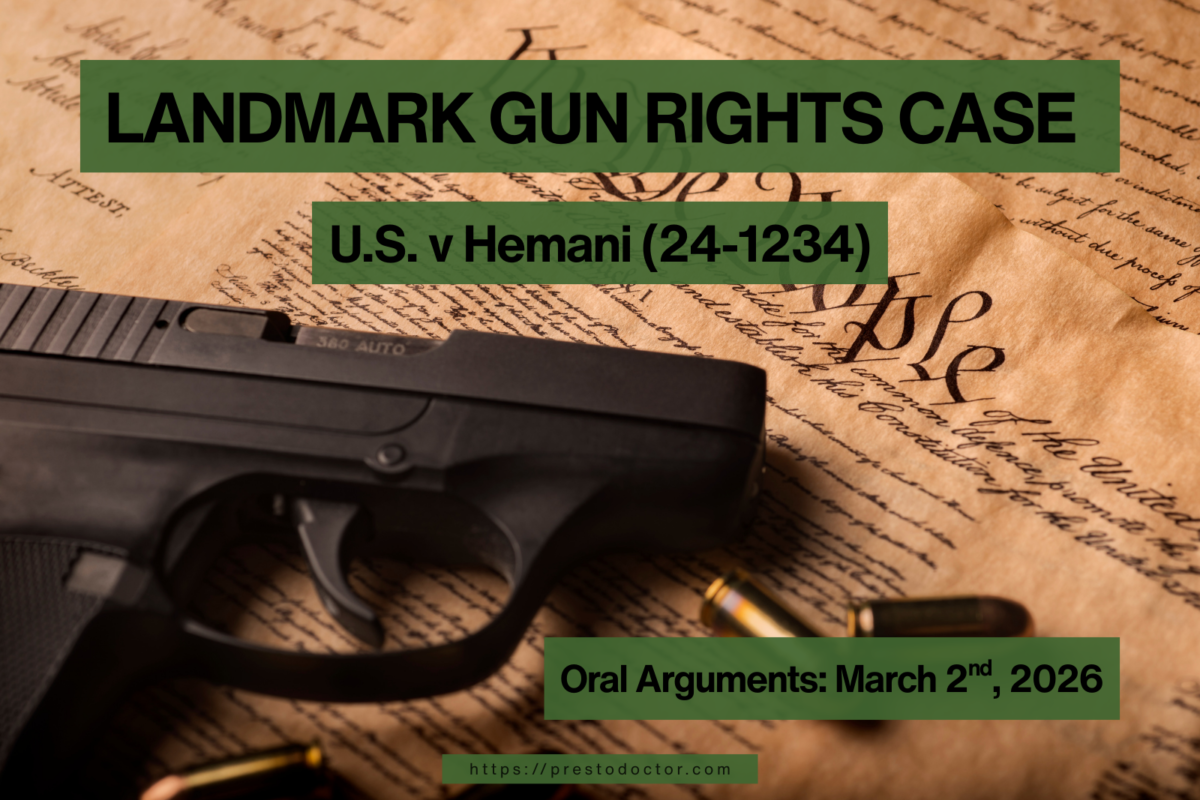
On March 2, 2026, the U.S. Supreme Court will hear oral arguments in United States v. Hemani. The Court will decide if the federal ban on firearm possession by “unlawful users” of controlled substances (18 U.S.C. § 922(g)(3)) violates the Second Amendment. A final ruling is expected by June 2026.
The “Hemani” Conflict
The Issue: Whether the Fifth Circuit’s ruling—which found disarming non-violent marijuana users unconstitutional—should apply nationwide.
The Impact: A victory for Ali Danial Hemani would invalidate the “unlawful user” status for cannabis consumers, ending federal firearm prohibitions for medical and recreational users in legal states.
2026 Legal Fast Facts: U.S. v. Hemani
- The Law Under Fire: 18 U.S.C. § 922(g)(3), the same statute used in the Hunter Biden firearm conviction.
- The “Circuit Split”: The Supreme Court intervened because the Fifth Circuit ruled the ban unconstitutional, while the Seventh and Third Circuits have historically upheld it.
- The “Vagueness” Challenge: Hemani’s team, supported by the ACLU, argues the term “unlawful user” is unconstitutionally vague—it fails to define if “use” means once a day, once a month, or once a year.
Why “United States v. Hemani” is the Landmark Case
The case began when Ali Danial Hemani was charged in Texas after federal agents found 60 grams of marijuana and a firearm in his home. Hemani was not involved in violent crime or trafficking; his only “offense” was being a marijuana user in possession of a gun.
Under the NYSRPA v. Bruen standard, the government must prove that disarming drug users is consistent with the “historical tradition of firearm regulation.”
Because Hemani was charged within the Fifth Circuit, the court’s ruling that the ban was unconstitutional created an immediate ‘Circuit Split’ with other regions like the Seventh Circuit, forcing the Supreme Court to intervene and establish a single national standard.
The “Unconstitutional Vagueness” Challenge
Beyond the Second Amendment, Hemani’s legal team, supported by the ACLU, argues that 18 U.S.C. § 922(g)(3) is void for vagueness. The statute fails to define what constitutes an “unlawful user.” Does a single use of cannabis six months ago trigger a lifetime ban, or does it require active addiction? This lack of clarity leaves millions of citizens in a “legal gray zone” where they cannot know if they are committing a felony by simply possessing a home-defense firearm.
The Hunter Biden & Rahimi Connection: Why 2026 is Different
This case sits at the intersection of two major legal precedents:
- The Bruen Standard (2022): Any gun law must match “historical traditions” from 1791. Hemani’s team argues that early American law only disarmed those activelyintoxicated, not private users.
- The Rahimi Precedent (2024): The Court recently held that the government can disarm “dangerous” individuals. The DOJ now argues that marijuana users are inherently “dangerous”—a claim fiercely contested by the Duke Center for Firearms Law.
- High-Profile Stakes: This is the same statute involved in the Hunter Biden conviction, ensuring that the SCOTUS ruling will be the most talked-about legal event of the summer.
The “Circuit Split” Force Multiplier
The Supreme Court granted certiorari (agreed to hear the case) because of a massive “Circuit Split.” While the Fifth Circuit Court of Appeals ruled in favor of Hemani, the Seventh Circuit and Third Circuit have historically upheld the ban. SCOTUS must now resolve these conflicting rules to create a single national standard for cannabis and gun ownership.
The “Rahimi” Factor: Are Cannabis Users “Dangerous”?
In the 2024 ruling United States v. Rahimi, the Court held the government can disarm individuals found to be “dangerous,” such as those under domestic violence orders. The central fight in Hemani is whether a non-violent medical or recreational marijuana user fits the legal definition of “dangerous.”
Marijuana & Gun Rights: State-by-State Conflict (2026)
| State | Marijuana Status | Current Firearm Status |
|---|---|---|
| Florida | Medical Legal | Prohibited (Federal). Medical cards are seen as evidence of “unlawful use.” |
| Texas | Illegal | Felony. Basis of the Hemani case. |
| Pennsylvania | Medical Legal | Prohibited. State Police consider MMJ cards prima facie evidence. |
| California | Fully Legal | Prohibited (Federal). Legal under state law, but a felony under 922(g)(3). |
Does Marijuana Rescheduling to Schedule III Fix Gun Rights?
As of February 25, 2026, the DOJ has informed the Supreme Court that even if the DEAfinalizes the move of cannabis to Schedule III, the federal firearm ban for “unlawful users” must be upheld. Because Schedule III substances remain “controlled substances” under the Controlled Substances Act, the 18 U.S.C. § 922(g)(3) prohibition stays active for all marijuana users.
The Bottom Line: Federal rescheduling changes the medical classification of cannabis, but it does not automatically restore Second Amendment rights. The United States v. Hemani ruling is currently the only legal mechanism that can decouple “controlled substance status” from “firearm disqualification” nationwide.
The ATF Form 4473 “Perjury Trap”
Even in legal states, the ATF Form 4473 specifically asks if you are a user of marijuana. Checking “No” is a federal felony (perjury), regardless of whether the Supreme Court eventually rules in favor of gun rights. Users are advised to monitor the Supreme Court Docket before making new purchases.
The Core Conflict: 18 U.S.C. § 922(g)(3) vs. The Second Amendment
For decades, Section 922(g)(3) has been the primary tool for disarming drug users. However, since the landmark NYSRPA v. Bruen (2022) decision, all firearm restrictions must be consistent with the “historical tradition of firearm regulation”.
DOJ Arguments vs. Constitutional Rebuttals
| The Government’s Stance (DOJ) | The Constitutional Challenge (Hemani) |
|---|---|
| Historical Analogue: “Habitual Drunkards” | Rebuttal: “Public vs. Private” |
| The DOJ compares marijuana users to 19th-century laws disarming “habitual drunkards” to prove a historical tradition of disarming intoxicated people. | Hemani’s team argues early laws only disarmed people while actively intoxicated in public, not for private use or “status” as a user. |
| Public Safety & “Dangerousness” | Rebuttal: No “Credible Threat” |
| Claims drug use is linked to unpredictable behavior, citing United States v. Rahimi to argue users are “dangerous.” | Rebuttal: No evidence suggests non-violent cannabis users pose a “credible threat” to safety similar to violent domestic abusers. |
| The Vagueness Argument | Rebuttal: Lack of “Fair Notice” |
| Argues the term “unlawful user” in 18 U.S.C. § 922(g)(3) is clear enough for federal enforcement. | Rebuttal: The law is unconstitutionally vague; it doesn’t define if “use” means once a day, once a month, or once a year. |
Key Takeaway: The Unlikely Alliance for Gun Rights
A rare bipartisan coalition has formed to challenge the federal cannabis gun ban. In early 2026, the following major organizations filed Amicus Briefs urging the Supreme Court to strike down the prohibition:
- The NRA: Argues that the government lacks a “historical tradition” of disarming non-violent citizens for private substance use.
- The ACLU: Contends that the “unlawful user” status is unconstitutionally vague and violates due process.
- State Sovereignty: Over 20 states argue the ATF is overreaching into state-level police powers.
- Advocacy Groups: NORML and the Gun Owners of America (GOA)have joined forces to protect the rights of state-legal medical patients.
The “Medical Card” Dilemma: Will Patients Regain Their Rights?
The ATF currently considers an MMJ card “prima facie” evidence of being an unlawful user. In states like
Florida and Pennsylvania, patients are often forced to choose between their medicine and their self-defense. A victory for Hemani would likely prevent the government from using a medical card as the sole basis for stripping a citizen of their Second Amendment rights.
While the Supreme Court deliberates, thousands of patients are still successfully renewing their medical marijuana cards online to maintain state-level legal protection. PrestoDoctor provides the most secure and HIPAA-compliant way to ensure your medical status is valid during this legal transition.
Future Outlook: Rescheduling and the June 2026 Ruling
While the government has moved to reschedule marijuana to Schedule III, this does not automatically fix the gun rights issue. Schedule III substances are still “controlled.” Unless the Supreme Court strikes down the “unlawful user” clause, the federal firearm ban remains a threat to millions.
Who is Supporting Hemani at the Supreme Court?
A diverse coalition has filed amicus briefs in support of Hemani, including the Gun Owners of America (GOA) and several civil rights groups. They argue that the federal government’s “status-based” ban creates a second-class citizenship for millions of law-abiding state-legal patients. Follow the full list of filings on the Supreme Court’s Official Case Page.
Expert Analysis: What a “Win” Looks Like
If the Court rules for Hemani, they will likely distinguish between “active intoxication” and “status-based” disarmament. This would prevent the government from using a Medical Marijuana Card as the sole evidence to deny a firearm purchase.
How to Protect Yourself Until the 2026 Ruling
- Avoid “Simultaneous Possession”: Do not keep marijuana and firearms in the same accessible space.
- Honesty on Form 4473: Be aware that lying on federal forms is a felony.
- Monitor the Docket: Follow the Duke Center for Firearms Law for deep-dive analysis as the March 2 oral arguments approach.
Frequently Asked Questions: U.S. v. Hemani & Gun Rights
Can I own a gun if I have a medical marijuana card?
Under current federal law (18 U.S.C. § 922(g)(3)), no. However, the June 2026 Supreme Court ruling in U.S. v. Hemani is expected to decide if this ban is unconstitutional.
What happened in the Hunter Biden case regarding this law?
Hunter Biden was convicted under § 922(g)(3) for possessing a firearm while addicted to drugs. His lawyers have vowed to appeal his conviction on Second Amendment grounds.
When is the Supreme Court marijuana gun ruling?
Oral arguments are set for March 2, 2026. The final decision is expected by late June 2026.
Does rescheduling marijuana to Schedule III fix gun rights?
No. Even if marijuana is moved to Schedule III by the DEA, it remains a “controlled substance.” The “unlawful user” ban on firearms will remain until SCOTUS strikes it down or Congress amends the law.
Is the ‘unlawful user’ law too vague?
Yes, according to Hemani’s legal team. They argue that 18 U.S.C. § 922(g)(3) violates the Fifth Amendment’s Due Process Clause because it fails to give “fair notice” of what behavior is actually prohibited. For example, it is unclear if using marijuana once a month or once a year makes someone a “prohibited person”
Glossary of Key Legal Terms
- 18 U.S.C. § 922(g)(3): This is the federal statute that prohibits any “unlawful user” of a controlled substance from shipping, transporting, receiving, or possessing firearms or ammunition.
- The “Bruen” Standard: Established in NYSRPA v. Bruen (2022), this rule requires the government to prove that any firearm regulation is consistent with the United States’ “historical tradition of firearm regulation.”
- Circuit Split: This is a situation where different U.S. appellate courts (such as the Fifth Circuit and the Seventh Circuit) issue conflicting rulings on the same legal issue, necessitating a Supreme Court intervention.
- Certiorari: Often shortened to “cert,” this is the formal process and writ by which the Supreme Court agrees to review a lower court’s decision.
- Prima Facie: This legal term means “at first sight.” In this context, the ATF often views a medical marijuana card as prima facie evidence that an individual is an “unlawful user.”
How to Follow U.S. v. Hemani Live (March 2, 2026)
Here is how to stay informed as the constitutional landscape shifts in real-time:
Official Records: Monitor the Supreme Court Docket (No. 25-XXX) for the release of the final written opinion, expected by late June 2026.
Listen Live: Access the Supreme Court’s Official Live Audio Feed starting at 10:00 AM ET on March 2, 2026.
Expert Analysis: For a deep-dive technical breakdown of the oral arguments, follow the Duke Center for Firearms Law for real-time scholarship.
Entities & References in this Analysis:
- Primary Case: United States v. Ali Danial Hemani
- Statute: 18 U.S.C. § 922(g)(3)
- Precedents: NYSRPA v. Bruen, United States v. Rahimi
- Key Agencies: Department of Justice (DOJ), ATF, DEA