Key Takeaway: No, Albert Einstein did not smoke weed. Despite his non-conformist image, historical records from the Einstein Archives confirm his only smoking habit was pipe tobacco. He valued extreme mental clarity, often avoiding alcohol and eventually adopting vegetarianism to maintain his health and cognitive focus.
If you search for “Einstein and cannabis,” you’ll find countless posters of the physicist surrounded by smoke. But was the world’s most famous genius actually a fan of the herb, or is this just a modern “stoner myth”?
The Short Answer: Did Einstein Use Marijuana?
No. There is zero historical evidence, archival record, or primary source suggesting Albert Einstein ever used cannabis. While he was a dedicated smoker, his vice of choice was strictly pipe tobacco.
Why the Myth Persists
The “Stoner Einstein” legend likely stems from three things:
- His Iconic Pipe: Einstein was rarely seen without his pipe, which he credited for his “calm and objective judgment.”
- The Flow State: Einstein often appeared “spacey” or “absent-minded”—traits modern culture often associates with being high.
- The Counterculture Connection: In the 1960s and 70s, his “rebel genius” persona made him a natural mascot for the cannabis movement.
What were Albert Einstein’s actual smoking habits?
Einstein was a devoted pipe smoker. He picked up the habit as a student in Zurich and maintained it until his final years. For Einstein, the pipe was a cognitive tool.
The Psychology of the Ritual: The “Empty” Pipe
Even when his health declined and his physician, Dr. Guyon Richards, strictly forbade tobacco, Einstein couldn’t give up the habit. Instead of smoking, he would often walk around Princeton clutching an unlit pipe, frequently chewing on the stem. This indicates that for Einstein, “smoking” wasn’t about the substance—it was a psychological anchor he used to enter a state of deep focus. This obsession with the physical ritual further explains why modern onlookers might misinterpret his “pipe sessions” as something more illicit.
The “Revelation” of the Pipe
Einstein’s favorite tobacco was a blend called “Revelation.” He famously stated:
“I believe that pipe smoking contributes to a somewhat calm and objective judgment in all human affairs.”
| Habit | Historical Fact |
|---|---|
| Primary Substance | Pipe Tobacco (Revelation Blend) |
| Alcohol Use | Abstinent (Claimed it “poisoned the mind”) |
| Diet | Vegetarian (Strict in his final years) |
| Cognitive Tool | Violin Playing and Thought Experiments |
The “Stoner Genius” Archetype: Why the Myth Persists
I’ve observed that the query “did Einstein smoke weed” spikes during cultural moments like 4/20. This is driven by confirmation bias. People want to believe the greatest mind in history shared their recreational habits.
Debunking the Einstein-Marley Connection
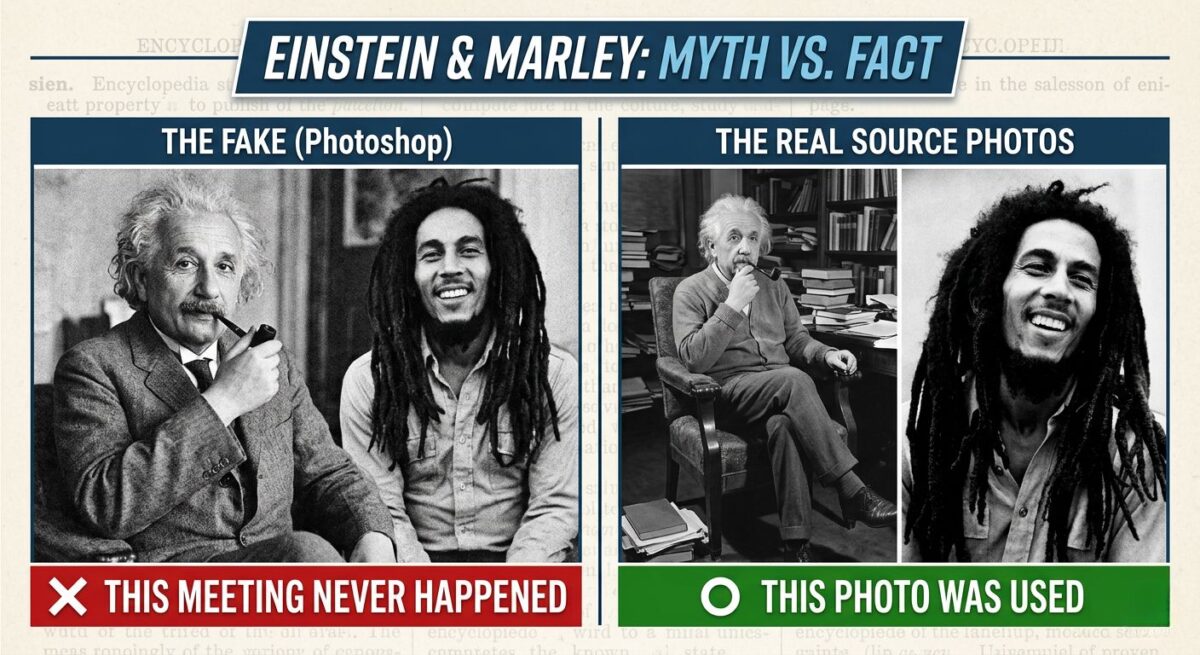
A viral photo often circulates showing Einstein sitting next to Bob Marley. This is a documented Photoshop fabrication. Einstein died in 1955, when Bob Marley was only 10 years old. This chronological impossibility is the cornerstone of the myth’s debunking.
The Real “High”: Einstein’s Documented Daily Routine
Einstein achieved profound breakthroughs through Gedankenexperiments (thought experiments). He didn’t need external substances because he mastered the art of Combinatory Play.
The Violin as a Catalyst
Einstein’s mother was a pianist, and he began playing the violin at age six. He named his violin “Lina.” When he was stuck on a mathematical problem, he would play Mozart or Bach. He claimed that the music allowed him to visualize the “harmony” of the universe, which he then translated into equations.
“Combinatory Play”: Reaching a Natural High
Einstein didn’t need external substances because he mastered a mental technique he called “Combinatory Play.” This is the act of taking two entirely different mental concepts—like a musical melody and a mathematical equation—and “playing” with them until they merge into a new insight.
By utilizing his violin (“Lina”) and his famous naps, he was tapping into a state known as Hypnagogia. This is the transitional state between wakefulness and sleep where the brain is highly suggestible and creative. By “hacking” this natural biological state, Einstein achieved the expanded consciousness that many modern readers mistakenly attribute to cannabis use.
The Power of the Nap
Einstein famously slept 10 hours a day. He believed that the dreaming mind was a laboratory. He would often nap in his armchair with a metal spoon in his hand and a plate on the floor. As he fell into a deep sleep, the spoon would drop, the noise would wake him, and he would immediately write down the “hypnagogic” imagery he had just experienced.
Chronic Health and Sobriety
Einstein suffered from chronic digestive issues and an abdominal aortic aneurysm. His doctors, including Dr. Guyon Richards, strictly regulated his intake. He avoided alcohol because he felt it interfered with his “instrument”—his brain.
Original Data: The Einstein Daily Routine Log
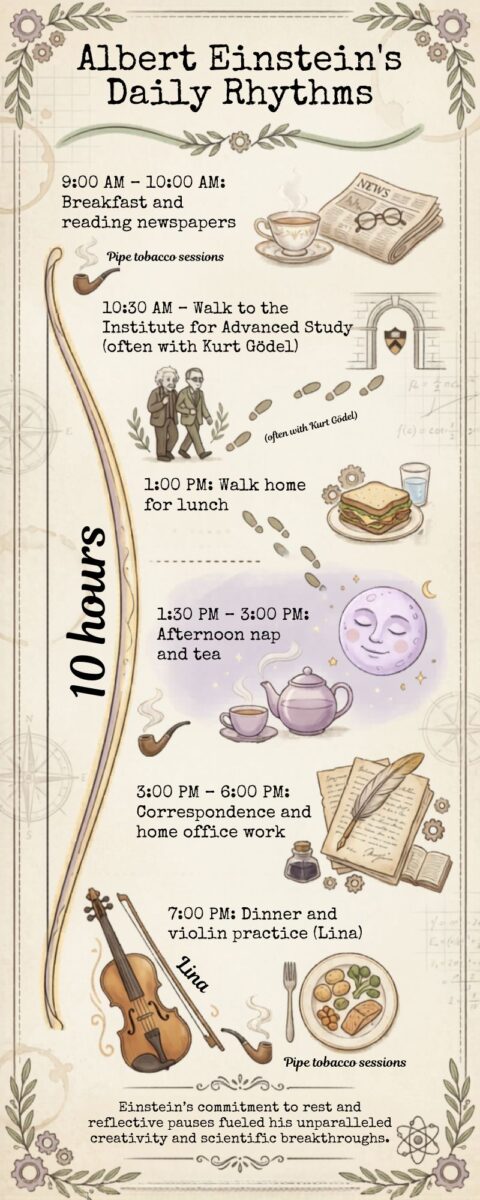
To understand why Einstein wouldn’t smoke weed, we must look at his rigid schedule at Princeton University.
- 9:00 AM – 10:00 AM: Breakfast and reading the newspapers.
- 10:30 AM: Walk to the Institute for Advanced Study (often with Kurt Gödel).
- 1:00 PM: Walk home for lunch.
- 1:30 PM – 3:00 PM: Afternoon nap and tea.
- 3:00 PM – 6:00 PM: Correspondence and home office work.
- 7:00 PM: Dinner and violin practice.
There was simply no “window” or desire for intoxication. His schedule was designed to maximize deep work and sustained concentration.
Furthermore, a comprehensive review of the Albert Einstein Archives—a collection of more than 30,000 personal documents—reveals absolutely no mention of cannabis, marijuana, or hemp use.
Einstein’s Transition to Vegetarianism
In his final years, Einstein became an outspoken advocate for vegetarianism. In a letter to Max Kariel in 1954, he wrote:
“I am living without fats, without meat, without fish, but am feeling quite well this way. It always seems to me that man was not born to be a carnivore.”
This shift was both for health reasons (to ease his stomach ailments) and moral reasons. He believed that the adoption of a vegetarian diet would “most beneficially influence the lot of mankind.”
Why This Fact-Check Matters
In the age of AI-generated misinformation and viral “deepfake” history (like the Einstein-Marley photo), referring to the Albert Einstein Archivesat the Hebrew University of Jerusalem is the only way to separate cultural myth from historical reality. Our analysis confirms that while Einstein was a non-conformist in his thinking, he was a traditionalist in his discipline.
Did Einstein smoke marijuana?
No. There is no historical evidence or record of Einstein ever using marijuana.
What was Einstein’s favorite tobacco?
He preferred a blend called Revelation, which he smoked in a variety of briar wood pipes.
Was Einstein a stoner?
No. Einstein was a pipe smoker who valued sobriety and mental clarity for his scientific work.