Can an RN, LPN, LVN, or other healthcare worker have a medical marijuana card without losing their nursing license? Generally, being a nurse does not by itself prevent someone from participating in a state medical marijuana program. However, getting a medical marijuana card, keeping a nursing license, and keeping a healthcare job are three separate legal questions. Your state’s medical cannabis law, Board of Nursing rules, employer drug-testing policy, and any applicable federal requirements can all affect the answer.
Medical cannabis laws and employment protections vary significantly from state to state. Some states protect registered medical cannabis patients from certain employment discrimination, while others give employers much greater discretion. Even where protections exist, they generally do not create a right to use cannabis at work or practice while impaired.
Important: This article provides general information, not legal, employment, or professional licensing advice. Cannabis laws, nursing regulations, and workplace policies can change. Nurses should verify the current rules in the state where they are licensed and employed.
Quick answer
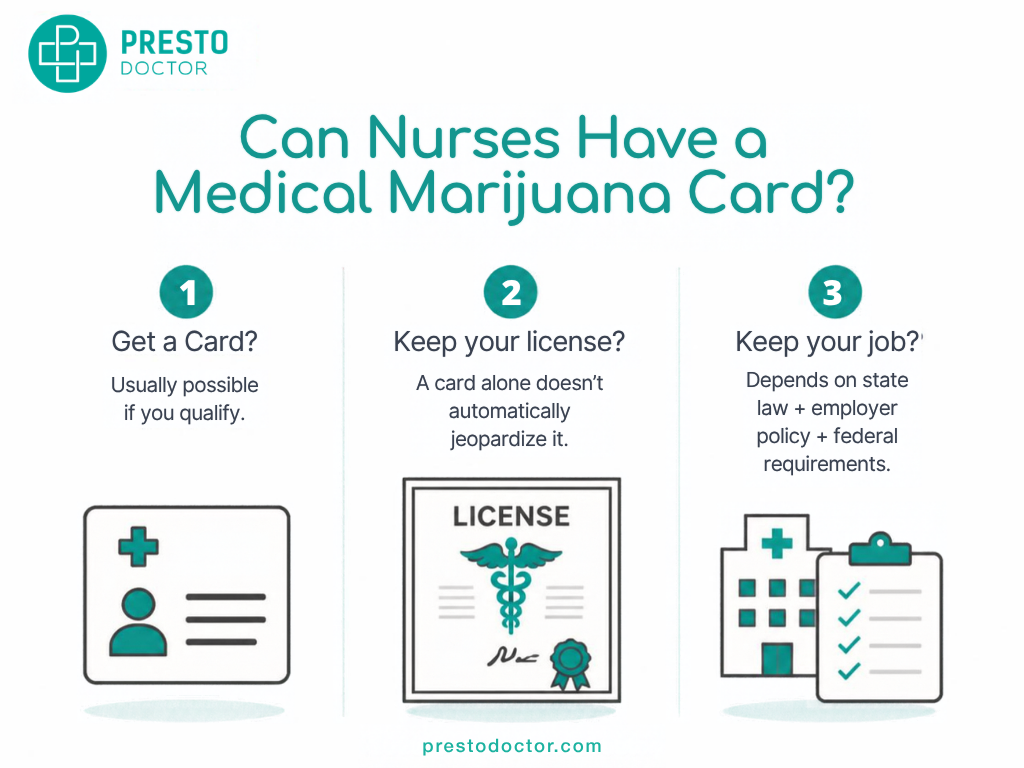
Yes. Nurses can generally participate in a state medical marijuana program if they meet that state’s eligibility requirements. However, a medical marijuana card does not automatically protect a nurse’s job, exempt them from workplace drug testing, or prevent a nursing-board investigation. State law, employer policy, professional licensing rules, and applicable federal requirements all matter.
Can I get a card?
Usually, yes, if you qualify under your state’s medical cannabis program.
Can I keep my nursing license?
Possibly yes, but cannabis use, impairment, professional conduct and nursing-board rules are separate issues.
Can I keep my job?
It depends. State employment protections and employer drug-testing policies vary substantially.
Can a nurse get a medical marijuana card?
Yes, a nurse can generally apply for a state medical marijuana program if they independently meet that state’s patient eligibility requirements.
Being an RN, LPN, LVN, APRN, nurse practitioner, or other healthcare professional is not generally a disqualifying condition by itself. The important question is whether the nurse qualifies as a patient under the medical cannabis laws of the state where they live or are registered.
Each state establishes its own rules for qualifying conditions, patient registration, physician certification or authorization, possession limits, and other program requirements. Terminology also varies. A state may use terms such as medical marijuana card, medical cannabis card, patient registration, certification, recommendation, or authorization.
NCSBN has recognized that cannabis laws differ by jurisdiction and has published national nursing guidance addressing the clinical and regulatory implications of cannabis.
Can an RN have a medical marijuana card?
Generally, yes. An RN may be able to participate in a state medical cannabis program if the RN meets that state’s patient requirements.
Having a medical cannabis authorization is different from practicing nursing while impaired. A nurse remains responsible for meeting the professional standards and requirements imposed by the state’s Nurse Practice Act, Board of Nursing, and workplace.
NCSBN’s national nursing guidance specifically recognizes the regulatory implications of cannabis use by licensees and provides guidance intended to help nursing regulatory bodies assess complaints involving cannabis.
Can an LPN or LVN have a medical marijuana card?
Generally, yes. An LPN or LVN is not automatically prohibited from obtaining a medical cannabis authorization solely because of their nursing license.
As with an RN, however, obtaining a medical cannabis authorization does not determine whether an employer can require drug testing, whether a workplace permits cannabis use, or what a state nursing board may consider if there is an allegation of impairment or unsafe practice.
Can a nurse lose their nursing license for having a medical marijuana card?
Simply being a registered medical cannabis patient is not the same as practicing while impaired, and the consequences depend on the law and circumstances in the state where the nurse is licensed.
Nursing boards are concerned with safe and competent nursing practice, professional conduct, and compliance with the state’s nursing laws and regulations. NCSBN published guidelines for nursing regulators addressing complaints involving cannabis, including cases in which a licensee tests positive for THC or its metabolite. The guidance was published in 2018, so nurses should also consult the current laws and regulations in the state where they are licensed.
Potential issues can arise when cannabis is connected to allegations such as:
- impairment while providing patient care;
- unsafe or negligent practice;
- conduct that violates the state’s Nurse Practice Act or professional regulations;
- workplace drug-testing results that become relevant to a disciplinary or licensing matter; or
- other conduct that causes a complaint or investigation.
A positive THC test and proof of workplace impairment are not necessarily the same thing. The significance of a drug test depends on the state’s law, the employer’s policy, the type and timing of the test, and the circumstances surrounding the result.
NCSBN’s medical marijuana guidelines emphasize that nursing practice must continue to protect patient safety and that nurses should understand jurisdiction-specific requirements concerning cannabis.
Can a nurse fail a drug test with a medical marijuana card?
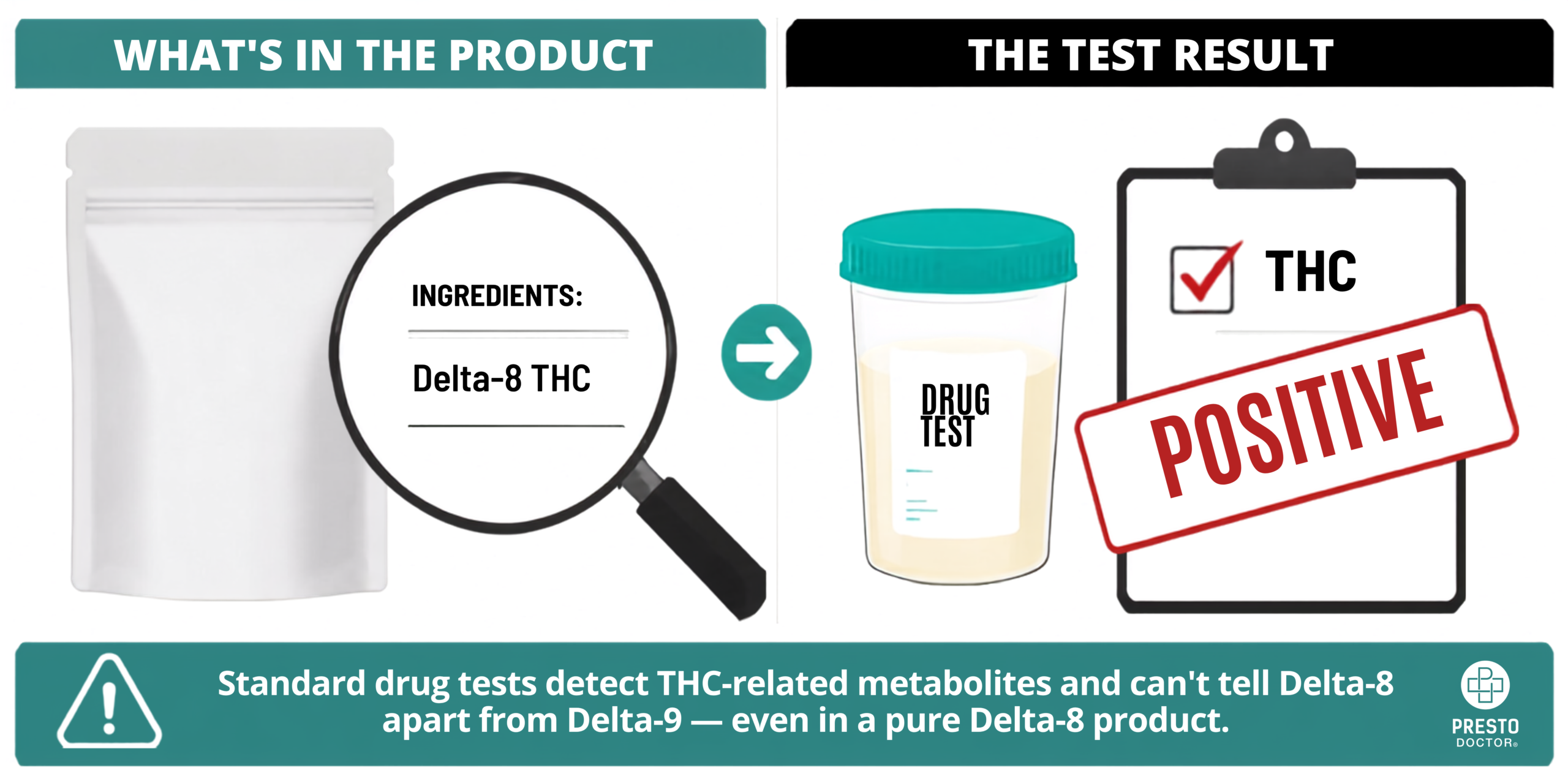
Yes. A medical marijuana card does not automatically prevent an employer’s drug test from detecting THC or its metabolites.
Whether an employer may take action after a positive result depends heavily on state employment law and the employer’s policies. Some states provide statutory protections for registered medical cannabis patients, while others provide fewer or no broad protections. NCSL reports that many states have some form of medical-cannabis employment protection, but the scope of those protections differs substantially.
A particularly important distinction is that a drug test may detect cannabis exposure without establishing when cannabis was used or whether a person was impaired at the time of testing. Employment and licensing consequences therefore cannot be assumed from the test result alone.
Does a medical marijuana card protect a nurse from workplace drug testing?
Not necessarily. A medical marijuana card does not create a nationwide exemption from employer drug-testing policies.
Some states restrict an employer’s ability to discriminate against a registered medical cannabis patient solely because of their patient status or a particular type of positive test. Other states allow employers considerably more discretion.
Federal requirements, safety-sensitive duties, contracts, licensing requirements, and the employer’s own lawful policies can also affect what protections are available. NCSL’s state-by-state research shows that employment protections for medical cannabis patients vary widely.
That means a nurse should not assume that obtaining a medical marijuana card will make a workplace drug test irrelevant.
Can a hospital fire a nurse for having a medical marijuana card?
It depends on the state, the employer’s policy, the reason for the employment decision, and any applicable federal requirements.
Some states prohibit employers from discriminating against registered medical cannabis patients solely because of their patient status. Other states provide much less protection.
For example, Pennsylvania law provides that an employer generally may not discharge, threaten, refuse to hire, or otherwise discriminate or retaliate against an employee solely because the employee is certified to use medical marijuana. The same statute does not require an employer to permit cannabis use on the workplace premises and preserves the employer’s ability to discipline an employee for being under the influence at work when the employee’s conduct falls below the normally accepted standard of care for that position.
California provides another example of how protections can work differently. California Government Code §12954 generally prohibits employment discrimination based on off-the-job cannabis use and certain tests that detect nonpsychoactive cannabis metabolites, subject to important exceptions. The law does not permit employees to possess, use, or be impaired by cannabis on the job, and it preserves certain state and federal testing requirements.
These examples demonstrate why there is no single nationwide answer for nurses.
Can nurses use medical marijuana off duty?
Off-duty cannabis use is treated differently from cannabis use or impairment at work, but the exact protection depends on state law and the employer.
Some states expressly protect off-duty medical cannabis use or registered patient status. Others allow employers to impose broader restrictions.
California, for example, generally protects lawful off-the-job cannabis use and certain testing results, while expressly preserving the employer’s ability to prohibit cannabis possession, use, or impairment at work and recognizing exceptions for certain federally required testing or other legal obligations.
A nurse should therefore look beyond whether medical marijuana is legal in the state and determine what the state’s employment law actually says.
What do Boards of Nursing consider when cannabis is involved?
A Board of Nursing is concerned primarily with the nurse’s compliance with professional standards, safe practice, and applicable nursing law—not simply the existence of a medical cannabis authorization.
NCSBN’s National Nursing Guidelines for Medical Marijuana address the regulatory implications of cannabis and provide guidance for nursing regulatory bodies evaluating complaints involving licensees and cannabis.
Depending on the state and circumstances, a nursing-board matter could involve allegations of impairment, unsafe practice, professional misconduct, or other conduct governed by the state’s nursing laws.
Because nursing regulation is state-specific, nurses should check directly with the Board of Nursing in the state where they hold their license rather than relying on a nationwide assumption.
Is a positive THC test the same as being impaired?
No. A positive cannabis test does not automatically establish that a person was impaired at the time of testing.
Different testing methods can detect cannabis or its metabolites for different periods of time. A positive result therefore needs to be interpreted in the context of the test method, workplace policy, timing, and applicable law.
This distinction is especially important for nurses because an employer, licensing board, or other authority may be evaluating different questions:
Did the person use cannabis?
Did the person violate an employer policy?
Was the person impaired while working?
Did the conduct affect patient safety or professional performance?
Those questions are related, but they are not legally identical.
Does the ADA protect nurses who use medical cannabis?
The ADA does not automatically require an employer to permit medical cannabis use simply because an employee has a disability or medical cannabis authorization.
The federal ADA contains specific provisions concerning the current illegal use of drugs. The statute excludes a person currently engaging in illegal drug use from certain disability protections when an employer acts on that basis, while also distinguishing disability discrimination from drug-use issues and preserving protections in specified circumstances.
At the same time, the ADA is not a blanket rule that allows an employer to disregard a worker’s underlying disability. An employee may have rights concerning the underlying medical condition even when an employer does not have to accommodate cannabis use itself.
State law can provide additional protections that go beyond federal requirements.
What changed with federal cannabis law in 2026?
Federal cannabis policy changed significantly in April 2026, but that change did not create a nationwide employment exemption for nurses.
On April 28, 2026, the Department of Justice and DEA placed FDA-approved marijuana products and marijuana products subject to a qualifying state medical-marijuana license into Schedule III of the federal Controlled Substances Act. Separately, the federal government opened a new administrative process to consider broader rescheduling of marijuana. The two actions should not be treated as the same thing.
For nurses, the practical takeaway is that the federal change does not automatically override state nursing regulations, employer drug-testing policies, employment protections, or other requirements that may apply to a particular healthcare job. Nurses should evaluate the federal, state, professional-licensing, and employment rules separately.
What should a nurse check before getting a medical marijuana card?
Before applying, a nurse should evaluate the medical cannabis rules in their state and the employment and licensing rules that apply to their particular job.
1. Check your state’s medical cannabis program
Determine whether you meet the state’s patient requirements, including qualifying conditions and residency or registration rules.
2. Read your employer’s drug-testing policy
Look for rules concerning pre-employment testing, random testing, reasonable suspicion, post-incident testing, THC, cannabis metabolites, safety-sensitive positions, and disciplinary consequences.
3. Review your Board of Nursing requirements
Check your state’s Nurse Practice Act and Board of Nursing rules for provisions concerning impairment, substance use, professional conduct, reporting, and fitness to practice.
4. Determine whether federal requirements affect your job
Certain employers, positions, contracts, funding arrangements, federal licensing requirements, or security-related positions may be subject to rules that affect cannabis testing or employment decisions. California’s employment statute, for example, expressly recognizes exceptions involving certain federal testing, funding, licensing-related benefits, and federal contracts.
5. Keep medical and employment questions separate
A healthcare professional treating your medical condition can advise you about your health and treatment options. Questions about whether cannabis use could affect your employment or nursing license are different legal questions and may require guidance from your employer, state licensing authority, or an attorney familiar with healthcare employment or professional licensing.
Can travel nurses have a medical marijuana card?
A travel nurse may be able to participate in a medical cannabis program, but working across state lines can create additional legal and employment questions.
Medical cannabis programs are administered by individual states, and the rules governing patient registration, possession, employment, and professional licensing can differ.
A travel nurse should check the laws of the state where they are registered as a patient, the state where they are working, and the policies of the staffing agency and healthcare facility.
Can hospital employees other than nurses have a medical marijuana card?
Generally, the same basic distinction applies: being a registered medical cannabis patient is different from being permitted to use or be impaired by cannabis at work.
Medical assistants, technicians, therapists, administrative staff, pharmacists, and other healthcare workers may face different employment and professional requirements depending on their job and state.
For workers in healthcare settings, the safest approach is to evaluate the specific state law, employer policy, and any licensing or federal requirements that apply to the position.
The bottom line for nurses
Yes, a nurse may be able to obtain a medical marijuana card without automatically losing their nursing license. But a medical cannabis card is not a universal shield against workplace drug testing, employment discipline, or licensing consequences.
The most important distinction is:
Medical cannabis eligibility ≠ nursing-license protection ≠ employment protection.
A state may allow you to become a registered medical cannabis patient while your employer maintains a THC testing policy. Another state may give registered patients statutory employment protections. A nursing board may separately evaluate allegations involving impairment or unsafe practice. Federal requirements can add another layer.
Before making a decision, check the current medical cannabis law in your state, your employer’s written drug-testing policy, and the rules of your state Board of Nursing.
Need a medical cannabis evaluation?
PrestoDoctor connects eligible patients with licensed physicians for state-specific medical cannabis evaluations where available. State requirements, eligibility, and available services vary.
Medical and legal disclaimer: This article is provided for general educational purposes and is not medical, legal, employment, or professional licensing advice. Cannabis laws and nursing regulations vary by state and can change. A medical cannabis authorization does not guarantee employment protection, exemption from workplace drug testing, or protection from professional discipline. For questions about your nursing license or employment, consult the applicable state Board of Nursing, your employer, or a qualified attorney.