Walk into a dispensary and you may see THC, CBD, TAC and total terpene numbers printed right on the label.
But then comes the obvious question:
What does the terpene percentage actually mean?
A common assumption is that a higher number automatically means better cannabis.
It doesn’t.
There is no universal terpene percentage that guarantees a cannabis product is higher quality, more effective or better suited to you. Total terpene content is useful information, but you need to look at the individual terpene profile, product type, testing information and freshness to put the number into context.
Here’s how to do that.
What does total terpene percentage mean?
Total terpenes refers to the combined amount of detected terpenes in a tested cannabis sample.
For example, a COA might report:
Total terpenes: 2.4%
That doesn’t mean the product contains 2.4% of one terpene.
It could mean:
- Limonene: 0.82%
- Myrcene: 0.61%
- β-Caryophyllene: 0.44%
- Linalool: 0.18%
- Other terpenes: 0.35%
The individual profile is often more informative than the headline number alone.
For a broader primer on terpene chemistry, see our complete guide to what cannabis terpenes are and why they power every strain.
What is considered a high terpene percentage?
There isn’t a scientifically established cutoff that universally classifies cannabis as “low,” “good,” “high” or “exceptional” based solely on total terpenes.
You’ll see websites and product marketers publish numerical ranges, but those shouldn’t be treated as universal quality standards.
Why?
Because terpene concentrations can vary according to:
- Genetics
- Cultivation
- Harvest
- Curing
- Storage
- Product type
- Extraction and processing
- Laboratory methodology
So rather than asking:
“Is 3% terpenes good?”
A better question is:
“What are the dominant terpenes, how much is present, and what do I know about this product?”
Does a higher terpene percentage mean stronger effects?
Not necessarily.
A high terpene percentage doesn’t guarantee a stronger high, better therapeutic outcome or more desirable experience.
Terpenes are only one part of cannabis chemistry.
Your experience can also depend on THC, other cannabinoids, dose, route of administration, tolerance and individual biology.
That is why we don’t recommend using total terpene percentage as a standalone quality score.
How to read a terpene COA
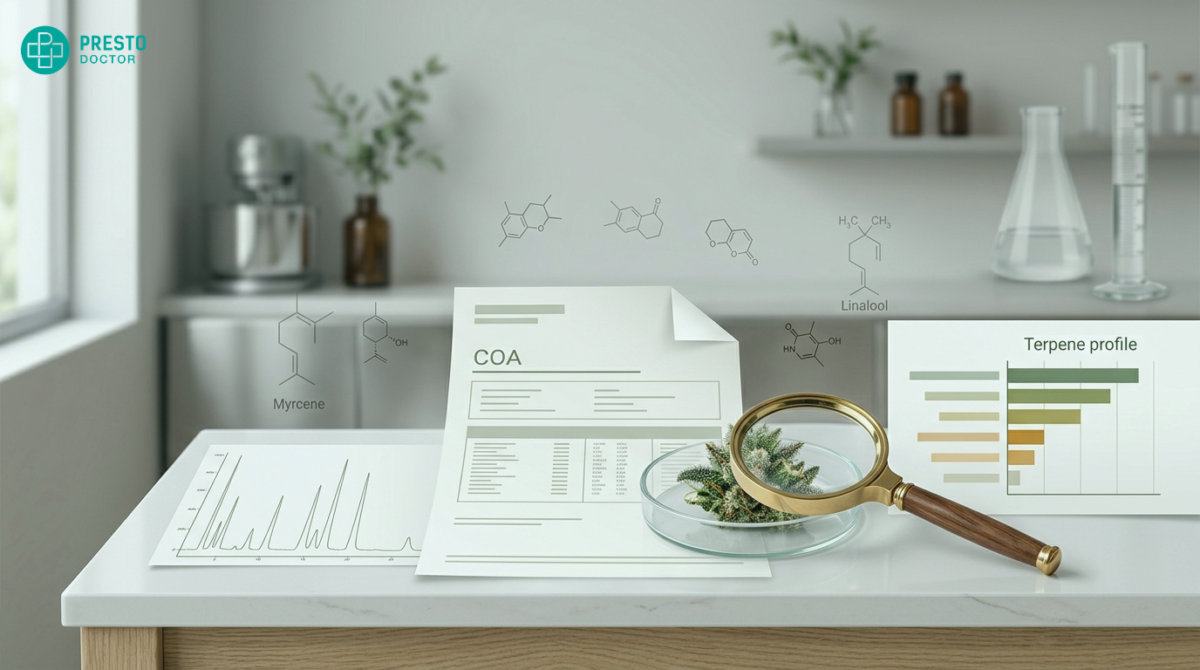
A COA, or Certificate of Analysis, is a laboratory report showing the analytical results for a specific product batch.
Depending on the jurisdiction and laboratory, a cannabis COA may include cannabinoid potency, terpene concentrations and other testing categories.
When you’re looking specifically at terpenes, find these pieces of information.
1. Total terpenes
This gives you the combined amount of reported terpenes.
Useful—but incomplete.
2. Dominant terpenes
Look at the individual compounds making up the total.
Does the profile lean toward:
- Limonene?
- Myrcene?
- β-Caryophyllene?
- Linalool?
- Pinene?
The answer tells you more about the product’s aromatic chemistry than the total number alone.
3. The full terpene list
A product that reports only one or two terpenes may give you less information than a more complete profile.
4. Batch information
A COA should correspond to the actual product batch you’re purchasing.
A generic “strain report” isn’t necessarily the same thing as a laboratory report for your package.
For a complete breakdown of packaging stickers, harvest dates, and TAC metrics, refer to our guide on how to read a dispensary label.
5. Testing date
Freshness matters because volatile compounds can change or decrease with storage and processing.
Example: comparing two products
Imagine you see these two products.
Product A
Total terpenes: 2.5%
- Limonene: 1.0%
- Caryophyllene: 0.6%
- Myrcene: 0.4%
Product B
Total terpenes: 3.4%
- Myrcene: 1.8%
- Linalool: 0.7%
- Other terpenes: 0.9%
Which one is better?
There’s no universal answer.
Product B has a higher total terpene percentage.
Product A has a very different aromatic profile.
If you’ve previously enjoyed citrus-forward products and found that you preferred them, Product A may be the more useful choice for you, even though the total percentage is lower.
That’s the point of terpene data.
It’s information—not a leaderboard.
Should you choose the cannabis product with the most terpenes?
Not automatically.
Think about terpene shopping the same way you might think about wine.
A higher concentration of aroma compounds isn’t automatically better.
The question is whether the profile suits what you’re looking for.
For cannabis, you can use terpene data to become more consistent in your choices:
- Find products you enjoy.
- Record their terpene profiles.
- Look for patterns.
- Compare future products against those patterns.
- Pay attention to the full cannabinoid and terpene profile rather than THC alone.
How fresh cannabis affects terpene information
Terpenes are volatile compounds, which means the profile of a cannabis product can change over time.
Storage conditions can matter, especially exposure to heat, light and air.
That’s one reason the batch date and storage history can be useful when evaluating a terpene-rich product.
Research into cannabis aroma has also shown that volatile sulfur compounds can change substantially through the plant’s lifecycle and curing/storage processes.
What’s more important: THC percentage or terpene percentage?
Neither number tells the whole story.
THC percentage gives you information about one major cannabinoid.
Terpene percentage gives you information about aromatic compounds.
They answer different questions.
A useful product label therefore isn’t:
THC = everything
or:
Terpenes = everything
It’s:
Here’s the overall chemical profile of this product.
Quick terpene COA checklist
Before buying, ask:
Does the report identify total terpenes?
Does it list the individual terpenes?
Does the COA correspond to the actual batch?
Is the laboratory information easy to verify?
Is the product reasonably fresh and appropriately stored?
Does this terpene profile resemble products I’ve personally enjoyed?
That’s a much better framework than chasing a magic percentage.
FAQ
What is a good terpene percentage for cannabis flower?
There is no universal percentage that guarantees quality. Total terpene content should be considered alongside the individual profile, product type, freshness and laboratory testing.
Is 1% terpenes low?
It may be considered relatively modest compared with some terpene-rich products, but percentage alone doesn’t determine quality or effects.
Is 3% terpenes high?
It can represent a relatively terpene-rich sample, but there is no universal rule that makes 3% “premium.”
What does total terpenes mean?
It refers to the combined detected concentration of the terpenes reported by the laboratory.
How do I know which terpene is dominant?
Look at the individual terpene breakdown on the COA. The compound with the largest reported concentration is typically the dominant terpene in that sample.