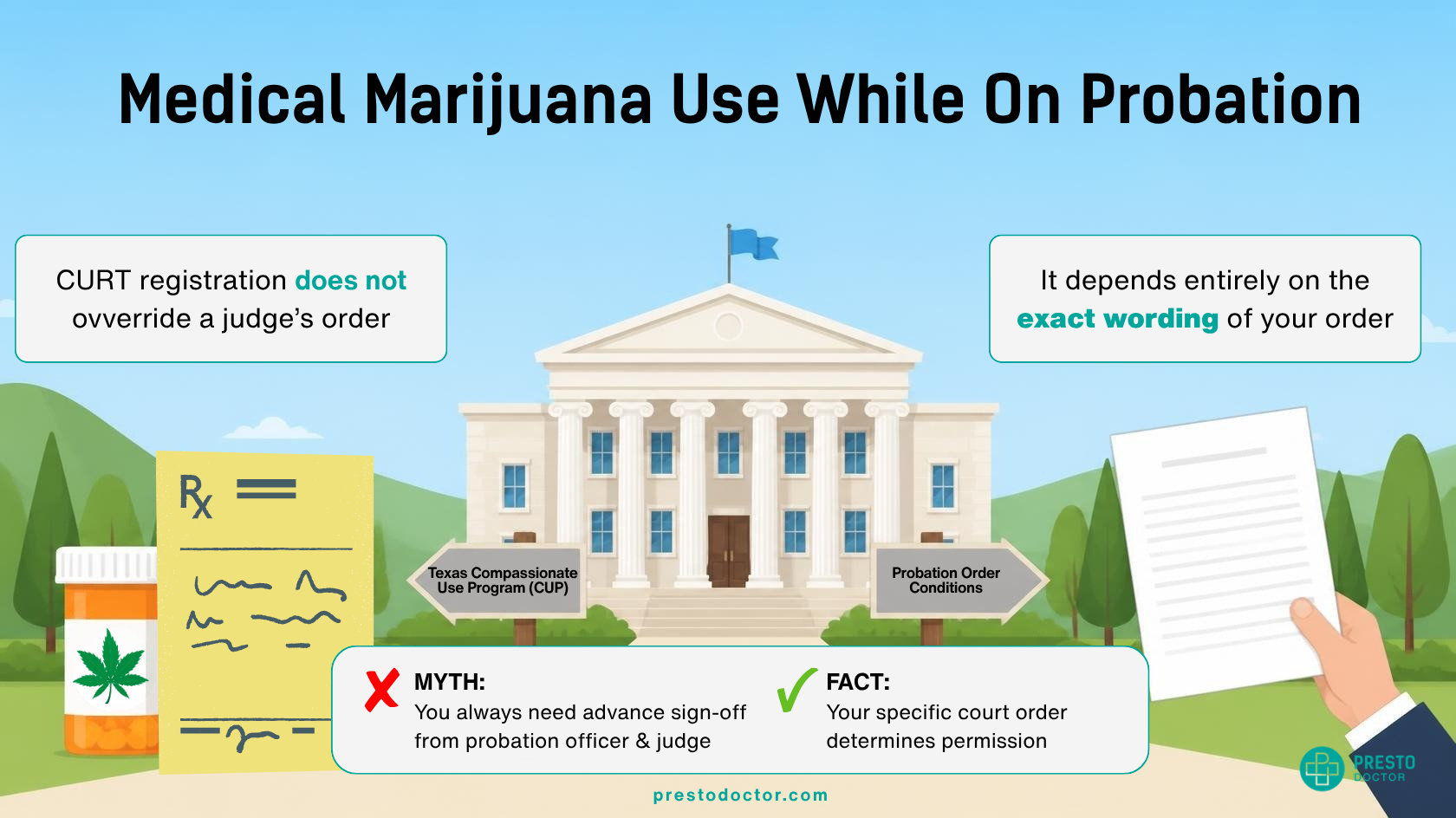
Can you use medical marijuana while on probation in Texas? Possibly — but not because you have a prescription, and not because someone gave you verbal sign-off. It depends entirely on the exact wording of your community-supervision order.
You may have already seen a quick answer online claiming you cannot use medical marijuana on probation in Texas unless you get explicit, advance approval from both your probation officer and the sentencing judge. That’s not accurate as a blanket rule. Texas does not require every probationer to get advance sign-off from both a probation officer and a judge before becoming a Texas Compassionate Use Program (CUP) patient. What actually controls is narrower: the language your judge already wrote into your probation conditions.
Here’s the distinction that gets lost in short answers:
- Texas CUP law governs whether you can lawfully obtain and use low-THC cannabis as a patient.
- Your probation order governs whether your specific court will let you use it while under supervision.
- CURT registration (the state’s prescription registry) proves you’re a legitimate patient — it does not modify a judge’s order.
These are three separate legal questions, and a “yes” to one doesn’t answer the others. The most important question is not whether medical marijuana is legal in Texas — it is:
What do your specific community-supervision conditions say about marijuana, THC, controlled substances, prescription medication, and drug testing — and has anyone with authority over your case actually modified that language?
For information about getting evaluated for the Texas program, see our Texas medical marijuana prescription page.
Can you use medical marijuana on probation in Texas?
You should not assume a Texas medical marijuana prescription lets you use cannabis while on probation — and you should not assume you need a judge’s advance sign-off either. Both extremes are wrong. The real answer sits in the paperwork.
Texas law permits eligible patients to receive low-THC cannabis through the Compassionate Use Program, but that medical authorization and your probation conditions are separate legal issues.
The Texas State Law Library explains that medical use of low-THC cannabis is legal for patients participating in CUP, subject to the program’s requirements. For the state’s official explanation, see the Texas State Law Library’s medical marijuana guidance.
At the same time, Texas law allows courts to impose conditions of community supervision, and it’s the court’s written condition — not a general legal rule — that decides what you’re allowed to do.
The key distinction
Texas medical cannabis law answers whether you may lawfully obtain and use qualifying medical cannabis under the Compassionate Use Program.
Your probation order answers whether you are permitted to use it while under community supervision.
Those are not necessarily the same question — and neither one is answered by a one-line summary.
Does Texas have medical marijuana cards?
Texas does not issue a traditional physical medical marijuana card.
Instead, qualifying patients receive prescriptions through the Texas Compassionate Use Program, and physicians enter patient prescriptions into the Compassionate Use Registry of Texas (CURT).
For a detailed explanation, see our Texas CURT Registry Explained.
The Texas Department of Public Safety also explains that CURT is the system physicians use to register and prescribe low-THC cannabis to qualifying patients. Patients themselves do not register in CURT.
This is why terms such as “Texas medical marijuana card,” “Texas medical card,” and “medical marijuana prescription” are often used interchangeably online even though Texas’ actual system is prescription- and registry-based.
Can you get a Texas medical marijuana prescription while on probation?
Being on probation is not itself listed by Texas’ Compassionate Use Program as an automatic patient disqualifier.
Texas’ program focuses on factors such as Texas residency, a qualifying condition, and a qualified physician’s determination that the potential benefits of low-THC cannabis outweigh the risks.
You can learn more about the current eligibility requirements in our guide to Texas medical marijuana qualifying conditions.
However, being medically eligible for the Texas Compassionate Use Program does not by itself determine whether your probation permits cannabis use.
Why your probation order matters
Texas Code of Criminal Procedure Article 42A.051 provides that, unless jurisdiction has been transferred, the court that tried the defendant may impose community-supervision conditions, and the judge may modify those conditions during the supervision period.
This matters because simply telling your probation officer that you have a medical marijuana prescription may not be enough to change an existing court order.
Article 42A.052 does provide a limited circumstance in which a judge may authorize a supervision officer or magistrate to modify certain conditions. That authority is narrower than a general power to rewrite the court’s probation order.
Read these parts of your probation paperwork carefully
Look for language involving:
Marijuana or marihuana: Some orders expressly prohibit marijuana.
THC: An order may prohibit THC or cannabinoid use even when the language does not simply say “marijuana.”
Controlled substances: A broad controlled-substance restriction may create additional concerns depending on the wording of the order.
Prescription drugs: Some conditions address prescription medications or require current prescriptions.
Drug testing: A condition requiring random or scheduled testing can make cannabis use particularly important to address before consuming THC.
Substance-abuse treatment: Some cases include treatment-related conditions or sobriety requirements that can affect whether cannabis use is permitted.
What happens if your probation order says “no marijuana”?
If your probation paperwork expressly prohibits marijuana, do not assume that a Texas medical marijuana prescription cancels that condition.
Texas law recognizes the court’s authority over community-supervision conditions, and the wording of the particular order matters.
A 2026 Texas appellate decision, Richey v. State, shows exactly how this plays out. Richey was on community supervision for a felony DWI, under a condition barring him from consuming marijuana “without first obtaining a current prescription for said substances from a licensed physician.” He tested positive for marijuana on December 12, 2024 — but the physician’s prescription for his Compassionate Use Program cannabis wasn’t issued until December 13, the day after. He also later tested positive for both marijuana and alcohol on two additional dates. On appeal, Richey argued that his CURT registration and physician’s letter should have protected him from revocation. The Sixth Court of Appeals disagreed and affirmed, reasoning that a prescription obtained after a positive test doesn’t retroactively authorize the earlier use — and noting that his probation officer had already told him marijuana wasn’t permitted under his conditions. See the Richey v. State (2026) decision.
The lesson isn’t just “the court can revoke you.” It’s that timing and documentation matter as much as the prescription itself. A valid CURT registration obtained after a violation already occurred did not undo that violation — and a probation officer’s earlier warning about what the condition meant was treated as relevant evidence, even though a probation officer alone cannot rewrite a court’s order.
The case does not mean every Texas probationer with a medical cannabis prescription will receive the same result. It demonstrates why the exact probation conditions and facts of the individual case matter.
Can a probation officer allow medical marijuana?
A probation officer plays an important role in supervising compliance, but Texas law generally gives the court authority to impose and modify community-supervision conditions.
Under Article 42A.051, the judge with jurisdiction over the case may modify conditions during community supervision, subject to the limited authority that may be delegated under Article 42A.052.
For this reason, a verbal statement from a probation officer should not automatically be treated as a modification of the court’s written order.
The safest approach is to determine what written authority exists in your case before using medical cannabis.
Do you need court approval before using medical marijuana on probation?
There is an important distinction here.
Texas does not establish a blanket rule that every person on probation must obtain advance approval from both a probation officer and the sentencing judge before becoming a medical cannabis patient.
Instead, the issue depends on the person’s existing probation conditions and the court’s authority over those conditions.
If your order permits appropriately prescribed medication or does not prohibit cannabis, your situation may differ from someone whose order expressly bans marijuana or THC.
If your order prohibits marijuana or THC, however, you should not rely solely on the fact that a physician has prescribed low-THC cannabis. Address the probation restriction before using cannabis.
What if your probation officer says you cannot use it?
Take the instruction seriously and review the written terms of your community supervision.
If the probation officer is enforcing a written court condition prohibiting marijuana or THC, obtaining a medical cannabis prescription does not necessarily eliminate that condition.
If you believe medical cannabis should be permitted because of your medical needs, the legal issue may be whether the condition can be modified by the court.
See Texas Code of Criminal Procedure Chapter 42A for the statutory framework governing community supervision and modification of conditions.
Do not stop following an existing probation condition simply because you have obtained a medical cannabis prescription.
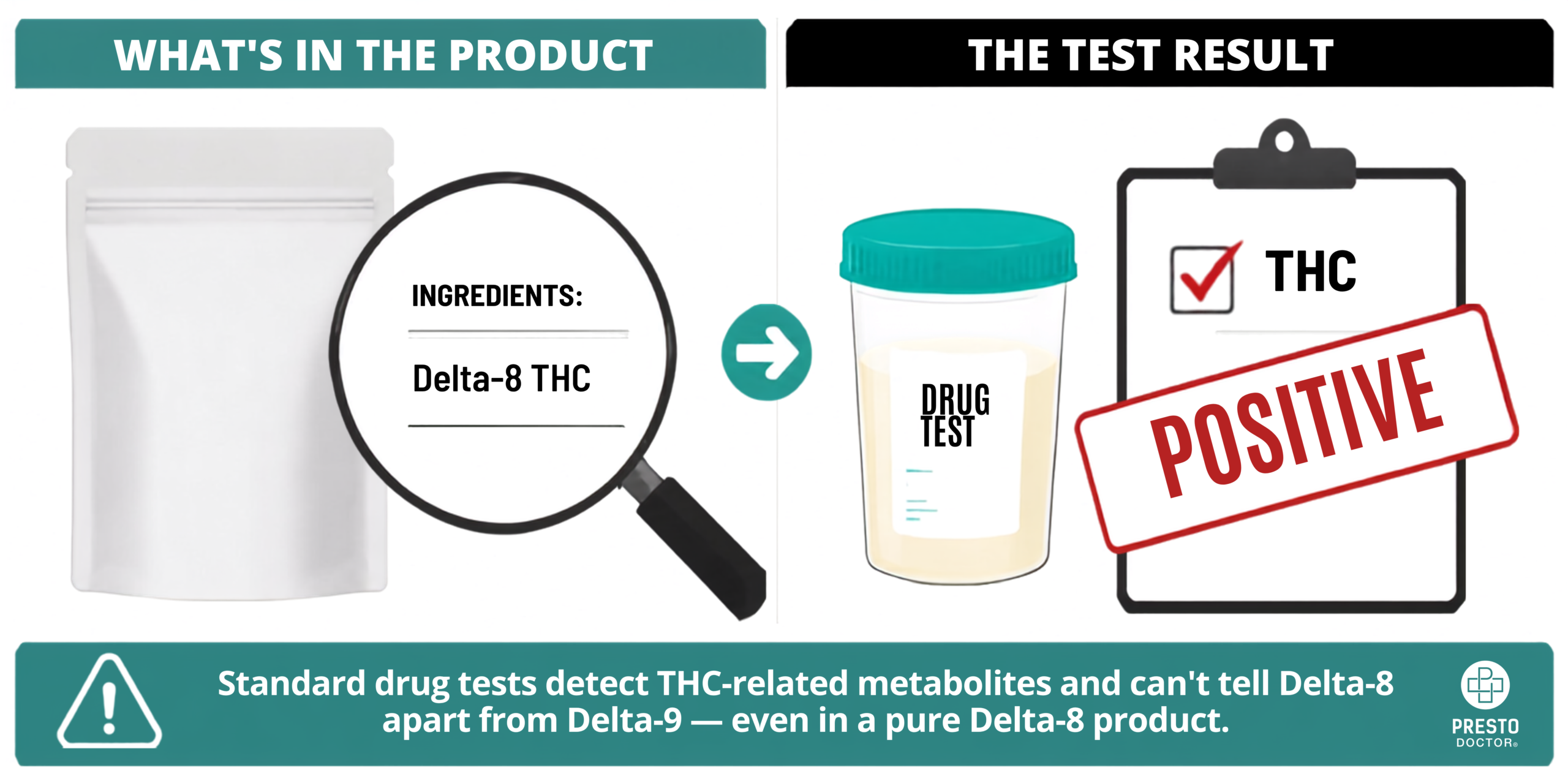
What if you fail a drug test for THC while on probation?
A positive THC test can create a probation problem when marijuana or THC use violates the conditions of community supervision.
Texas law provides procedures for alleged community-supervision violations, including circumstances in which a judge may issue a warrant.
However, a positive THC test does not automatically mean every case will result in probation revocation.
The outcome depends on the conditions of supervision, the evidence, the timing, and the circumstances of the case.
The 2026 Richey v. State case is useful here because the court considered the defendant’s medical marijuana prescription and CURT registration in the context of specific probation violations.
Can you be arrested for using medical marijuana on probation?
Possibly, depending on the circumstances and the alleged probation violation.
Texas Code of Criminal Procedure Chapter 42A contains the procedures governing alleged violations of community supervision, including warrants and revocation proceedings. See Texas Code of Criminal Procedure Chapter 42A.
It would be inaccurate, however, to say that every probationer who tests positive for THC is automatically arrested or sent to jail.
Possible consequences depend on the case and may include additional court proceedings, modification or continuation of community supervision, sanctions, or revocation.
What if your original criminal charge involved marijuana?
Your underlying offense can be particularly important.
For example, someone placed on probation following a drug-related conviction may have substance-abuse conditions or restrictions that are different from those imposed in an unrelated case.
The exact language of your order, the offense involved, and the evidence presented therefore matter.
Does a medical marijuana prescription protect you from a probation violation?
No—not automatically.
A valid Texas Compassionate Use Program prescription may establish that your medical cannabis use is authorized under Texas’ medical cannabis program. It does not necessarily establish that your use complies with every condition imposed by a criminal court.
A useful way to think about the issue is:
Medical authorization ≠ automatic probation authorization.
Both questions need to be addressed separately.
Is smoking medical marijuana allowed in Texas?
Texas’ medical cannabis rules are specific about permitted forms and methods of use.
The Texas State Law Library explains that the statutory definition of low-THC cannabis medical use historically excluded smoking. Because Texas cannabis laws have changed, readers should rely on current state guidance concerning permitted delivery methods rather than applying rules from older articles.
For current Texas program information, see the Texas Department of Public Safety Compassionate Use Program.
What should you do before using medical marijuana while on Texas probation?
1. Get a copy of your probation order
Do not rely on memory or a verbal summary.
Read the conditions imposed by the court and identify any language concerning marijuana, THC, controlled substances, prescriptions, drug testing, or sobriety.
2. Determine whether you are eligible for Texas CUP
Texas requires patients to meet the Compassionate Use Program’s eligibility requirements, including having a qualifying condition and receiving a prescription from a qualified physician.
Read our guide to Texas medical marijuana qualifying conditions.
3. Tell your medical provider that you are on probation
Your physician should know about relevant legal and medical circumstances when determining whether low-THC cannabis is appropriate.
A medical provider can determine whether you qualify medically; a medical provider does not modify your criminal-court probation conditions.
4. Address conflicting probation conditions before using cannabis
If your order prohibits marijuana or THC, consider obtaining legal advice about whether the condition can be modified.
Because Texas law gives the court authority over community-supervision conditions, a formal court process may be necessary in some cases.
5. Keep documentation
If you participate in the Texas Compassionate Use Program, maintain documentation relating to your physician, prescription, and CURT status.
Texas probation and medical marijuana: What you should know about CURT
CURT stands for the Compassionate Use Registry of Texas.
It is the state’s system for recording prescriptions for low-THC cannabis.
DPS explains that CURT allows registered physicians to enter prescriptions and allows licensed dispensing organizations to verify those prescriptions. You can also learn more about the process through our Texas CURT Registry Explained.
Patients should not assume that CURT registration by itself changes the conditions of a criminal court’s probation order.
Frequently Asked Questions About Probation and Medical Marijuana in Texas
Can you use medical marijuana while on probation in Texas?
Possibly, but it depends on your probation conditions. A Texas medical marijuana prescription does not automatically override a court-ordered restriction on marijuana or THC.
Can you get medical marijuana while on probation in Texas?
Potentially, yes. Probation status itself is not listed as a categorical disqualifier for the Texas Compassionate Use Program. You must otherwise meet the program’s eligibility requirements.
See our Texas medical marijuana prescription page for current program information.
Does a Texas medical marijuana prescription override probation?
No. A Texas Compassionate Use Program prescription and a criminal court’s supervision conditions are separate legal matters.
Can a probation officer approve medical marijuana in Texas?
A probation officer supervises compliance with community supervision, but Texas law generally gives the court authority to impose and modify conditions, subject to limited statutory delegation.
Do you have to tell your probation officer about a medical marijuana prescription in Texas?
In most cases, yes. Standard probation conditions typically require disclosure of any prescription medication — including CUP-issued low-THC cannabis — to your supervising officer, and many conditions explicitly require a “current prescription” before any use is permitted at all. Failing to disclose, or using cannabis without first clearing it with your court or officer where required, can itself be treated as a separate violation from the substance use. Check the disclosure language in your specific order, and put any disclosure in writing rather than relying on a verbal conversation.
What happens if you fail a THC test on probation in Texas?
The consequences depend on the conditions of supervision and circumstances of the case. A positive THC test does not automatically produce the same outcome in every case.
Can you be arrested for using medical marijuana on probation in Texas?
Possibly. An alleged violation of community-supervision conditions can lead to court proceedings and, in some circumstances, a warrant or arrest. The outcome depends on the particular case.
Does Texas issue medical marijuana cards?
No. Texas uses the Compassionate Use Program and Compassionate Use Registry of Texas rather than a traditional physical medical marijuana card.
Can you get a medical marijuana prescription while on probation?
Potentially. The key issue for the medical program is whether you meet Texas’ eligibility requirements. Whether you may actually use the prescription while on probation is a separate question controlled by your supervision conditions.
Does medical marijuana protect you from a probation violation in Texas?
Not automatically. A medical cannabis prescription does not by itself modify or cancel a court-ordered probation condition.
Can you smoke CBD on probation in Texas?
CBD products are treated differently from THC under Texas law, but that doesn’t make them automatically safe on probation. Full-spectrum and even some “broad-spectrum” CBD products can contain trace THC, which can trigger a positive THC drug test regardless of the label’s claims. If your condition prohibits THC, controlled substances, or requires clean drug screens, CBD use still carries real risk of an unintended positive result. Check your order’s specific THC and controlled-substance language, and consider discussing lab-tested, THC-free products with your probation officer before use.
What are the new rules for medical marijuana in Texas?
Texas’ Compassionate Use Program has expanded significantly since it was first enacted in 2015, including a broader list of qualifying conditions and additional legislative changes to the program over time. Because these rules keep changing, probationers shouldn’t rely on older articles or outdated qualifying-condition lists. For the current, authoritative list of qualifying conditions and permitted forms of low-THC cannabis, see the Texas Department of Public Safety Compassionate Use Program page, and confirm with a licensed Texas CUP physician before assuming a particular condition or delivery method qualifies.
The Bottom Line: Probation + Medical Marijuana in Texas
If you are on probation in Texas, do not assume that a medical marijuana prescription automatically gives you permission to use cannabis.
Texas permits qualifying patients to receive medical cannabis through its Compassionate Use Program. Your probation, however, remains governed by the conditions imposed by the criminal court.
So the practical answer to “Can I use medical marijuana on probation in Texas?” is:
Maybe. Your Texas medical cannabis authorization does not automatically override your probation conditions. Check your court order and address any marijuana or THC restriction before using cannabis.
Need a Texas Medical Marijuana Prescription?
PrestoDoctor helps eligible Texas patients connect with a physician for evaluation for the Texas Compassionate Use Program.
Get a Texas medical marijuana prescription online
Start by determining whether you may qualify for Texas medical cannabis—and understand your probation conditions before using it.
Legal Disclaimer: This article is for general informational purposes only and is not legal advice. Texas probation and community-supervision conditions vary by case, court, county, offense, and individual circumstances. A medical cannabis prescription does not necessarily modify a criminal court’s conditions of supervision. Speak with a qualified Texas criminal-defense attorney for advice about your specific probation order or alleged violation.
Official Texas Resources
- Texas State Law Library — Medical Marijuana
- Texas Department of Public Safety — Compassionate Use Program
- Texas Department of Public Safety — Compassionate Use Registry of Texas (CURT)
- Texas Code of Criminal Procedure — Chapter 42A
- Texas Health and Safety Code — Chapter 487
- Richey v. State — Texas Sixth Court of Appeals (2026)
- Texas CURT Physician Search